
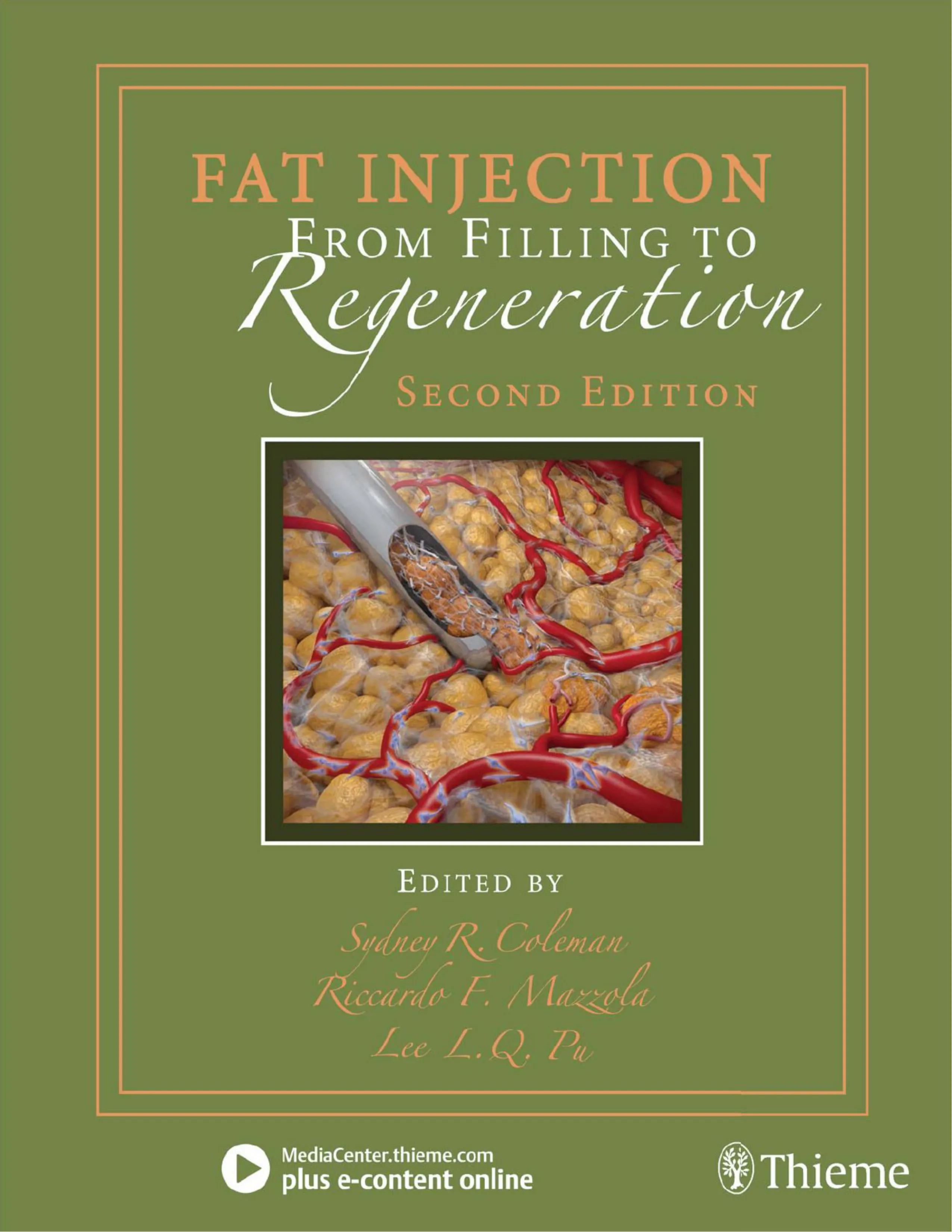


FAT INJECTION Regeneration ROM FILLING TO SECOND EDITION EDITED BY Sudney R. Coleman Riccardo F. Marola Lee L.Q. Pu MediaCenter.thieme.com plus e-content online Thieme
(Trang không có chữ)
Videos on MediaCenter.Thieme.com
supplement the text!
Simply visit MediaCenter.Thieme.com and, when prompted during the
registration process, enter the code below to get started today.
58BQ-9965-4Q99-Z2N6
Connect with us on social media
(Trang không có chữ)
FAT INJECTION FROM FILLING TO Regeneration
(Trang không có chữ)
EDITED BY
Sydney R. Coleman, MD
Clinical Assistant Professor of Plastic Surgery,
Hansjög Wyss Department of Plastic Surgery,
NYU School of Medicine, NYU Langone Medical Center,
New York, New York
Riccardo F. Mazzola, MD
Plastic Surgeon, Department of Clinical Sciences and Community Health,
University of Milan; Fondazione IRCCS Ca’ Granda, Policlinico, Milan; Director,
G. Sanvenero Rosselli Foundation for Plastic Surgery, Milan, Italy
Lee L.Q. Pu, MD, PhD, FACS, FICS
Professor of Surgery, Division of Plastic Surgery, University of California, Davis,
Sacramento, California
ILLUSTRATED BY
Eric Olson, Wendy Hiller Gee, and Kathy M. Grey
Managing Editor: Nikole Y. Connors
Director, Editorial Services: Mary Jo Casey
Production Editor: Sean Woznicki
International Production Director: Andreas Schabert
Editorial Director: Sue Hodgson
International Marketing Director: Fiona Henderson
International Sales Director: Louisa Turrell
Director of Institutional Sales: Adam Bernacki
Senior Vice President and Chief Operating Officer: Sarah
Vanderbilt
President: Brian D. Scanlan
Library of Congress Cataloging-in-Publication Data
Names: Colem an, Sydney, editor. | Mazzola, Riccardo F., editor. |
Pu, Lee L. Q., editor.
Title: Fat injection : from filling to regeneration / Sydney R.
Coleman, MD, FACS, Clinical Assistant Professor of Plastic
Surgery, Hansjög Wyss Department of Plastic Surgery, NYU
School of Medicine, NYU Langone Medical Center, New York,
New York, Riccardo F. Mazzola, MD, Departm ent of Clinical
Sciences and Comm unity Health, Fondazione IRCCS Ca' Granda
Ospedale Maggiore Policlinico, Milano, Italy, Lee L.Q. Pu, MD,
PhD, FACS, FICS, Professor of Surgery, Division of Plastic Surgery,
University of California, Davis, Sacramento, California.
Description: Second edition. | New York : Thieme, 2017. | Includes
bibliographical references and index.
Identifiers: LCCN 2017029039 (print) | LCCN 2017038447 (ebook)
| ISBN 9781626238862 (e-book) | ISBN 9781626236752 (print)
Subjects: LCSH: Adipose tissues--Transplantation.
Classification: LCC RD119.5.L55 (ebook) | LCC RD119.5.L55 F38
2017 (print) | DDC 617.9/52--dc23
LC record available at
This book, including all parts thereof, is legally protected by copy-
right. Any use, exploitation, or commercialization outside the nar-
row limits set by copyright legislation without the publisher’s con-
sent is illegal and liable to prosecution. This applies in par- ticular
to photostat reproduction, copying, m imeographing or duplication
of any kind, translating, preparation of m icr s, and electronic
data processing and storage.
Im portant note: Medicine is an ever-changing science undergoing
continual development. Research and clinical experience are con-
tinually expanding our knowledge, in particular our knowledge of
proper treatm ent and drug therapy. Insofar as this book mentions
any dosage or application, readers m ay rest assured that the au-
thors, editors, and publishers have made every effort to ensure that
such references are in accordance with the state of knowledge at
the tim e of production of the book.
Nevertheless, this does not involve, imply, or express any guar-
antee or responsibility on the part of the publishers in respect
to any dosage instructions and form s of applications stated in the
book. Every user is requested to exam ine carefully the m anufac-
turers’ le ets accompanying each drug and to check, if necessary
in consultation with a physician or specialist, whether the dosage
schedules mentioned therein or the contraindications stated by
the manufacturers differ from the statements m ade in the present
book. Such examination is particularly important with drugs that
are either rarely used or have been newly released on the market.
Every dosage schedule or every form of application used is entire-
ly at the user’s own risk and responsibility. The authors and pub-
lishers request every user to report to the publishers any discrep-
ancies or inaccuracies noticed. If errors in this work are found
after publication, errata will be posted at on the
product description page.
Som e of the product nam es, patents, and registered designs
referred to in this book are in fact registered tradem arks or proprie-
tary names even though s reference to this fact is not always
made in the text. Therefore, the appearance of a name without des-
ignation as proprietary is not to be construed as a representation
by the publisher that it is in the public domain.
Copyright © 2018 by Thieme Medical Publishers, Inc.
Thieme Publishers New York
333 Seventh Avenue, New York, NY 10001 USA
+1 800 782 3488, customerservice@thieme.com
Thieme Publishers Stuttgart
Rüdigerstrasse 14, 70469 Stuttgart, Germ any
+49 [0]711 8931 421, custom erservice@thieme.de
Thieme Publishers Delhi
A-12, Second Floor, Sector-2, Noida-201301
Uttar Pradesh, India
+91 120 45 566 00, customerservice@thiem e.in
Thieme Publishers Rio de Janeiro, Thieme Publicações Ltda.
Edifício Rodolpho de Paoli, 25º andar
Av. Nilo Peçanha, 50 – Sala 2508
Rio de Janeiro 20020-906, Brasil
+55 21 3172 2297 / +55 21 3172-1896
Cover design: Thieme Publishing Group
Typesetting by Debra Clark, Christopher Lane, Susan Trail
Printed in India by Replika Press Pvt Ltd.
5 4 3 2 1
ISBN 978-1-62623-675-2
Also available as an e-book:
eISBN 978-1-62623-886-2
To the late Byron Economidy, who gave me un ailing
support in my struggles to understand the
wonders o LipoStructure
S.R.C.
To my wi e, Carola, or her wisdom, support,
and loyalty and to my marvelous children,
Isabella and Sebastiano
R.F.M.
To my wi e, Yu-Shan (Emily), and my children,
Felix, Dustin, and Adrian, whose love, sacrif ces,
understanding, and unself sh support
have made my work on this book possible
L.L.Q.P.
T e art on the cover is an artist’s rendition o at transplanted through the Coleman technique. A type II
Coleman mini-cannula has been advanced bluntly. Concentrated at that was harvested can be seen in
the lumen o the cannula and f owing out o the aperture and into the surrounding atty tissue. iny blood
vessels are seen connecting rom the newly transplanted at to the intact surrounding at. Stem cells and
broblasts (blue-colored) are seen clinging to the small vessels, and the extracellular matrix can be seen as
a gossamer veil providing structure and growth actors.
Zeni Alfonso, PhD
Senior Scientist, Navigate BioPharma (Novartis),
Carlsbad, Cali ornia
Eric Auclair, MD
Membre SoFCPRE, SOFCEP, ISAPS (Société
Internationale) Board Member, Chairman o
Fellowship Program, Président SOFCEP 2012,
Clinique Nescens Paris Spontini, Paris, France
Valeria Bandi, MD
Reconstructive and Aesthetic Plastic Surgery
School, Department o Medical Biotechnology
and ranslational Medicine BIOME RA, Plastic
Surgery Unit, Humanitas Clinical and Research
Center, University o Milan, Milan, Italy
Barbara Banzatti, MD
Reconstructive and Aesthetic Plastic Surgery
School, Department o Medical Biotechnology
and ranslational Medicine BIOME RA, Plastic
Surgery Unit, Humanitas Clinical and Research
Center, University o Milan, Milan, Italy
Janos A. Barrera, MD
Plastic Surgery Resident, Division o Plastic and
Reconstructive Surgery, Stan ord Health Care,
Stan ord, Cali ornia
Francesco Bertolini, MD, PhD
Laboratory o Hematology-Oncology, European
Institute o Oncology, Milan, Italy
Jacqueline Bliley, MS
Research Fellow, Carnegie Mellon University,
Pittsburgh, Pennsylvania
Massimiliano Brambilla, MD
Board Certif ed Plastic Surgeon, Plastic and
Breast Surgery Unit, General and ransplant
Surgery Department, IRCCS Fondazione
Ospedale Maggiore Policlinico, Milan, Italy
James Christian Brown, MD
Division o Plastic and Reconstructive Surgery,
Department o Surgery, University o Florida
College o Medicine, Gainesville, Florida
Daniel Calva, MD
Miami Breast Center, Key Biscayne, Florida
David Cangello, MD, FACS
Department o Plastic Surgery, Lenox Hill/
Manhattan Eye, Ear, and T roat Hospital, New
York, New York
Giovanna Cantarella, MD
Sta Physician, in charge o the Laryngology
Unit, Department o Otolaryngology, Fondazione
IRCCS Ca’ Granda Ospedale Maggiore
Policlinico, Milan, Italy
Barbara Catania, MD
Reconstructive and Aesthetic Plastic Surgery
School, Department o Medical Biotechnology
and ranslational Medicine BIOME RA, Plastic
Surgery Unit, Humanitas Clinical and Research
Center, University o Milan, Milan, Italy
Fabio Caviggioli, MD
Reconstructive and Aesthetic Plastic Surgery
School, MultiMedica Holding S.P.A., Plastic
Surgery Unit, University o Milan, Sesto San
Giovanni, Milan, Italy
Valerio Cervelli, MD
Associate Pro essor and Chie o Plastic and
Reconstructive Surgery, University o Rome or
Vergata, Rome, Italy
Luigi C. Clauser, MD, DMD, PhD, FEBOMFS
Clinical Pro essor, Director and Chie , Unit o
Cranio-Maxillo-Facial Surgery, St. Anna Hospital
and University, Ferrara, Italy
vii
C o n t ri b u t o rs
viii
Contributors
Sydney R. Coleman, MD
Clinical Assistant Professor of Plastic Surgery,
Hansjög Wyss Department of Plastic Surgery,
NYU School of Medicine, NYU Langone Medical
Center, New York, New York
Giamaica Conti, PhD
Researcher in Radiology, oxicology, and
Neuroradiology, Department of Neurological
and Movement Sciences, University of Verona,
Verona, Italy
Guido Cornegliani, MD
Reconstructive and Aesthetic Plastic Surgery
School, MultiMedica Holding S.P.A., Plastic
Surgery Unit, University of Milan, Sesto San
Giovanni, Milan, Italy
Odile Damour, MD
Hospices Civils de Lyon, Lyon, France
Aurélie Daumas, MD
Department of Internal Medicine, Assistance
Publique des Hôpitaux de Marseilles,
Aix-Marseilles University, Marseilles, France
Emmanuel Delay, MD, PhD
Department of Plastic Surgery, Leon Berard
Center, Lyon, France
Albert D. Donnenberg, PhD
Professor of Medicine, Director, University
of Pittsburgh Medical Center, Hematopoietic
Stem Cell Laboratories; Director, University of
Pittsburgh Cancer Institute, Cytometry Facility,
Pittsburgh, Pennsylvania
Vera S. Donnenberg, PhD, FCP
Associate Professor, Department of
Cardiothoracic Surgery, University of Pittsburgh
School of Medicine; Member, University
of Pittsburgh Cancer Institute, McGowan
Institute of Regenerative Medicine, Pittsburgh,
Pennsylvania
Giovanni Elia, MD
Craniofacial Fellow, Unit of Cranio-Maxillo-
Facial Surgery, St. Anna Hospital and University,
Ferrara, Italy
Dino Elyassnia, MD
Marten Clinic of Plastic Surgery, San Francisco,
California
Joan Fontdevila, MD, PhD
Chief, Department of Plastic and Maxillofacial
Surgery, Hospital Clinico de Barcelona; Professor
of Surgery, Department of Surgery and Surgical
Specialties, University of Barcelona, Barcelona,
Spain
Davide Forcellini, MD
Reconstructive and Aesthetic Plastic Surgery
School, MultiMedica Holding S.P.A., Plastic
Surgery Unit, University of Milan, Sesto San
Giovanni, Milan, Italy
Jean-Louis Foyatier, MD
Plastic Surgeon, St. Luc St. Joseph Hospital, Lyon,
France
John K. Fraser, PhD
Chief Scientist, Cytori T erapeutics, Inc., San
Diego, California
Manlio Galiè, MD, DMD, FEBOMFS
Clinical Professor, Unit of Cranio-Maxillo-
Facial Surgery, St. Anna Hospital and University,
Ferrara, Italy
Riccardo Gazzola, MD
Plastic Surgeon, Department of Plastic Surgery,
Policlinico di Monza, Monza, Italy
Pietro Gentile, MD, PhD
Chief, Department of Plastic and Reconstructive
Surgery, Catholic University, irane, Albania;
Research Fellow, University of Roma or Vergata,
Rome, Italy
Micol Giaccone, MD
Reconstructive and Aesthetic Plastic Surgery
School, Department of Medical Biotechnology
and ranslational Medicine BIOME RA, Plastic
Surgery Unit, Humanitas Clinical and Research
Center, University of Milan, Milan, Italy
Silvia Giannasi, MD
Reconstructive and Aesthetic Plastic Surgery
School, Department of Medical Biotechnology
and ranslational Medicine BIOME RA, Plastic
Surgery Unit, Humanitas Clinical and Research
Center, University of Milan, Milan, Italy
Brigitte Granel, MD, PhD
Department of Internal Medicine, Vascular
Research Center, Hôpitaux de Marseille, Aix-
Marseilles University, Marseilles, France
ix
Contributors
Damian Grybowski, MD
Research Fellow, Department o Plastic Surgery
& Bioengineering, University o Pittsburgh,
Pittsburgh, Pennsylvania
Samia Guerid, MD
Centre Léon Bérard, Lyon, France
Geof rey Cash Gurtner, MD, FACS
Pro essor o Surgery, Department o Surgery,
Stan ord University, Stan ord, Cali ornia
Steven E.R. Hovius, MD, PhD
Department o Plastic and Reconstructive
Surgery, Erasmus Medical Center, Rotterdam,
T e Netherlands
Hester J. Kan, MD, PhD
Resident in raining, Department o Orthopedic
Surgery, Noordwest Ziekenhuisgroep Alkmaar,
Alkmaar, T e Netherlands
Adam J. Katz, MD, FACS
Pro essor, Division o Plastic Surgery,
Department o Surgery, University o Florida,
Gainesville, Florida
Roger K. Khouri, MD, FACS
Surgeon and Founder, Miami Hand Center,
Miami, Florida
Bong-Sung Kim, MD
Resident, Department o Plastic Surgery, Hand
Surgery, Burn Center, RW H University
Hospital Aachen, Aachen Germany; Visiting
Researcher, Department o Internal Medicine,
Rheumatology, Yale School o Medicine, New
Haven, Connecticut
Francesco Klinger, MD
Reconstructive and Aesthetic Plastic Surgery
School, MultiMedica Holding S.P.A., Plastic
Surgery Unit, University o Milan, Sesto San
Giovanni, Milan, Italy
Marco Klinger, MD
Pro essor, Department o Plastic, Reconstructive
and Aesthetic Surgery, Università Degli Studi
di Milano, Milan; Head Physician, Plastic,
Reconstructive and Aesthetic Surgery, Humanitas
Research Hospital, Rozzano, Milan, Italy
Lauren E. Kokai, PhD
Research Assistant Pro essor, Co-Director,
Adipose Stem Cell Center, Department o Plastic
Surgery, University o Pittsburgh School o
Medicine, Pittsburgh, Pennsylvania
Charlotte Lequeux, PhD
Laboratoire des Substituts Cutanés, Edouard
Herriot Hospital, University o Lyon, Lyon,
France
Fa-Cheng Li, MD, PhD
Pro essor and Chie , Department o Body
Contouring and Fat Graf ing, Plastic Surgery
Hospital, Peking Union Medical College, Chinese
Academy o Medical Science, Beijing, China
Qing Feng Li, MD, PhD
Yangtze River Scholar Award Scheme Pro essor
and Chairperson, Department o Plastic and
Reconstructive Surgery, Shanghai Ninth People’s
Hospital, A liated to Shanghai Jiao ong
University School o Medicine, Shanghai, China
Jeng-Yee Lin, MD
Chie Plastic Surgeon, Department o Plastic
Surgery, United Aesthetic Plastic Clinic;
Attending Physician, Department o Plastic
Surgery, National aiwan University, aipei,
aiwan
Andrea Lisa, MD
Reconstructive and Aesthetic Plastic Surgery
School, Department o Medical Biotechnology
and ranslational Medicine BIOME RA, Plastic
Surgery Unit, Humanitas Clinical and Research
Center, University o Milan, Milan, Italy
Visnu Lohsiriwat, MD
Plastic Surgeon, Phuket Plastic Surgery Institute,
Phuket, T ailand
Zeshaan N. Maan, MD, MSc, MRCS
Resident, Division o Plastic Surgery, Department
o Surgery, Stan ord University, Stan ord,
Cali ornia
Guy Magalon, MD
Department o Plastic Surgery; Assistance
Publique des Hôpitaux de Marseilles, Culture
and Cell T erapy Laboratory, Aix-Marseilles
University, Marseilles, France
x
Contributors
Jéremy Magalon, Pharm-D
Assistance Publique des Hôpitaux de Marseille,
Culture and Cell T erapy Laboratory, Aix-
Marseilles University, Marseilles, France
Luca Maione, MD
University o Milan, Reconstructive and
Aesthetic Plastic Surgery School, Department
o Medical Biotechnology and ranslational
Medicine BIOME RA, Plastic Surgery Unit,
Humanitas Clinical and Research Hospital,
Rozzano, Milan, Italy
Alberto Marchetti, MD
Resident, Department o Plastic and
Reconstructive Surgery, and Burns Unit,
University Hospital o Verona, Verona, Italy
Alessandra Marchi, MD
Breast Reconstruction Unit, Department o
Plastic Surgery, Ospedale Civile Maggiore,
Verona, Italy
Maria Rosaria Marinozzi, PhD
Department o Neuroscience, Biomedicine and
Movement Science, Anatomy and Histology
Section, University o Verona, Verona, Italy
Kacey Gribbin Marra, PhD
Associate Pro essor, Department o Plastic
Surgery, University o Pittsburgh School o
Medicine, Pittsburgh, Pennsylvania
imothy Marten, MD, FACS
Founder and Director, Marten Clinic o Plastic
Surgery, San Francisco, Cali ornia
Riccardo F. Mazzola, MD
Plastic Surgeon, Department o Clinical Sciences
and Community Health, University o Milan;
Fondazione IRCCS Ca’ Granda, Policlinico,
Milan; Director, G. Sanvenero Rosselli
Foundation or Plastic Surgery, Milan, Italy
Constantino Mendieta, MD, FACS
Plastic Surgeon, 4 Beauty Aesthetics Institute,
Inc., Miami, Florida
Ernest Michael Meyer, BA
Manager, University o Pittsburgh Cancer
Institute, Cytometry Facility, University
o Pittsburgh Cancer Center, Pittsburgh,
Pennsylvania
Ali Mojallal, MD, PhD
Pro essor, Department o Plastic Surgery, Co-
Chair o the Plastic and Aesthetic Surgery
Department, Croix Rousse Hôpital, Hospices
Civils de Lyon, University Claude Bernard Lyon,
Lyon, France
Pierre Sébastien Nguyen, MD
Plastic Surgeon, St. Roch Private Hospital,
oulon, France; Plastic Surgery Department,
Laboratory o Cell T erapy, La Conception
Hospital, Marseilles, France
Julien Niddam, MD
Department o Plastic Surgery, Assistance
Publique des Hôpitaux de Marseilles, Aix-
Marseilles University, Marseilles, France
Christianne A. van Nieuwenhoven, MD, PhD
Department o Plastic and Reconstructive
Surgery, Erasmus MC, Rotterdam, T e
Netherlands
Norbert Pallua, MD, PhD, FEBOPRAS
Pro essor and Chairman, Honorary Pro essor
Mult., Department o Plastic Surgery, Hand
Surgery, Burn Center, RW H University Hospital
Aachen, Aachen, Germany
Jean-Yves Petit, MD
Former Director o the Department o Plastic
Surgery, European Institute o Oncology, Milan,
Italy
Cécile Philandrianos, MD
Plastic Surgeon, Assistance Publique des
Hôpitaux de Marseilles, Marseilles, France
Maria T ereza Sarto Piccolo, MD, PhD
Scientif c Director, Pronto Socorro para
Queimaduras, Goiânia, Goiás, Brazil
Mônica Sarto Piccolo, MD, MSc, PhD
Clinical Director, Pronto Socorro para
Queimaduras, Goiânia, Goiás, Brazil
Nelson Sarto Piccolo, MD
Chie , Division o Plastic Surgery, Pronto Socorro
para Queimaduras, Goiânia, Goiás, Brazil
Lee L.Q. Pu, MD, PhD, FACS, FICS
Pro essor o Surgery, Division o Plastic Surgery,
University o Cali ornia, Davis, Sacramento,
Cali ornia
xi
Contributors
Smita R. Ramanadham, MD
Assistant Professor, Division of Plastic and
Reconstructive Surgery, Department of Surgery,
Boston University School of Medicine, Boston,
Massachusetts
Pierre Carlo Rey, MD
European Institute of Oncology, Division of
Plastic and Reconstructive Surgery, Milan, Italy
Mario Rietjens, MD
Director of the Plastic and Reconstructive
Department, European Institute of Oncology
(IEO); Professor of Plastic Surgery, University of
Milan, Milan, Italy
Gino Rigotti, MD
Clinica San Francesco, Verona, Italy
Jonathan Rodriguez, PhD
Cornea Biology Laboratory, Stein Eye Institute,
University of California Los Angeles (UCLA),
Los Angeles, California
Rod J. Rohrich, MD, FACS
Clinical Professor and Founding Chairman,
Distinguished eaching Professor, Department of
Plastic Surgery, University of exas Southwestern
Medical Center, Dallas; Founding Partner, Dallas
Plastic Surgery Institute, Dallas, exas
Ondine Rouyer, Pharm-D
Banque de issus et Cellules, Laboratoire des
Substituts Cutanés, Hôpital Edouard Herriot,
Hospices Civils de Lyon, Lyon, France
J. Peter Rubin, MD, FACS
University of Pittsburgh Medical Center
Endowed Professor and Chair, Department of
Plastic Surgery, University of Pittsburgh School
of Medicine, Pittsburgh, Pennsylvania
Florence Sabatier, Pharm-D, PhD
Culture and Cell T erapy Laboratory, Vascular
Research Center, Assistance Publique des
Hôpitaux de Marseille, Aix-Marseilles University,
Marseilles, France
Nolwenn Sautereau, MD
Department of Internal Medicine, Assistance
Publique des Hôpitaux de Marseille, Aix-
Marseilles University, Marseilles, France
Andrea Sbarbati, MD, PhD
Department of Neuroscience, Biomedicine and
Movement Science, Anatomy and Histology
Section, University of Verona, Verona, Italy
Benedikt Schäfer, Dr Med
Department of Plastic Surgery, Hand Surgery,
Burn Center, RW H University Hospital
Aachen, Aachen Germany
Mayara N.A. Silva, MD
Division of Plastic Surgery, Department of
Surgery, Federal University of São Paulo, São
Paulo, Brazil; T e Adipose Stem Cell Research
Laboratory, Department of Plastic Surgery,
University of Pittsburgh School of Medicine,
Pittsburgh, Pennsylvania
Ewa Anna Siolo, MD
Morningside Mediclinic, Morningside, South
Africa
Riccardo Tieghi, MD
Assistant, Unit of Cranio-Maxillo-Facial Surgery,
St. Anna Hospital and University, Ferrara, Italy
Elie Toledano, MD
Hand Center, oulon, France
Luca Vaienti, MD
Specialista in Chirurgia Plastica, Ricostruttiva
ed Estetica Specialista in Chirurgia della Mano
Ordinario di Chirurgia Plastica, Ricostruttiva
ed Estetica, Università degli Studi di Milano,
Direttore dell'U.O. di Chirurgia Plastica,
I.R.C.C.S. Policlinico San Donato Piazza
Edmondo Malan, Milan, Italy
Julie Veran, PhD
Culture and Cell T erapy Laboratory, Assistance
Publique des Hôpitaux de Marseille, Aix-
Marseilles University, Marseilles, France
Jennifer S.N. Verhoekx, MD, PhD
T e Eye Hospital Rotterdam, Rotterdam, T e
Netherlands
Alessandra Veronesi, MD
Reconstructive and Aesthetic Plastic Surgery
School, Department of Medical Biotechnology
and ranslational Medicine BIOME RA, Plastic
Surgery Unit, Humanitas Clinical and Research
Center, University of Milan, Milan, Italy
xii
Contributors
Valeriano Vinci, MD
Adjunct Professor, Humanitas University and
Humanitas Research Hospital, Rozzano, Milan,
Italy
Chunmei Wang, MD, PhD
Vice-Director, Chief and Professor, Department
of Plastic and Reconstructive Surgery, Dongguan
Kanghua Hospital, Guangdong, China
Yun Xie, MD
Department of Plastic and Reconstructive
Surgery, Shanghai Ninth People’s Hospital,
Shanghai Jiao Tong University School of
Medicine, Shanghai, China
Kotaro Yoshimura, MD
Professor and Chair, Department of Plastic
Surgery, Jichi Medical University, Shimotsuke-
Tochigi, Japan
Ludovic Zimmerlin, PhD
Research Associate, Oncology, Division of
Pediatric Oncology, Johns Hopkins University,
Baltimore, Maryland
During my plastic surgery residency, when I re-
turned to exas in 1982 to visit my grandmother,
Mary Coleman, I was struck by how much she
looked like one o the patients that I had just re-
cently seen with a history o three upper blepha-
roplasties. My grandmother never had any acial
surgery; she was just simply old. Her photos at
30 years o age and at 99 years demonstrate the
aging changes that had taken place over the years.
When I returned to my residency, the AIDS epi-
demic had f lled San Francisco General Hospital
with 20-year-olds with hollow eyes and temples.
T ey had lost their periorbital ullness because
they were terminally ill. It was at that point that
it became obvious to me that excisional aesthetic
procedures o the upper third o the ace skeleton-
ize the periorbital region in an unhealthy manner.
I began to realize that procedures that skeletonize
the upper third o the ace make patients appear
sick, anorexic, or old.
During the past 14 years, since the publication o
my f rst book, Structural Fat Graf ing, there has
been a growing awareness worldwide o the critical role that at transplantation can play in aesthetic and
reconstructive surgery. Increasingly, European and American surgeons have embraced at gra ing as a
primary plastic surgery procedure.
Although gra ed at was initially advocated or its ability to alter acial and body proportions and to
f ll de ects, it is now recognized or its enormous regenerative potential. T is appreciation o the added
benef ts con erred by at gra ing corresponds with my personal observations extending back to the
early 1990s, when I noted that transplanted at appeared to improve the quality o the tissues into which
it was gra ed. For example, at placed into damaged muscle f bers precipitated not only an increase in
volume but also a recovery o muscle strength. I observed that there was o en a gradual, long-term im-
provement in the quality o the skin. Wrinkles so ened, pore size decreased, and pigmentation improved
or up to 10 years a er at gra ing. About 1995, I noted that at gra ed under depressed scars not only
relieved the depression but also so ened or even completely eliminated the specif c scar tissue, making
it look like normal skin. T is led me to begin routinely treating depressed scars, acne scars, and even old
chemical burns by gra ing at.
xiii
A P erso n a l P erspect i ve
xiv
A Personal Perspective
During the mid 1990s, Guy Magalon, director o the largest department o plastic surgery in France,
visited me in New York. T at visit prompted Dr. Magalon and me to organize a at gra ing sympo-
sium in Marseilles in 1998. T is symposium introduced my technique or structural at gra ing to a
European audience. Since that meeting, French surgeons in particular have been enthusiastic advocates
o the Coleman at gra ing technique and its potential. Dr. Magalon and plastic surgery departments
throughout France have explored applications o at gra ing and contributed enormously to its current
popularity. In 2006, the French Society o Plastic Surgery presented 18 scientif c papers on at gra ing
in their general session. O particular interest was the French experience with the treatment o subacute
trauma as well as chronic ulcers o the legs.
I have had the unique opportunity to ollow the international experience with at gra ing over the last
20 years because o close communications with plastic surgeons and other physicians worldwide. In 2004,
Italian plastic surgeons began reporting remarkable clinical results using my structural at gra ing tech-
nique or treating pathologic processes. For example, Gino Rigotti described treating end-stage radiation
dermatitis and breast scarring with at gra ing; while Giovanna Cantarella—an otolaryngologist working
with this book’s co-editor, Riccardo F. Mazzola, in Milan—reported the remarkable recovery o paralyzed
or scarred vocal cords in dozens o cases a er the injection o at directly into the cords. Excitement about
at gra ing and a recognition o its potential applications have not gone unnoticed in the United States
either. For instance, Dr. Henry Kawamoto, a cranio acial surgeon in Los Angeles, has reported on the
healing o irradiated ulcerating skin a er treatment with at gra s.
In 2005, Dr. Mazzola organized a course in Milan sponsored by the Fondazione G. Sanvenero Rosselli.
He invited me to speak along with a select group o European surgeons, such as Guy Magalon, Gino
Rigotti, Giovanna Cantarella, and others who were using my at gra ing technique with impressive
results. Particular attention was directed to unusual applications, such as breast augmentation. Many
Italian and French surgeons shared their unique experiences at that meeting. O special interest were the
reconstructive and unctional uses or at gra ing that were highlighted.
In 2006, when Dr. Mazzola became President o the European Association o Plastic Surgery (EURAPS),
we organized a 2-hour panel on the expanding opportunities presented by transplanted at, with special
emphasis on its reconstructive and regenerative applications. We then organized a second symposium
in Milan in 2007, which represented a collaborative e ort between EURAPS and the Fondazione G.
Sanvenero Rosselli. T e in ormation presented at that meeting orms the oundation or this new book
that Dr. Mazzola and I have edited. My 30-year experience with at gra ing is ull o anecdotal evidence
o its regenerative e ects. T ose clinical experiences are now being repeated, expanded, and studied by
other physicians worldwide. T is book provides a vehicle or spreading the word about these exciting
developments.
S yd n ey R . C ol ema n
In May 2006, the f rst international panel to address at injection—“Fat injection, Expanding Opportu-
nities”—was organized by Riccardo F. Mazzola, then President o the European Association o Plastic
Surgeons (EURAPS), and held during the Seventeenth Annual Meeting o the Association. At the panel’s
conclusion, the idea o assembling the contents o the panel into a textbook was discussed by Riccardo F.
Mazzola and Sydney R. Coleman, panelist and creator o the technique.
In 2009, under the editorship o Sydney R. Coleman and Riccardo F. Mazzola, Fat Injection: From Filling
to Regeneration was published. T e book evolved rom the panel discussion and included chapters writ-
ten by world-renowned leaders in the f eld to o er the reader a scientif c and clinical perception on the
subject. T e title def ned the subject. Fat is considered the ideal f ller, but at the same time, it plays a key
role in tissue regeneration as well.
T e volume was a great editorial success in terms o worldwide sales, a true bestseller. It came out at the
appropriate moment; it was the only textbook on the topic available on the market, and the spreading
o the technique was at its zenith. Moreover, Quality Medical Publishing put considerable e ort into
achieving excellence by producing a truly impressive publication. A Chinese translation was issued in
2014 and had great success as well.
Eight years have elapsed since the f rst edition came out, and the clinical applications o at gra ing and
adipose-derived regenerative cells have constantly been expanding. With the many improvements o the
technique and in particular with the numerous ongoing clinical trials done all over the world in the f eld
o basic science, the need or a second edition o the textbook became imperative.
As a second edition, the purpose o this book is to def ne the role o at trans er. o accomplish this goal,
contributions have been sought rom the leaders o the discipline worldwide. O necessity, the book has
grown. T e previous 30 chapters are now 53, and keeping all o them in one volume has been di cult.
We have tried to maintain the same ormat, but we have remained exible enough or each author to
present material in his or her own style. We would like to express our gratitude to all the contributors or
preparing their chapters with great dedication and skill.
Pro essor Lee L.Q. Pu, head o the Division o Plastic Surgery, University o Cali ornia, Davis, has been
added as a new co-editor. He is a leading editor or two recent issues o Clinics in Plastic Surgery on at
gra ing. His expertise in at gra ing is well known, and we are greatly indebted to him or including
numerous contributors rom Eastern countries.
T e text has been divided into three parts: Part I: Principles and Basic Concepts; Part II: Regenerative
Potential; and Part III: Clinical Applications. Part I includes the essential principles that are basic to at
gra ing, including anatomy, physiology, determination o at viability, and resorption. Part II empha-
sizes the biology o at, wound healing, and the role o platelet-rich plasma. In addition to the ability to
provide a so tissue f ller or cosmetic and reconstructive purposes, at is an abundant source o mesen-
chymal pluripotent cells, which can di erentiate into every cell type in the body. T us the regenerative
aspect o the procedure and the impressive results obtained is the leitmoti that dominates the book.
xv
P ref a ce
xvi
Pre ace
Part III covers the clinical applications o the procedure, which have revolutionized our specialty. Much
o what is basic now could only be imagined a generation ago. T is section begins with an overview o
the current techniques o at harvesting, processing, and placement. It continues with the e ect o at
gra ing on the skin, the ace and neck, the breast, and the upper and lower extremities in both the re-
constructive and aesthetic f elds. An entire chapter devoted to complications has been added. T e uture
o the technique concludes the textbook. Few paragraphs o this volume remain unchanged rom the
f rst edition; the great majority o the chapters are either ully revised or newly added.
In addition, an e-book version is available, and multiple clinical videos by the experts are included with
the book.
T is text is directed at plastic surgeons, general surgeons, otolaryngologists, maxillo acial surgeons, gy-
necologists, orthopedists, biologists, and anyone else in the medical f eld who is interested in at gra ing
and regenerative medicine.
We sincerely hope that the second edition will enjoy the same success and popularity as the f rst edition
and that it will greatly benef t readers worldwide or years to come.
S yd n ey R . C ol ema n
R i cca r d o F . M
a zzol a
L ee L . Q . P u
During my residency, the 14 plastic surgeons at St. Francis Memorial, with Mark Gorney at the helm,
and the team o surgeons at RK Davies, with Harry Buncke in charge, gave me the opportunity to see
diversity in plastic surgery. T ey taught me that not only is it okay to think di erently, but it can be su-
perior.
Bruce Connell gave me my f rst voice. He was the f rst person to ask me to speak at a meeting or more
than 7 minutes, and he promoted my vision even when he did not agree with it.
T is book is dedicated to the memory o Byron Economidy, the late president o Byron Medical, who
aided me in the development o the cannulas and other instruments depicted throughout this book.
Only by using the instruments he manu actured was I able to attain the successes depicted in the pages
o this text.
My grandmothers and great-grandmothers grew old grace ully and naturally. T ey were role models, but
also models o aging to compare with my patients.
Writing a book is a team endeavor. Help is required rom numerous sources to bring all o the elements
together. T is book was no exception, and I have many people to thank:
• I wish to express my appreciation to Amanda Enriquez, my amazing assistant, who prepared much o
the photography in the book and somehow kept track o everything; she did a wonder ul job.
• Kathy M. Grey developed the remarkable illustrations and hundreds o overlays used throughout the
book. She helped me to depict the concepts o aging that are central to this book. Other excellent il-
lustrations were rendered by Eric Olson and Wendy Hiller Gee, under the guidance o the un appable
Brenda Bunch.
• Finally, acknowledgment is above all due to my patients, especially to the many patients who are pic-
tured in these pages. Every procedure described in this book was my patients’ idea f rst. I just listened
to them and then devised procedures to realize their requests. My patients have been a source o in-
sight and education and have motivated me to strive to meet the highest standards.
S yd n ey R . C ol ema n
xvii
A ck n o w l ed gmen t s
xviii
We would like to express our appreciation to T ieme Publishers. In preparing this second edition,
T ieme continued to pursue the hallmark o excellence represented in the f rst edition. wo members
o the sta —Sue Hodgson, Editorial Director, Plastic Surgery, and Jenni er Gann, Developmental Edi-
tor—deserve special thanks or the e ort they put into revising manuscripts, stimulating contributors,
and coordinating production. T e mastery and capability o the entire publishing team in combining
illustrations and ref ning text greatly enhanced the f nal product. Each team member played a signif cant
role in the success ul completion o the work. Without their constant but tenacious assistance, the book
would never have come to ruition.
R i cca r d o F . M
a zzol a
I am very honored and grate ul to be asked by Dr. Sydney R. Coleman, the lead editor, to serve as a co-
editor o the second edition. He not only taught me how to per orm at gra ing properly, but also in-
troduced me to this exciting area o plastic surgery. Over the past decade, he and I have become close
riends and have worked together on many projects and scientif c meetings on at gra ing. Dr. Riccardo
F. Mazzola is a true gentleman and a well-respected expert in at gra ing. His vision in promoting the
worldwide scientif c exchange o at gra ing technique and data is legendary. Both Syd and Riccardo not
only represent a wealth o clinical experience in at gra ing, but also provide their vision and skills on
how to write such a world-class text on at gra ing. With our combined e orts, we have maintained a
high benchmark or every chapter o the book.
My sincere appreciation also to all the contributors who have shared their clinical expertise and desire to
achieve excellence in at gra ing and regenerative therapy in this comprehensive textbook.
I wish to express my gratitude to T ieme and Sue Hodgson and all the members o their publishing
team. Sue is a gi ed editor with visionary leadership, and this dedicated team has ensured the best pos-
sible quality o content, illustration, and accessible layouts or this edition.
I have been very ortunate to hold a ull-time academic position at the University o Cali ornia Davis, in
Sacramento, Cali ornia. T is renowned institution has superb aculty, sta , and residents. Many o my
ormer and current aculty associates have created an intellectually stimulating environment in which to
write and edit. Many o my ormer and current aculty colleagues have helped me to cover my patients
while I was concentrating on writing the book chapters. I would like to thank my current administrative
assistant, Mrs. Cynthia Perry-Baker, who has provided me with tireless administrative support in prepa-
ration o manuscripts or the book.
Finally, I wish to express my heart elt gratitude to my wi e, Yu-Shan (Emily), who has supported me or
all these years o my academic career, and has kept everything in order at home so that I can concentrate
on my work or this project in the late evenings and weekends, to my sons, Felix, Dustin, and Adrian,
who have taught me the joy o li e outside o work, to my parents, and to my younger brother, Lijun
(Leo), who has always encouraged me to take on a di cult task. Also, my appreciation and respect to
my ormer pro essors and training program directors, Drs. Zhong-Gao Wang, James F. Symes, Marvin
A. McMillan, and T omas J. Krizek. I also wish to express my gratitude to my riends and plastic surgery
colleagues worldwide who have encouraged and supported me during this book project.
L ee L . Q . P u
Acknowledgments
Riccardo F. Mazzola, Sydney R. Coleman
T e minimally invasive character o the at gra ing procedure, with its current wide range o clinical ap-
plications in the f eld o aesthetic as well as reconstructive surgery, is the result o a long evolution o ideas,
f rst developed at the end o the nineteenth century ( ) by the German Gustav Neuber ( - ),1
who trans erred adipose tissue en bloc rom the arm to the orbit to correct depressed and unpleasant scar
sequelae o osteomyelitis and by Eugene Holländer ( - ),2 who proposed, during the f rst decade
o the twentieth century, the injection o a cocktail o human and ram at into specif c areas to be treated.
Surgeons con ronted with at gra ing empirically noted two aspects o the procedure: one positive,
the healing potential o at, and one negative, the reabsorption rate. Adipocytes, transplanted into the
wounds, contributed to enhance the reparative process signif cantly, making the course o the acially
disf gured soldiers rom World War I less devastating.3,4 Investigators were unable to give a likely ex-
planation or this phenomenon. On the other hand, the reabsorption rate was considered a rustrating
drawback. Lyndon Peer ( - ) demonstrated in the s that about % o at cells rupture and
die a er transplantation and that they were replaced by f brous tissue.5 For this reason and or the unpre-
dictable results obtained, the technique was abandoned.
T e recent surge in popularity, which made the procedure part o the current plastic surgeon’s armamen-
tarium, is related f rst o all to the systematization o the technique done by Sydney R. Coleman in the
s,6 key to the success o the outcomes, and secondly to the discovery o the adipose-derived stem
cells (ADSCs) done by the Pittsburgh team o plastic surgeons and researchers at the beginning o the
new millennium.7,8 T ey demonstrated that at is the greatest reservoir o adult mesenchymal stem cells
capable o di erentiating into other type o tissues. T ey also identif ed the stromal vascular raction
(SVF), a source o preadipocytes, mesenchymal stem cells (MSCs), endothelial progenitor cells, cells,
B cells, mast cells, as well as adipose tissue macrophages with repair and regenerative potential, obtained
rom the lipoaspirate, once the adipose and uid portion has been discarded.
We learned that autologous at has been used by some investigators to success ully manage di cult
wounds that ailed to improve with the traditional therapy.9,10 Although the true mechanism behind
this phenomenon is still unknown, most researchers consider that the capability o at gra ing to heal
complex de ects resides in the regenerative potential o the ADSC. T e power o the ADSC may also ex-
plain why at placed into the wounds o the acially disf gured soldiers rom World War I is e ective or
accelerating the healing process, as our ore athers Lexer and Gillies empirically noticed in the s.3,4
T ere is no other mean in our specialty that can achieve the same regenerative e ects on the tissues. Is
this the result o the abundance o stem and regenerative cells (ADRCs) included in the lipoaspirate?11,12
We do not have a def nitive answer or that, despite the numerous ongoing clinical trials published all
over the world.
Whether enriching traditional at gra ing with stem and regenerative cells (ADRCs) is the appropriate
method or improving the f nal outcomes and obtaining more predictable results is still a matter o dis-
pute.13 Alternatively, there is considerable skepticism regarding the advantage o combining at gra ing
with stem and regenerative cells.14
xix
I n t ro d u ct i o n
xx
Introduction
T ere are numerous unanswered questions in at gra ing, especially those that surround best practices
or harvesting, processing, placement, and recipient site preparation.15 echniques have been consid-
erably ref ned over the years, but they have not yet been standardized. We still do not know the ideal
method or each o the steps o at trans er. When we better understand how to control adipocyte vi-
ability and the percentage o cell take at the recipient site, the problem o resorption rate will decrease
dramatically, and results will become more predictable. Only by the meticulous preclinical and clinical
study o these unanswered questions will we obtain satis actory answers.
Autologous at gra ing is a challenging new f eld o research and clinical applications in both aesthetic
and reconstructive plastic surgery. It has completely revolutionized our specialty and replaced numerous
complicated operations with a minimally invasive procedure. Moreover, it has an established record o
sa ety, although reports o adverse outcomes do occur, as with any surgical procedure. For this reason,
the chapter about complications requires special attention rom the reader.
T e title o the book, Fat Injection: From Filling to Regeneration, re ects the act that at is considered an
ideal f ller, and at the same time it plays a key role in tissue regeneration.
We sincerely hope that the present edition will enjoy a success comparable to that o the earlier volumes.
REFERENCES
. Neuber G. Über die Wiederanheilung vollständig vom Körper getrennter, die ganze Fettschicht enthal-
tender Hautstücke. Zbl Chir 30: 6, 893.
2. Holländer E. Über einen Fall von ortschreitenden Schwund des Fettgewebes und seinen kosmetischen
Ersatz durch Menschen ett. Münch med Wochenschr 7: 794, 9 0.
3. Lexer E. Die reien ransplantationen. Stuttgart: Enke, 9 9.
4. Gillies HD. Plastic Surgery o the Face. London: Frowde, Hodder, Stoughton, 920.
. Peer LA. ransplantation o issues. Baltimore: Williams & Wilkins, 9 .
6. Coleman SR. T e technique o periorbital lipoinf ltration. Oper ech Plast Surg : 20, 994.
7. Zuk PA, Zhu M, Mizuno H, et al. Multilineage cells rom human adipose tissue: implications or cell-
based therapies. issue Eng 7:2 , 200 .
8. Zuk PA, Zhu M, Ashjian P, et al. Human adipose tissue is a source o multipotent stem cells. Mol Biol Cell
3:4279, 2002.
9. Moseley A, Zhu M, Hedrick MH. Adipose-derived stem and progenitor cells as f llers in plastic and
reconstructive surgery. Plast Reconstr Surg 8(3 Suppl): 2 S, 2006.
0. Rigotti G, Marchi A, Galiè M, et al. Clinical treatment o radiotherapy tissue damage by lipoaspirate
transplant: a healing process mediated by adipose-derived adult stem cells. Plast Reconstr Surg 9: 409,
2007.
. Gir P, Oni G, Brown SA, Mojallal A, Rohrich RJ. Human adipose stem cells: current clinical applications.
Plast Reconstr Surg 29: 277, 20 2.
2. Brayf eld C, Marra K, Rubin JP. Adipose stem cells or so tissue regeneration. Handchir Mikrochir Plast
Chir 42: 24, 20 0.
3. Kølle SF, Fischer-Nielsen A, Mathiasen AB, et al. Enrichment o autologous at gra s with ex-vivo ex-
panded adipose tissue-derived stem cells or gra survival: a randomised placebo-controlled trial. Lancet
382: 3, 20 3.
4. Eaves FF III, Haeck PC, Rohrich RJ. ASAPS/ASPS position statement on stem cells and at gra ing. Plast
Reconstr Surg 29:28 , 20 2.
. Longaker M , Aston SJ, Baker DC, Rohrich RJ. Fat trans er in 20 4: what we do not know. Plast Reconstr
Surg 33: 30 , 20 4.
A Personal Perspective xiii
Sydney R. Coleman
Pre ace xv
Acknowledgments xvii
Introduction xix
Riccardo F. Mazzola, Sydney R. Coleman
Videos xxvi
T e Evolution o Fat Graf ing: From Sof issue Augmentation
to Regenerative Medicine xxix
Riccardo F. Mazzola
P a r t I P r i n ci pl es a n d B a si c C on cept s
Chapter 1
T e Coleman echnique 3
Sydney R. Coleman
Chapter 2
Analysis o the Patient 39
Sydney R. Coleman
Chapter 3
T e Niche T eory or Fat Graf Survival 55
Andrea Sbarbati • Giamaica Conti
Chapter 4
Nomenclature o the Stromal Vascular Fraction 67
Jacqueline Bliley • Damian Grybowski • Lauren E. Kokai • Ernest Michael Meyer
Albert D. Donnenberg • Kacey Gribbin Marra • J. Peter Rubin
Chapter 5
Antiin ammatory Stem Cell Principles 83
Mayara N.A. Silva • Vera S. Donnenberg • J. Peter Rubin • Ludovic Zimmerlin • Albert D. Donnenberg
Chapter 6
Adipose issue and the Stromal Vascular Fraction 99
Kotaro Yoshimura
Chapter 7
Automated Systems or Processing the Stromal Vascular Fraction and Calculating the
Number o Stem Cells 107
John K. Fraser • Zeni Alfonso
xxi
C o n t en t s
xxii
Contents
Chapter 8
Determination o Fat Viability 117
Lee L.Q. Pu • Kotaro Yoshimura
Chapter 9
Growth Factors in the Lipoaspirate 127
Norbert Pallua • Benedikt Schä er • Bong-Sung Kim
Chapter 10
An Overview o Fat Gra ing echniques 137
Lee L.Q. Pu • Jeng-Yee Lin
P a r t I I R egen er a t i ve P ot en t i a l
Chapter 11
T e Evolution o Adipose Biology and Regenerative Medicine 157
James Christian Brown • Adam J. Katz
Chapter 12
T e Physiology o Injured, Obese, Gra ed, and Dying Fat 167
Kotaro Yoshimura
Chapter 13
Adipose issue in Wound Healing 177
Janos A. Barrera • Zeshaan N. Maan • Geof rey Cash Gurtner
Chapter 14
Platelet-Rich Plasma and Fat Gra ing 189
Valerio Cervelli • Pietro Gentile
Chapter 15
Cryopreservation o Adipose issue or Fat Gra ing 205
Lee L.Q. Pu • Chunmei Wang
P a r t I I I C l i n i ca l A ppl i ca t i on s
SECTION ONE
SKIN
Chapter 16
Improving Skin Quality: An Experimental and Clinical Study o the Ef ects o Fat and
Stromal Cells on the Skin 221
Ali Mojallal • Jonathan Rodriguez • Ondine Rouyer • Charlotte Lequeux • Jean-Louis Foyatier
Samia Guerid • Odile Damour
Chapter 17
Micro at Injections With Disposable Cannulas 235
Guy Magalon • Pierre Sébastien Nguyen
Chapter 18
Scar Remodeling With Fat Gra ing A er Burn Injury 245
Marco Klinger • Francesco Klinger • Fabio Caviggioli • Silvia Giannasi • Alessandra Veronesi
Valeria Bandi • Barbara Banzatti • Davide Forcellini • Luca Maione • Barbara Catania
Valeriano Vinci • Andrea Lisa • Guido Cornegliani • Micol Giaccone
Chapter 19
Structural Fat Gra ing or the Regeneration o Irradiated issue 263
Alessandra Marchi • Alberto Marchetti • Gino Rigotti
xxiii
Contents
Chapter 20
Scleroderma and Fat Graf ing 277
Guy Magalon • Aurélie Daumas • Jéremy Magalon • Nolwenn Sautereau • Julie Veran
Florence Sabatier • Brigitte Granel
Chapter 21
Treatment o Di cult Wounds and Scars With Fat Graf s 291
Nelson Sarto Piccolo • Mônica Sarto Piccolo • Maria T ereza Sarto Piccolo
SECTION TWO
FACE AND NECK: AESTHETIC
Chapter 22
A Model o Aging: A Paradigm Change 325
Sydney R. Coleman
Chapter 23
Simultaneous Facelif and Fat Graf ing: Combined Lif ing and Filling
or Rejuvenation o the Aging Face 339
imothy Marten • Dino Elyassnia
Chapter 24
Structural Fat Graf ing in the Supraorbital Area 387
Sydney R. Coleman
Chapter 25
Structural Fat Graf ing in the Nose 431
Sydney R. Coleman
Chapter 26
Structural Fat Graf ing in the Nasolabial Fold 455
Sydney R. Coleman
Chapter 27
Structural Fat Graf ing in the Lips 479
Sydney R. Coleman
Chapter 28
Structural Fat Graf ing in the Chin and Jawline 501
Sydney R. Coleman
Chapter 29
Structural Fat Graf ing in the Neck 529
Sydney R. Coleman
SECTION THREE
FACE AND NECK: RECONSTRUCTIVE
Chapter 30
Structural Fat Graf ing in Cranio acial Surgery 549
Ewa Anna Siolo
Chapter 31
Treatment o Romberg Disease 565
Yun Xie • Qing Feng Li
Chapter 32
Fat Graf ing in Orbitocranial and Maxillo acial Restoration: From Surgery
to Regeneration 581
Luigi C. Clauser • Manlio Galiè • Giovanni Elia • Riccardo ieghi
Chapter 33
Fat Graf ing in HIV-Positive Patients 609
Joan Fontdevila
xxiv
Contents
Chapter 34
Treatment o Velopharyngeal Incompetence With Autologous Fat Gra ing 625
Riccardo F. Mazzola • Giovanna Cantarella
Chapter 35
Vocal Fold Augmentation in the Dysphonic Patient 637
Giovanna Cantarella • Riccardo F. Mazzola
SECTION FOUR
BREAST: AESTHETIC
Chapter 36
Augmentation o the Breast and Tuberous Breast 653
Sydney R. Coleman
Chapter 37
Fat Gra ing or Breast Augmentation in Asians 695
Fa-Cheng Li • Lee L.Q. Pu
Chapter 38
Composite Breast Augmentation 707
Eric Auclair
SECTION FIVE
BREAST: RECONSTRUCTIVE
Chapter 39
Oncologic Risks o Fat Gra ing o the Breast 721
Jean-Yves Petit • Mario Rietjens • Pierre Carlo Rey • Visnu Lohsiriwat • Francesco Bertolini
Chapter 40
Lipomodeling or Congenital Breast De ormities: Tuberous Breasts, Poland Syndrome,
and Asymmetry 729
Emmanuel Delay • Samia Guerid
Chapter 41
Reconstruction o Breast De ormities 743
Alessandra Marchi • Alberto Marchetti • Gino Rigotti
Chapter 42
Fat Gra ing or Breast Reconstruction With External Vacuum Expansion 765
Daniel Calva • Roger K. Khouri
SECTION SIX
UPPER EXTREMITY
Chapter 43
Hand and Forearm Rejuvenation 783
Sydney R. Coleman
Chapter 44
Percutaneous Aponeurotomy and Lipof lling as a Regenerative Treatment Alternative
or Dupuytren’s Disease 805
Steven E.R. Hovius • Hester J. Kan • Jennifer S.N. Verhoekx • Christianne A. van Nieuwenhoven
Roger K. Khouri
xxv
Contents
SECTION SEVEN
LOWER EXTREMITY AND GENITAL AREA: AESTHETIC
Chapter 45
Iatrogenic Liposuction De ormities 817
Sydney R. Coleman • David Cangello
Chapter 46
Aesthetic Liposculpting and Fat Graf ing or the Buttock and Torso 847
Constantino Mendieta
SECTION EIGHT
LOWER EXTREMITY AND GENITAL AREA: RECONSTRUCTIVE
Chapter 47
Fat Graf ing o the Female Genital Area 889
Massimiliano Brambilla
Chapter 48
Lower Extremity Reconstruction 909
Guy Magalon • Elie Toledano • Julien Niddam
SECTION NINE
SPECIAL PROBLEMS
Chapter 49
Anatomy and Histology o the Fat Compartments o the Face 933
Rod J. Rohrich • Smita R. Ramanadham
Chapter 50
Anatomy and Histology o the Fat Compartments o the Body 945
Andrea Sbarbati • Maria Rosaria Marinozzi • Giamaica Conti
Chapter 51
Perineural Fat Graf ing or the Management o Neuromas and Pain Syndrome 957
Luca Vaienti • Riccardo Gazzola
Chapter 52
Complications 967
Sydney R. Coleman • Riccardo F. Mazzola
SECTION TEN
FUTURE PERSPECTIVES
Chapter 53
Future Perspectives in Skin Rejuvenation by Fat Graf ing:
A Clinical and Histologic Demonstration 987
Gino Rigotti
Credits 993
Index 997
Chapter 1
.1 Abdomen Harvesting and Ref nement
Sydney R. Coleman
Chapter 10
0.1 Facial Rejuvenation
Lee L.Q. Pu
Chapter 17
7.1 Treatment o Scleroderma Injuries o the Face Using a Mixture o Fat and PRP
Cécile Philandrianos, Guy Magalon
Chapter 20
0.1 Treatment o Scleroderma Injuries o the Face Using a Mixture o Fat and PRP
Cécile Philandrianos, Guy Magalon
0.2 Treatment o the Hands o Patients With Systemic Scleroderma With the Stromal
Vascular Fraction o Adipose Tissue
Guy Magalon
Chapter 21
.1 Fat Gra ing and Fat Delivery to Finger Wounds
Nelson Sarto Piccolo
.2 Fat Gra ing and Fat Delivery to Scars
Nelson Sarto Piccolo
.3 Fat Gra ing to a Facial Scar: Injection and Delivery
Nelson Sarto Piccolo
Chapter 23
.1 Treatment o Facial Aging in the Upper Face
Sydney R. Coleman
2 .2 Treatment o Facial Aging in the Lower Face in a Male Patient
Sydney R. Coleman
Chapter 26
6.1 Treatment o Nasolabial Fold
Sydney R. Coleman
Chapter 27
7.1 Intradermal Needle Technique to Lips and Nose
Sydney R. Coleman
7.2 Lip Enhancement
Sydney R. Coleman
xxvi
V i d eo s
Chapter 34
34.1 reatment o Velopharyngeal Incompetence by Fat Graf ing
Riccardo F. Mazzola
Chapter 35
35.1 Vocal Fold Augmentation by Autologous Fat Injection
Giovanna Cantarella
Chapter 36
36.1 Augmentation o the Breast
Sydney R. Coleman
36.2 Augmentation o the uberous Breast
Sydney R. Coleman
Chapter 43
43.1 Rejuvenation o the Hand and Forearm
Sydney R. Coleman
Chapter 45
45.1 Correction o Liposuction De ormities
Sydney R. Coleman
Chapter 47
47.1 Fat Graf ing or the Female Genital Area: Reconstruction, Regeneration, and
Aesthetics
Massimiliano Brambilla
Chapter 49
49.1 T e Lif and Fill Facelif
Rod J. Rohrich
xxvii
Videos
(Trang không có chữ)
xx x
T he O ri g i n s o f F a t G ra f ti n g
I y, Sw J q R ( 84 - 9 9)
p k , y p , w
p p b y w . I 869,
f p , w w -
.1 T p k w p . F , w w y
b , w f p .
I 893, f y p y, G G N b
( 850- 93 ) p p w b
, y y ; p p -
.2
The Evol ut ion o Fat
Gr a t ing: Fr om So t
Tissue Augment at ion t o
Regener at ive Medicine
Riccardo F. Mazzola
xxx
The Evolution o Fat Gra ting
Two years later, another German, Vincenz Czerny (1842-1916), transplanted a f st-sized lipoma re-
moved rom the patient’s buttock and inserted it into the le breast to replace the gland partially excised
or f brocystic mastitis3 (Fig. 1). According to the author, the result was stable at a year, achieving good
symmetry with the contralateral breast.
Fig. 1 Report of the first use of fat grafting in breast reconstruction by Vincenz Czerny in 1895.
xxxi
he Evolution o Fat Gra ting
However, at trans er to correct depressions was a challenging, di cult, time-consuming major proce-
dure. Sometimes the gra ailed to take. o bypass the drawbacks encountered with this operation, in an
1830 innovation by Baron Karl von Reichenbach (1 88-18 9), para n began to be widely used4 (Fig. 2).
Un ortunately, complications rom such materials soon appeared. Granulomas occurred rom oreign
body reactions, called para nomas—wax, oil, and Vaseline requently penetrated the tissues, creating
a problem almost impossible to correct. In addition, migration o the implant, extrusion, in ection, and
pulmonary embolism were reported.5-6 T us the para n “miracle” began to lose avor.
EUGENE HOLLÄNDER (1867-1932) AND HIS REVOLUTIONARY
IDEA: FAT INJECTION
o avoid the side e ects associated with para n, Eugene Holländer7 (18 -1932), a pro essor o surgery
in Berlin, instead o transplanting at parcels en bloc, o en with dermis, proposed the use o a cocktail
o human and ram at injected into the areas o the ace requiring improvement. T is was a more natural
f ller, less prone to resorption, according to him (Fig. 3). He described his original procedure:
A method which gives avorable cosmetic results or correcting severe acial atrophy, inde-
pendently rom its origin, consists o lling in the canine ossa with at and also the zones below
and above the malar bone, where the most dramatic signs o atrophy are noticeable. Until now I
used sterile human at as ller. Fat was surgically harvested rom healthy patients. It was injected
like saline, but it had the disadvantage o reabsorbing almost completely. T us it was necessary to
mix it with harder at, and eventually I used a blend o ram and human at, which, at room tem-
perature is creamy, whereas i heated moderately becomes f uid. I one adds more ram at the re-
action, which consists o a pain ul rash or 2-3 days, is more severe under certain circumstances.
Fig. 2 Paraffin injection into the dorsum for
saddle-nose deformity.
Fig. 3 First report of treatment of facial atrophy by fat injection. Preoperative and
postoperative views of two patients.
xxxii
The Evolution o Fat Gra ting
It is highly important to per orm the injection o the mixture at blood temperature, otherwise it
becomes pain ul ( or technical details see my paper published in Münch Med Wochenschr, 19107).
T ese principles apply or managing limited depressions. Also in case o acial atrophy second-
ary to acial palsy I achieved good cosmetic results. However, should the skin be adherent to the
depth o the depression, as occurs in traumas or in bony diseases, one should begin f rst rom the
mouth or rom the nose, possibly also rom the eyebrow or rom the skin o the skull to release the
scar between the bone and the skin and then make the inner layer. Use o liquid at or cosmetic
purposes is pre erable to the transplantation o at parcels (according to Lexer). However, i an
invasive operation is already envisaged, like resection o maxillary bone or another aggressive
procedure, then the latter option should be employed with advantage.
Regarding the de ormities o the breast, Holländer8 stated: “De ects o the breast, as they occur a er op-
erations or massive tumor excision or or total mastectomy, leave the patient in a miserable condition.
Czerny3 success ully transplanted a lipoma to replace the missing breast. Personally, on several occasions
ollowing mastectomy, I tried to solve the problem with at injection” (Fig. 4).
Wederhake9 and Brunning10 reported their experience using a similar technique. Curiously, at injection
is seldom mentioned in the European literature o the period. However, Holländer occupies an impor-
tant place in the history o plastic surgery, because he published the f rst report on at injection to the
ace and to the breast.
In 2 , the Italian surgeon Alessandro Pennisi11 reviewed the di erent applications o at gra ing in
his comprehensive monograph, rapianti di essuto Adiposo a Scopo Chirurgico (Fat Gra s in Surgery)
(Fig. 5), the f rst publication entirely devoted to this topic. Although he acknowledged that Holländer’s
procedure could not be considered a real trans er, Pennisi recognized the procedure as o great clinical
value because o its avorable impact on aesthetic outcomes.
Fig. 4 The first reported case of fat injection into the breast
after a mastectomy. The patient is seen preoperatively and
postoperatively.
Fig. 5 The first monograph on fat grafting by
Alessandro Pennisi, published in 1920.
xxxiii
The Evolution o Fat Gra ting
In Chicago, Charles C. Miller ( 880- 950), who was considered “a blatant quack” by some and the “ a-
ther o modern cosmetic surgery” by others, in 907 published the textbook Cosmetic Surgery: T e Cor-
rection of Featural Imperfections.12 He was a supporter o at gra ing or aesthetic purposes. In 9 6, he
published Cannula Implants and Review of Implantation echnics in Esthetic Surgery13 (Fig. 6), in which
besides subcutaneous injections o rubber, celluloid, and gutta percha to correct nasolabial olds, crow’s-
eet, and saddle-nose de ormity, he reported on at injection or the f rst time in the U.S. literature. To
avoid visible scars in the donor site, he wrote: “I resorted to a technique o excising a segment o at rom
the patient’s abdominal wall, inserting this in a power ul screw piston syringe and injecting it subcuta-
neously into the depression which it was intended to f ll” (Fig. 7). However, at injection never became
popular among the plastic surgical circles and was seldom employed until the advent o liposuction.
Fig. 6 Cannula Implants and Review of
Implantation Technics in Esthetic Sur-
gery by C.C. Miller, published in 1926.
Fig. 7 The syringe used by C.C. Miller to inject fat. The barrel is being loaded (left); the syringe ready for use (right).
xxxiv
The Evolution o Fat Gra ting
ERICH LEXER (1867-1937) AND THE DEVELOPMENT
OF FAT GRAFTING
Erich Lexer, head o the Surgical Clinic in Freiburg, Germany, a skilled orthopedist and brilliant plastic
surgeon, is rightly considered one o the ounders o plastic and maxillo acial surgery (Fig. 8). He was
an authoritarian personality, and contemporary chronicles report that he did not allow anyone to assist
at his operations: “Ich will allein sein in der Wunde” (“I want to be alone within the wound”), and that
be ore starting a reconstructive procedure, he o en quoted the phrase rom the poem “Prometheus” by
Johann Wol gang von Goethe: “Ich sitze hier und orme Menschen” (“I sit here and mold men”).
His two-volume treatise, Die Freien Transplantationen (Free Transplantations), published in 9 9 (Fig.
9), devoted almost 300 pages to the technique o at gra ing, o which he was a strong advocate. He
reported its di erent clinical applications in both reconstructive/ unctional and cosmetic f elds and sup-
plied a detailed review o the entire literature on the topic.14
Fig. 8 Erich Lexer
(1867-1937).
Fig. 9 Title page of Lexer’s Die Freien
Transplantationen (Free Transplantations),
published in 1919.
xxxv
he Evolution o Fat Gra ting
Lexer’s book gave a step-by-step description o the procedure or harvesting adipose tissue rom the
lateral thigh and transplanting it en bloc, o en with dermis (Fig. 0), and covering a broad spectrum o
clinical applications. T ese included adherent, depressed scars o the orehead and ace (Fig. ), asym-
metry o the breast ollowing gland removal or f brocystic mastitis (Fig. 2), reconstruction o the eye
socket to accommodate a prosthesis in a World War I soldier (Fig. 3), correction o knee ankylosis (Fig.
4), micrognathia, the so-called birdlike prof le, associated with temporomandibular ankylosis (Fig. ),
and contour de ormities in hemi acial microsomia (Fig. 6). T e prevention o skin adhesions ollow-
ing nerve surgery and the restoration o the gliding tissue ollowing tendon repair, especially in hand
surgery, were other indications. In these cases, having reed the nerves and tendons rom scar tissue, he
wrapped them with at gra (Fig. 7). In the large series o cases he reported amazing results, including
over the long term (Fig. 8). He recommended the use o at gra s in the correction o the f nger con-
tractures caused by Dupuytren disease and acknowledged that Peiser15 was the f rst to gra at between
the tendons and the skin a er excision o the palmaris ascia.
Fig. 11 Correction of a depressed forehead scar by fat
grafting. The patient is seen preoperatively and 6 months
postoperatively.
Fig. 12 Fat graft into the breast after gland excision for fibrocystic
mastitis. The patient is seen preoperatively and 3 years postoper-
atively.
Fig. 10 Lexer shows the technique of fat harvesting: incision, undermining, and fat removal from the lateral thigh.
xxxvi
The Evolution of Fat Grafting
Fig. 13 Reconstruction of the eye socket with fat and cartilage
graft and skin flap in a World War I soldier. The patient is seen
preoperatively and postoperatively with a prosthesis in position.
Fig. 14 Treatment of knee ankylosis. Preoperative view
and postoperatively with fat grafted into position.
Fig. 15 Birdlike profile following temporomandibular ankylosis
correction, and improvement of the microgenia after a fat graft
to the chin.
Fig. 16 Correction of contour deformity in hemifacial micro-
somia with fat grafting. The patient is seen preoperatively and
4 years postoperatively.
Fig. 17 Fat graft wrapped
around the tendons of the
hand to restore the gliding
tissue.
Fig. 18 Skin-tendon adhesion of the left hand and replacement of the gliding tissue with
a fat graft and functional restoration. Preoperative and postoperative views in flexion and
extension.
xxxvii
he Evolution o Fat Gra ting
FAT TRANSPLANTATION IN THE MANAGEMENT OF FACIALLY
DISFIGURED SOLDIERS FROM WORLD WAR I
T e healing potentials o at was empirically noticed by the surgeons who were con ronted with the
management o the terrible disf gurements resulting rom World War I battle injuries. Fat was trans-
planted into the wounds en bloc or in parcels, either to promote the healing process or to correct uneven
scars rom gunshot wounds. T ese corrections allowed modif cation o the disf gurement, enabling the
soldiers to return to society in a shorter time. Hippolyte Morestin16 ( - ), surgeon in chie at
the Military Hospital o Val-de-Grâce in Paris, Harold D. Gillies17 ( 2- 0), Johannes Esser18 ( -
4 ), Gustavo Sanvenero Rosselli19 ( - 4), and others reported similar experiences. Gillies, in
his book Plastic Surgery of the Face, issued in 20 (Fig. ), presented numerous cases o soldiers rom
World War I with dramatic acial wounds treated by at gra ing in which amazing results were achieved.
Fig. 19 Facial wound in a World War I soldier (top). Fat par-
cels were inserted into the wound to facilitate healing (left).
Final result (right).
xxxviii
he Evolution o Fat Gra ting
A REVIEW OF THE DIFFERENT CLINICAL APPLICATIONS
OF FAT GRAFTING IN THE 1920s
T e growing importance o tissue transplantation led to the publication o two treatises dealing with all
the varieties o gra s known at that time; these texts contained exhaustive chapters on at gra ing ap-
proached rom a histologic, clinical, and surgical perspective, along with a detailed literature review. T e
f rst book, Les Gre es Chirurgicales (Surgical Graf s), by Placide Mauclaire20 ( 863- 94 ), was published
in France in 9 (Fig. ), with the illustration o at placed around the tendons o the hands to restore
the gliding tissue (see Fig. 7) and a gra o greater omentum to repair a wide bladder de ect (Fig. ).
T e second book, T e ransplantation o issues, by Harold Neuho 21 ( 884- 964), was published in 9 3
in the United States (Fig. ).
Fig. 20 Title page of Les Greffes Chirurgicales
(Surgical Grafts) by Placide Mauclaire, published
in 1922.
Fig. 21 Graft of greater omentum
to repair a large bladder defect.
xxxix
he Evolution o Fat Gra ting
Between the second hal o the 19 0s and the early 19 0s, transplantation o at expanded the array o
clinical applications considerably, including treatment o velopharyngeal incompetence (VPI), using at
parcels inserted into the retropharyngeal space to correct nasal air escape,22 management o hemi acial
atrophy,23 augmentation mammaplasty,24 and correction o acial scars.25
However, because o the tendency o atty tissue to reabsorb, to orm cysts, and to be almost completely
replaced by f brous tissue, all o which made the results unpredictable, at gra ing and at injection ell
rom avor, especially in the f eld o acial aesthetics. Over time, it became a somewhat neglected tech-
nique.
THE FIRST SCIENTIFIC INVESTIGATIONS OF FAT
GRAFT SURVIVAL
T e ate o autologous human at gra ing, the evaluation o the loss in weight and volume o large and
small gra s at 1 year a er transplantation, and the gross and microscopic appearance o adipose trans-
plants were studied by Lyndon A. Peer26 (1898-19 ) in the 19 0s. He concluded that adipose gra s lose
approximately % o their weight and volume at 1 year, because at cells rupture and die, but the cells
that do not rupture tend to survive, and these orm the at gra that remains. Interestingly, he ound
that single gra s the size o a walnut lost less bulk a er transplantation than smaller multiple gra s o
the same original weight. T e explanation or this is probably related to the increased number o cut
sur aces, and to the greater number o at lobules involved. Peer emphasized the importance o a care-
ul management o the transplant: “A ree at gra improperly handled during an operation will ail to
take. . . . Fat cells are undeniably sensitive to even the slightest amount o trauma during a surgical oper-
ation. . . . Connective tissue will o en replace the gra ”27 (Fig. ). He postulated the cell survival theory
Fig. 22 Title page of The Transplantation
of Tissues by Harold Neuhof, published
in 1923.
xl
he Evolution o Fat Gra ting
based on the evidence that some adipocytes ail to survive the surgical trauma at the recipient site.28
Microscopic studies indicated that early revascularization was essential or adipocyte survival and that
at cells did not tolerate ischemia well. Consequently, early breakdown o cells might occur and oil cysts
developed in areas that had not been revascularized as a result o necrosis.28,29 T is could explain why
the ree at gra was so unpredictable.
Besides adipocytes, at contains multiple cell types. Among them are preadipocytes, or immature adipo-
cyte precursors, which are f broblast-like mesenchymal cells, destined to become adult adipose cells.29-34
Billings and May30 suggested that a suspension o preadipocytes, grown in tissue culture, might be used
as an injectable autologous transplant to manage a so tissue def ciency. T is procedure may provide an
unlimited amount o so tissue replacement that could be tailored through multiple injections.
THE ADVENT OF LIPOSUCTION
In the early 1 s, Pierre Fournier35 and Yves-Gerard Illouz,36 both rom Paris, developed liposuction,
awakening new interest in autologous at reinjection, mainly to correct the sequelae o excessive at
removal. For at aspiration, Fournier used the less traumatic syringe, whereas Illouz employed a suc-
Fig. 23 Transplantation of Tissues by Lyndon A.
Peer (1898-1977), published in 1955.
xli
he Evolution o Fat Gra ting
tion pump with a moderate vacuum. Despite these technical di erences, they independently noted a
complete or almost complete resorption o the reinjected material. In a letter to the editor o the journal
Plastic and Reconstructive Surgery, Illouz recommended that although at injection ailed or was only
partially success ul, the procedure should be pursued. He concluded: “Perhaps it will be necessary to
prepare the at by means o more sophisticated laboratory techniques in order to obtain pure isolated at
cells ready or gra -culture.”37
FAT INJECTION BECOMES A POPULAR PROCEDURE
In line with these suggestions, Chajchir and Benzaquen38 in , a er reviewing patients over a
-year period, reported % avorable results with at injection or aesthetic as well as reconstructive
procedures. T eir recommendations were as ollows:
. No local anesthesia to avoid changes in the anatomic structure o tissues
. Delicate at manipulation during aspiration and injection to reduce adipocytes destruction
. No rinsing o the gra in a saline solution to prevent modif cation o at morphology
. Use o good-quality adipose tissue only
. Placement o the material under three di erent layers: skin, ascia, and muscle
T e authors reported an improvement in skin texture in all the areas treated by at gra ing. Despite
some negative reports,39,40 and although many clinicians based their opinions on largely empirical con-
siderations, autologous atty tissue seemed the ideal replacement material.35-38,41,42 However, much con-
usion and controversy existed.
SYSTEMATIZATION OF THE FAT INJECTION PROCEDURE
In the s Sydney R. Coleman,43 with his vast experience with autologous at trans er, reemphasized
the importance o the most atraumatic technique or at harvesting and placement to preserve ragile
adipocytes. He considered that the key or success lay in the ollowing44:
. Use o a 17-gauge blunt cannula connected to a 10 cc syringe or harvesting at
. Purif cation o the gra ing material by centri ugation to remove the oil and aqueous components
. Minimal amounts or aliquots o at placement, to maximize the close contact o the gra ed cells
with the surrounding tissues or increasing the survival o the adipocytes until neovasculariza-
tion occurs
Over the years, he codif ed his technique by adding two important points:
. Microinjections o the purif ed lipoaspirate
. Placement o at parcels in an intricate nest o tunnels in superimposed layers to implement their
vascularization
Coleman coined and trademarked the term LipoStructure®
to ormalize the steps o the procedure.45 In
, he comprehensively presented the principles or structural at gra ing to achieve a long-lasting
result, with applications in di erent anatomic regions, in his landmark text, Structural Fat Graf ing.46
xlii
he Evolution o Fat Gra ting
In 99 , the f rst scientif c course on autologous at gra ing was organized in Marseilles, France, by Guy
Magalon in conjunction with and eaturing Sydney Coleman (Fig. 4). T us, with this course on at
gra s, LipoStructure was reintroduced to France more than 0 years a er Morestin’s report,16 this time
o ering a di erent technique and applications or a range o indications in aesthetic and reconstructive
plastic surgery. Coleman structural at gra ing is used or correction o contour de ormities as well as
in reconstructive surgery to restore ullness, ameliorate unsightly postburn scars, and to treat Romberg
syndrome, hemi acial microsomia, breast asymmetries, and chronic ulcers o the leg.
Summary o the Coleman Fat Graf ing Technique
1. Harvesting. T e goal is to collect small parcels o adipose tissue or cell clusters without inter ering with
cell viability. A syringe is considered a better option with respect to lipoharvesting instrumentation.
2. Processing. T e aim is to create the purest gra possible by removing blood, cell debris, and atty acids.
Apparently, these components stimulate an in ammatory response, which may result in gra degradation.
Current methods o processing include centri ugation, decanting, f ltration, straining. Centri ugation is
the most common procedure. Damage to adipocytes is reported by exposure to open air and cell lysis.
issue f ltration has numerous proponents, because a closed system within a sterile f eld is used.
3. Placement. Choice o the appropriate type o cannula is o paramount importance. For acial at gra ing,
an 18- or 22-gauge blunt cannula should be used or placement. Delivery includes the deposition o small
threads o at in a retrograde way and in multiple tunnels. o enhance the contact between the gra and
the surrounding tissues only minimal aliquots should be trans erred avoiding bolus.
Fig. 24 Cover sheet of the first course on “Autologous
Fat Grafts,” held at Marseille, France, by Guy Magalon
in May 1998.
xliii
he Evolution o Fat Gra ting
T e pursuit o LipoStructure has led to an improvement in at gra ing outcomes in reconstructive as
well in aesthetic procedures.47,48 In particular, repsat48 was among the f rst to per orm aceli ing con-
current with at injection to improve acial rejuvenation results. A good review o autologous at trans er
presenting techniques, survival, and longevity, with an extensive bibliography, was published by oledo
and Mauad.49
A d i p ose- D eri ved S tem C el
s: A C ruci a D i scovery
At the beginning o the new millennium, the Pittsburgh team o plastic surgeons and researchers, coor-
dinated by Bill Futrell, made a crucial discovery.50-53 T ey demonstrated that adipose tissue is the greatest
source o adult mesenchymal stem cells, the so-called adipose-derived stem cells (ADSCs), which are
capable o di erentiating into other types o tissues such as bone, muscle, cartilage, muscle, nerve, blood
vessels. T ey also identif ed the stromal vascular raction (SVF) o the lipoaspirate, a source o ADSCs,
endothelial (progenitor) cells, cells, B cells, mast cells, and adipose tissue macrophages, with repair and
regenerative potential. T ese are obtained rom the lipoaspirate, once the uid and adipose portion has
been removed and processed. T is ability to become other tissues allows the transplanted at to produce
more capillaries or blood vessels and to create a new blood supply54-55 and may explain the role o struc-
tural at gra ing in accelerating the healing process and in replacing damaged or missing cells. Soon
a er, in 2 2, the same group o surgeons established the f rst interdisciplinary scientif c society ocused
on this topic, the International Federation or Adipose T erapeutics and Science (IFA S), to discuss,
comment and share in ormation, which may be directly translated to therapeutic applications in the f eld
o adipose biology and related technology.
Experimental studies demonstrated that ADSCs implanted into the calvarial de ect o an animal model
showed the capacity to heal such a de ect, although not as well as isolated osteoblasts.56 Encouraging
results were obtained in humans. Implantation o autologous ADSCs, placed between polymeric reab-
sorbable sheets with f brin glue and bony ragments in a calvarial de ect o a -year-old girl, achieved
complete resolution o the bony de ect.57
A N ew C oncep t: F a t I s a R e p a i r O r g a n
T us, in addition to the traditional notion that at is a high-energy reservoir typically involved in ho-
meostasis because o its ability to bind large amounts o uids, and with insulating properties designated
to the maintenance o thermoregulation, it becomes apparent that at is an organ with healing potential.31
When at is transplanted to another part o the body, these reparative properties appear more evident.
M
ovi n g T owa rd R e g enera ti ve M
ed i ci ne
In 2 , Rigotti et al58 obtained a complete restitutio ad integrum o the irradiated area in 2 patients
ollowing injection o at, based on the regenerative potential o the ADSCs. T eir report demonstrated,
or the f rst time, in a large series o clinical cases, the therapeutic e ects o ADSCs or the treatment o
damaged irradiated tissue through a process o replacement.
xliv
he Evolution o Fat Gra ting
In May 2 , the f rst organized international panel on “Fat Injection, Expanding Opportunities,” was
held in Istanbul, urkey, during the Seventeenth Annual Meeting o the European Association o Plastic
Surgeons (EURAPS), by Riccardo F. Mazzola, at that time President o the Association (Fig. 2 ). T anks
to the wide variety o clinical applications presented by the aculty, such as contour restoration o the
ace, augmentation o the breast and o the vocal olds, management o acial atrophy, burn sequelae,
irradiated tissue damage, velopharyngeal incompetence, and others, the panel f rmly identif ed the con-
siderable clinical value o structural at gra ing and its regenerative potential.
In 2 , Sydney R. Coleman and Riccardo F. Mazzola published Fat Injection: From Filling to Regenera-
tion.59 T e book evolved rom that panel, with papers written by world-renowned leaders in the f eld, to
supply the reader with a scientif c and clinical overview on the subject.
Since then, the clinical applications in plastic surgery using at gra ing and adipose-derived regener-
ative cells (ADRCs) have constantly expanded. Much controversy was aroused about injecting at into
the breast. T is led to the publication o a joint position statement regarding sa ety and e cacy on stem
cells and at gra ing into the breast by the American Society o Plastic Surgeons (ASPS) and American
Society or Aesthetic Plastic Surgery (ASAPS).60
Fig. 25 The first international panel on “Fat Injection, Expanding Opportunities,” organized by
R.F. Mazzola and presented during the Seventeenth Annual Meeting of the European Associ-
ation of Plastic Surgeons (EURAPS), Istanbul, May 2006.
xlv
he Evolution o Fat Gra ting
Numerous ongoing clinical trials in regenerative medicine using ADRCs are progressing in various
countries. Meetings, panels, and live surgeries are continuously organized all over the world. In 20 ,
a renowned group o plastic surgeons established the International Society o Plastic and Regenerative
Surgery (ISPRES) to coordinate research, biology, clinical applications o the regenerative potential o
ADSCs, and standardization o the techniques or at gra ing, sa ety, and regulation. Stem cell therapy,
still in its in ancy, is promising, especially because o the regenerative potential o the ADSCs in the atty
tissue.61 T e potential risk o tumorigenesis exists.61
H i stori ca l P ea rl s
893
Gustav Neuber reports on at gra ing in plastic surgery literature.
895 Vincenz Czerny trans ers lipoma rom the buttock to the breast to replace the missing gland
excised or f brocystic mastitis.
9 0 First account o at injection to the ace in the history o plastic surgery by Eugene Holländer,
and f rst report o at injection to the breast in a postmastectomy case.
9 5
Hippolyte Morestin empirically observes the healing potentials o at. He trans erred adipocytes
in parcel into the wounds o soldiers injured in the battlef elds during WWI, to promote the
healing process. E. Lexer ( 9 9) and H.D. Gillies ( 920) report similar experiences.
9 9 Erich Lexer publishes Die Freien Transplantationen (Free Transplantations), a two-volume text-
book that devotes almost 300 pages to the technique o at gra ing with a wide range o clinical
unctional applications.
920
Alessandro Pennisi publishes Trapianti di Tessuto Adiposo a Scopo Chirurgico (Fat Graf s in Sur-
gery), the f rst monograph entirely devoted to at gra ing.
950
Lyndon Peer conducts the f rst scientif c studies on at gra survival.
997
Sydney Coleman ormalizes the steps o at injection procedure and coins the term LipoStructure.
998
First course on “Autologous Fat Graf ” is organized in Marseilles, France, by Guy Magalon.
200
P.A. Zuk and colleagues demonstrate that at tissue contains stem cells (ADSCs). T e stromal
vascular raction was identif ed.
2002
T e International Federation or Adipose T erapeutics and Science (IFA S) is ounded.
200 T e f rst international panel on at injection, “Fat Injection, Expanding Opportunities,” is orga-
nized during the Seventeenth Annual Meeting o the European Association o Plastic Surgeons
(EURAPS) by R.F. Mazzola.
2007
T e f rst publication on the therapeutic e ects o ADSCs (Regenerative Medicine) or the treat-
ment o radiation tissue damages by G. Rigotti et al.
2009
T e f rst textbook on the di erent applications o at gra ing, Fat Injection: From Filling to Re-
generation, is issued by S.R. Coleman and R.F. Mazzola.
20
T e American Society o Plastic Surgeons (ASPS) and American Society or Aesthetic Plastic
Surgery (ASAPS) publish a joint position statement regarding sa ety and e cacy on stem cells
and at gra ing into the breast. T e International Society o Plastic and Regenerative Surgery
(ISPRES) is ounded.
20 3
T e f rst randomized, placebo-controlled study by S.F. Kølle et al to show the e cacy o the use
o ADSCs to enhance at gra ing in humans.
xlvi
he Evolution o Fat Gra ting
REFERENCES
1. Reverdin J. Gre e épidermique. Expérience aite dans le service de M. le Docteur Guyon à l’Hôpital
Necker. Bull Soc Imp Chir (Paris) 10:511, 1869.
2. Neuber G. Über die Wiederanheilung vollständig vom Körper getrennter, die ganze Fettschicht enthal-
tender Hautstücke. Zbl Chir 30:16, 1893.
3. Czerny V. Drei plastische Operationen. 3. Plastischer Ersatz der Brustdrüse durch ein Lipom. Arch Klin
Chir 50:544, 1895.
4. Stein A. Para n-Injektionen. T eorie und Praxis. Stuttgart: Enke, 1904.
5. Goldwyn RM. T e para n story. Plast Reconstr Surg 65:517, 1980.
6. Haiken E. Venus Envy. A History o Cosmetic Surgery. Baltimore: Johns Hopkins University Press, 1997.
7. Holländer E. Über einen Fall von ortschreitenden Schwund des Fettgewebes und seinen kosmetischen
Ersatz durch Menschen ett. Münch Med Wochenschr 57:1794, 1910.
8. Holländer E. Die kosmetische Chirurgie. In Joseph M, ed. Handbuch der Kosmetik. Leipzig: Von Veit,
1912.
9. Wederhake K. Über die Verwendung des menschlichen Fettes in der Chirurgie. Berl Klin Wochenschr
55:47, 1918.
10. Brunning P. Contribution à l’étude des gre es adipeuses. Bull Mém Acad R Méd Belg 28:440, 1919.
11. Pennisi A. rapianti di essuto Adiposo a Scopo Chirurgico. Rome: ipograf a Operaia, 1920.
12. Miller CC. Cosmetic Surgery: T e Correction o Featural Imper ections. Chicago: Oak Printing, 1907.
13. Miller CC. Cannula Implants and Review o Implantation echnics in Esthetic Surgery. In wo Parts.
Chicago: Oak Press, 1926.
14. Lexer E. Fettgewebsverp anzung. In Lexer E. Die reien ransplantationen. I. eil. Stuttgart: Enke, 1919.
15. Peiser A. Freie Fetttransplantation bei der Behandlung der Dupuytrenschen Fingerkontraktur. Zbl Chir
44:6, 1915.
16. Morestin H. Quelques cas de gre es graisseuse appliquées à la chirurgie réparatrice. Bull Mém Soc Chir
(Paris) 41:1631, 1915.
17. Gillies HD. Plastic Surgery o the Face. London: Frowde, Hodder, Stoughton, 1920.
18. Esser JFS. Biological or Artery Flaps o the Face. Monaco: Institut Esser de Chirurgie Structive, 1935.
19. Sanvenero Rosselli G. Mutilviso. Iconograf a del Padiglione Sar atti per i Mutilati del Viso. Milan: Alf eri
e Lacroix, 1935.
20. Mauclaire P. Le Gre es Chirurgicales. Paris: JB Baillière, 1922.
21. Neuho H. T e ransplantation o issues. New York: Appleton, 1923.
22. von Gaza W. Über reie Fettgewebstransplantation in den retropharyngealen Raum bei Gaumenspalte.
Arch Klin Chir 142:590, 1926.
23. Moszkowicz L. Fettplastik bei Hemiatrophia aciei. Med Klin 26:1478, 1930.
24. Passot R. Chirurgie Esthétique Pure: echnique et Résultats. Paris: Doin, 1931.
25. Eitner E. Kosmetische Operationen. Vienna: J Springer, 1932.
26. Peer LA. Loss o weight and volume in human at gra , with postulation o a “cell survival theory.” Plast
Reconstr Surg 5:217, 1950.
27. Peer LA. ransplantation o issues. Baltimore: Williams & Wilkins, 1955.
28. Peer LA. T e neglected ree at gra . Plast Reconstr Surg 18:233, 1956.
29. Smahel J. Adipose tissue in plastic surgery. Ann Plast Surg 16:444, 1986.
30. Billings E, May JW. Historical review and present status o ree at gra autotransplantation in plastic and
reconstructive surgery. Plast Reconstr Surg 83:368, 1989.
31. Kinsell LW. Adipose issue as an Organ. Springf eld, IL: Charles C T omas, 1962.
32. Van RL, Roncari DA. Complete di erentiation o adipocyte precursors. A culture system or studying the
cellular nature o adipose tissue. Cell issue Res 195:317, 1978.
33. Van RL, Roncari DA. Complete di erentiation in vivo o implanted cultured adipocyte precursors rom
adult rats. Cell issue Res 225:557, 1982.
34. Green H, Kehinde O. Formation o normally di erentiated at pads in an established preadipose cell line.
J Cell Physiol 101:169, 1979.