

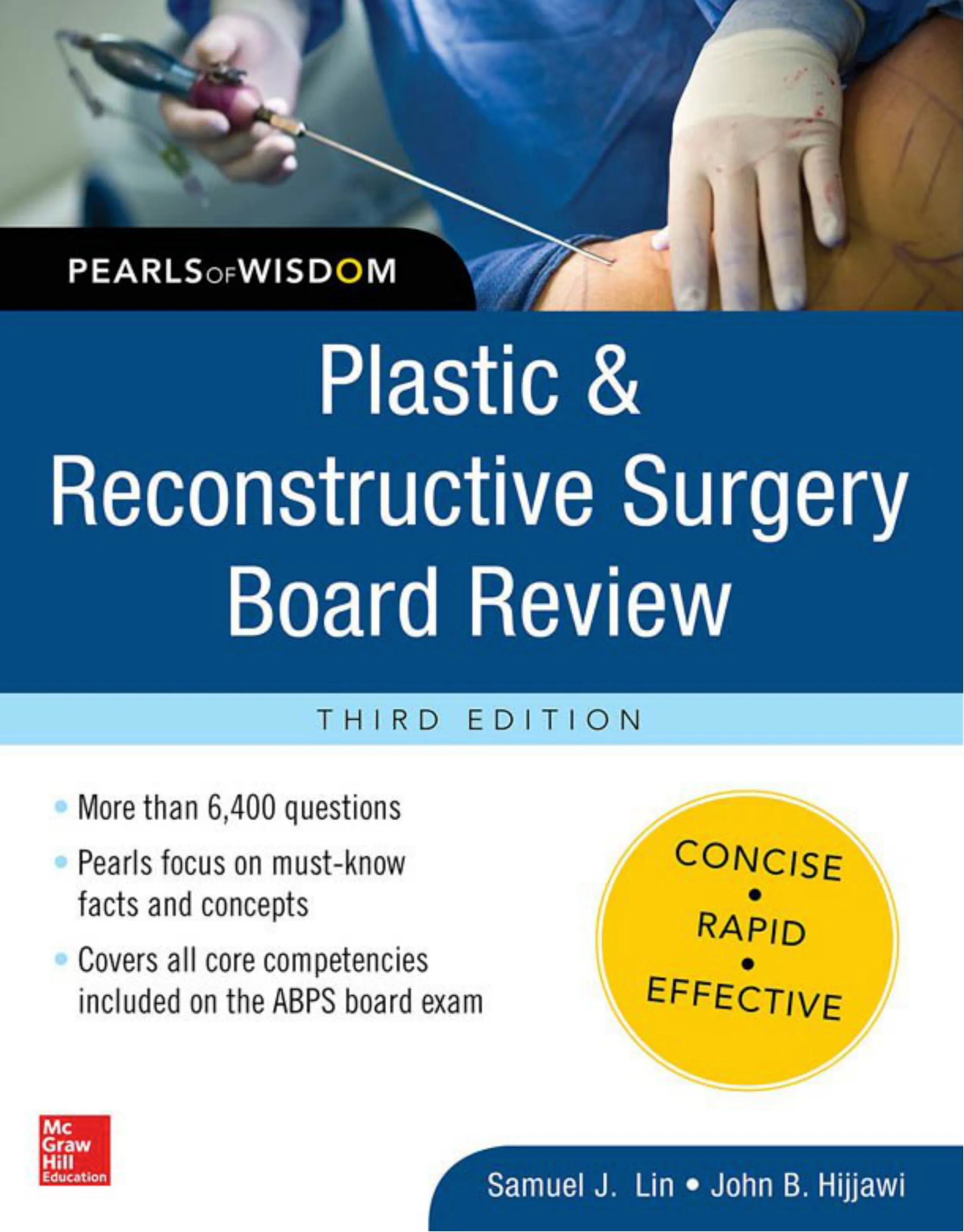
PEARLSOFWISDOM Plastic & Reconstructive Surgery Board Review THIRD EDITION More than 6,400 questions Pearls focus on must-know facts and concepts Covers all core competencies included on the ABPS board exam CONCISE RAPID EFFECTIVE Mc Graw Hill Education Samuel J. Lin • John B. Hijjawi
Plastic &
Reconstructive
Surgery
BOARD REVIEW
Third Edition
Sam ue l J. Lin, MD, MBA, FACS
John B. Hijjaw i, MD, FACS
New York Chicago San Francisco Athens London Madrid Mexico City
Milan New Delhi Singapore Sydney Toronto
Copyright © 2016 by McGraw-Hill Education. All rights reserved. Except as permitted under the United States Copyright Act of 1976, no part of this publication may be
reproduced or distributed in any form or by any means, or stored in a database or retrieval system, without the prior written permission of the publisher.
ISBN: 978-0-07-183399-8
MHID: 0-07-183399-4
The material in this eBook also appears in the print version of this title: ISBN: 978-0-07-183201-4,
MHID: 0-07-183201-7.
eBook conversion by codeMantra
Version 1.0
All trademarks are trademarks of their respective owners. Rather than put a trademark symbol after every occurrence of a trademarked name, we use names in an editorial fashion
only, and to the bene t of the trademark owner, with no intention of infringement of the trademark. Where such designations appear in this book, they have been printed with
initial caps.
McGraw-Hill Education books are available at special quantity discounts to use as premiums and sales promotions or for use in corporate training programs. To contact a
representative, please visit the Contact Us pages at
Previous edition copyright © 2011, 2006 by The McGraw-Hill Companies, Inc.
Notice
Medicine is an ever-changing science. As new research and clinical experience broaden our knowledge, changes in treatment and drug therapy are required. The authors and the
publisher of this work have checked with sources believed to be reliable in their efforts to provide information that is complete and generally in accord with the standards accepted
at the time of publication. However, in view of the possibility of human error or changes in medical sciences, neither the authors nor the publisher nor any other party who has been
involved in the preparation or publication of this work warrants that the information contained herein is in every respect accurate or complete, and they disclaim all responsibility
for any errors or omissions or for the results obtained from use of the information contained in this work. Readers are encouraged to con rm the information contained herein with
other sources. For example and in particular, readers are advised to check the product information sheet included in the package of each drug they plan to administer to be certain that
the information contained in this work is accurate and that changes have not been made in the recommended dose or in the contraindications for administration. This recommendation
is of particular importance in connection with new or infrequently used drugs.
TERMS OF USE
This is a copyrighted work and McGraw-Hill Education and its licensors reserve all rights in and to the work. Use of this work is subject to these terms. Except as permitted under
the Copyright Act of 1976 and the right to store and retrieve one copy of the work, you may not decompile, disassemble, reverse engineer, reproduce, modify, create derivative
works based upon, transmit, distribute, disseminate, sell, publish or sublicense the work or any part of it without McGraw-Hill Education’s prior consent. You may use the work
for your own noncommercial and personal use; any other use of the work is strictly prohibited. Your right to use the work may be terminated if you fail to comply with these terms.
THE WORK IS PROVIDED “AS IS.” McGRAW-HILL EDUCATION AND ITS LICENSORS MAKE NO GUARANTEES OR WARRANTIES AS TO THE
ACCURACY, ADEQUACY OR COMPLETENESS OF OR RESULTS TO BE OBTAINED FROM USING THE WORK, INCLUDING ANY INFORMATION THAT CAN BE
ACCESSED THROUGH THE WORK VIA HYPERLINK OR OTHERWISE, AND EXPRESSLY DISCLAIM ANY WARRANTY, EXPRESS OR IMPLIED, INCLUDING BUT
NOT LIMITED TO IMPLIED WARRANTIES OF MERCHANTABILITY OR FITNESS FOR A PARTICULAR PURPOSE. McGraw-Hill Education and its licensors do not
warrant or guarantee that the functions contained in the work will meet your requirements or that its operation will be uninterrupted or error free. Neither McGraw-Hill Education
nor its licensors shall be liable to you or anyone else for any inaccuracy, error or omission, regardless of cause, in the work or for any damages resulting therefrom. McGraw-Hill
Education has no responsibility for the content of any information accessed through the work. Under no circumstances shall McGraw-Hill Education and/or its licensors be liable
for any indirect, incidental, special, punitive, consequential or similar damages that result from the use of or inability to use the work, even if any of them has been advised of the
possibility of such damages. This limitation of liability shall apply to any claim or cause whatsoever whether such claim or cause arises in contract, tort or otherwise.
EDITORS IN CHIEF
Samuel J. Lin, MD, MBA, FACS
Associate Program Director, Combined Harvard Plastic
Surgery Residency
Associate Pro essor o Surgery
Divisions o Plastic Surgery and Otolaryngology-Head
and Neck Surgery
Beth Israel Deaconess Medical Center
Harvard Medical School
Boston, Massachusetts
John B. Hijjawi, MD, FACS
Editor-in-Chie , Plastic Surgery Education Network
Attending Plastic Surgeon
Intermountain Healthcare
Salt Lake City, Utah
MANAGING EDITORS
Pieter G. L. Koolen, MD
Senior Research Fellow
Division o Plastic Surgery
Beth Israel Deaconess Medical Center
Harvard Medical School
Boston, Massachusetts
Emily M. Clarke-Pearson, MD, MEd
Fellow in Microsurgery
Department o Plastic Surgery
Johns Hopkins Hospital
Baltimore, Maryland
DEDICATION
o our amilies and patients, who motivate
us at home and at work to do our best each day.
ACKNOWLEDGMENTS
Many thanks to Scott H. Plantz, M.D. and erri Lair or this wonder ul opportunity years ago.
v
CONTENTS
Contributors . . . . . . . . . . . . . . . . . . . . . . . . . . . . . . . . . . . . . . . . . . . . . . . . . . . . . . . . . . . . . . . . . . . . . . . . . . . . . xi
Previous Edition Contributors . . . . . . . . . . . . . . . . . . . . . . . . . . . . . . . . . . . . . . . . . . . . . . . . . . . . . . . . . . . . xxi
Pre ace . . . . . . . . . . . . . . . . . . . . . . . . . . . . . . . . . . . . . . . . . . . . . . . . . . . . . . . . . . . . . . . . . . . . . . . . . . . . . . . . xxvii
1. Strategies or Studying . . . . . . . . . . . . . . . . . . . . . . . . . . . . . . . . . . . . . . . . . . . . . . . . . . . . . . . . . . . . . . . . 1
2. History o Plastic Surgery . . . . . . . . . . . . . . . . . . . . . . . . . . . . . . . . . . . . . . . . . . . . . . . . . . . . . . . . . . . . . 9
Section I: AES HE IC SURGERY
3. Periorbital Region and Blepharoplasty . . . . . . . . . . . . . . . . . . . . . . . . . . . . . . . . . . . . . . . . . . . . . . . . 17
4. Chemodenervation (Botulinum oxin ype A [BoN -A]) . . . . . . . . . . . . . . . . . . . . . . . . . . . . . . 29
5. Brow Li t . . . . . . . . . . . . . . . . . . . . . . . . . . . . . . . . . . . . . . . . . . . . . . . . . . . . . . . . . . . . . . . . . . . . . . . . . . . . 35
6. Faceli t (Rhytidectomy) . . . . . . . . . . . . . . . . . . . . . . . . . . . . . . . . . . . . . . . . . . . . . . . . . . . . . . . . . . . . . . 41
7. Otoplasty . . . . . . . . . . . . . . . . . . . . . . . . . . . . . . . . . . . . . . . . . . . . . . . . . . . . . . . . . . . . . . . . . . . . . . . . . . . 51
8. Rhinoplasty . . . . . . . . . . . . . . . . . . . . . . . . . . . . . . . . . . . . . . . . . . . . . . . . . . . . . . . . . . . . . . . . . . . . . . . . . 59
9. Skin Resur acing . . . . . . . . . . . . . . . . . . . . . . . . . . . . . . . . . . . . . . . . . . . . . . . . . . . . . . . . . . . . . . . . . . . . 69
10. Chemical Peels . . . . . . . . . . . . . . . . . . . . . . . . . . . . . . . . . . . . . . . . . . . . . . . . . . . . . . . . . . . . . . . . . . . . . . 77
11. Alloplastic Augmentation o the Facial Skeleton . . . . . . . . . . . . . . . . . . . . . . . . . . . . . . . . . . . . . . . 85
12. Lasers . . . . . . . . . . . . . . . . . . . . . . . . . . . . . . . . . . . . . . . . . . . . . . . . . . . . . . . . . . . . . . . . . . . . . . . . . . . . . . 91
vi
Contents
13. Injectable Fillers . . . . . . . . . . . . . . . . . . . . . . . . . . . . . . . . . . . . . . . . . . . . . . . . . . . . . . . . . . . . . . . . . . . . . 99
14. Hair Removal/Hair ransplantation . . . . . . . . . . . . . . . . . . . . . . . . . . . . . . . . . . . . . . . . . . . . . . . . . 107
15. Body Contouring . . . . . . . . . . . . . . . . . . . . . . . . . . . . . . . . . . . . . . . . . . . . . . . . . . . . . . . . . . . . . . . . . . 115
16. Suction Lipectomy . . . . . . . . . . . . . . . . . . . . . . . . . . . . . . . . . . . . . . . . . . . . . . . . . . . . . . . . . . . . . . . . . 125
Section II: BREAS
17. Breast Anatomy/Embryology . . . . . . . . . . . . . . . . . . . . . . . . . . . . . . . . . . . . . . . . . . . . . . . . . . . . . . . . 135
18. Breast Augmentation . . . . . . . . . . . . . . . . . . . . . . . . . . . . . . . . . . . . . . . . . . . . . . . . . . . . . . . . . . . . . . . 143
19. Breast Implant E cacy and Sa ety . . . . . . . . . . . . . . . . . . . . . . . . . . . . . . . . . . . . . . . . . . . . . . . . . . . 151
20. Breast Cancer . . . . . . . . . . . . . . . . . . . . . . . . . . . . . . . . . . . . . . . . . . . . . . . . . . . . . . . . . . . . . . . . . . . . . . 157
21. Skin-Sparing Mastectomy (SSM) . . . . . . . . . . . . . . . . . . . . . . . . . . . . . . . . . . . . . . . . . . . . . . . . . . . . 175
22. Nipple-Sparing Mastectomy . . . . . . . . . . . . . . . . . . . . . . . . . . . . . . . . . . . . . . . . . . . . . . . . . . . . . . . . 179
23. Expander–Implant and Nipple–Areolar Reconstruction . . . . . . . . . . . . . . . . . . . . . . . . . . . . . . . 181
24. Breast Reconstruction: Alternative Flaps . . . . . . . . . . . . . . . . . . . . . . . . . . . . . . . . . . . . . . . . . . . . . 195
25. Breast Reconstruction: Microsurgery and Autologous Reconstruction . . . . . . . . . . . . . . . . . . 211
26. Radiation T erapy and Reconstruction . . . . . . . . . . . . . . . . . . . . . . . . . . . . . . . . . . . . . . . . . . . . . . 217
27. Gynecomastia . . . . . . . . . . . . . . . . . . . . . . . . . . . . . . . . . . . . . . . . . . . . . . . . . . . . . . . . . . . . . . . . . . . . . . 231
28. Breast Reduction and Mastopexy . . . . . . . . . . . . . . . . . . . . . . . . . . . . . . . . . . . . . . . . . . . . . . . . . . . . 239
Contents
vii
Section III: HAND AND EX REMI IES
29. Hand Anatomy/Embryology . . . . . . . . . . . . . . . . . . . . . . . . . . . . . . . . . . . . . . . . . . . . . . . . . . . . . . . . 249
30. Anesthesia . . . . . . . . . . . . . . . . . . . . . . . . . . . . . . . . . . . . . . . . . . . . . . . . . . . . . . . . . . . . . . . . . . . . . . . . . 265
31. Hand umors . . . . . . . . . . . . . . . . . . . . . . . . . . . . . . . . . . . . . . . . . . . . . . . . . . . . . . . . . . . . . . . . . . . . . . 283
32. In ections o the Hand . . . . . . . . . . . . . . . . . . . . . . . . . . . . . . . . . . . . . . . . . . . . . . . . . . . . . . . . . . . . . 293
33. Dupuytren Contracture . . . . . . . . . . . . . . . . . . . . . . . . . . . . . . . . . . . . . . . . . . . . . . . . . . . . . . . . . . . . . 305
34. Nerve Compression Syndromes . . . . . . . . . . . . . . . . . . . . . . . . . . . . . . . . . . . . . . . . . . . . . . . . . . . . . 313
35. Hand Fractures/Dislocations . . . . . . . . . . . . . . . . . . . . . . . . . . . . . . . . . . . . . . . . . . . . . . . . . . . . . . . . 327
36. endon Injuries . . . . . . . . . . . . . . . . . . . . . . . . . . . . . . . . . . . . . . . . . . . . . . . . . . . . . . . . . . . . . . . . . . . . 333
37. T e Perionychium . . . . . . . . . . . . . . . . . . . . . . . . . . . . . . . . . . . . . . . . . . . . . . . . . . . . . . . . . . . . . . . . . . 343
38. Rheumatoid Hand . . . . . . . . . . . . . . . . . . . . . . . . . . . . . . . . . . . . . . . . . . . . . . . . . . . . . . . . . . . . . . . . . 353
39. Obstetrical Brachial Plexus Injuries . . . . . . . . . . . . . . . . . . . . . . . . . . . . . . . . . . . . . . . . . . . . . . . . . . 365
40. Brachial Plexus . . . . . . . . . . . . . . . . . . . . . . . . . . . . . . . . . . . . . . . . . . . . . . . . . . . . . . . . . . . . . . . . . . . . . 369
41. endon rans ers . . . . . . . . . . . . . . . . . . . . . . . . . . . . . . . . . . . . . . . . . . . . . . . . . . . . . . . . . . . . . . . . . . . 381
42. Wrist Kinematics . . . . . . . . . . . . . . . . . . . . . . . . . . . . . . . . . . . . . . . . . . . . . . . . . . . . . . . . . . . . . . . . . . . 393
43. Replantation . . . . . . . . . . . . . . . . . . . . . . . . . . . . . . . . . . . . . . . . . . . . . . . . . . . . . . . . . . . . . . . . . . . . . . . 403
44. oe-to-Hand rans er . . . . . . . . . . . . . . . . . . . . . . . . . . . . . . . . . . . . . . . . . . . . . . . . . . . . . . . . . . . . . . 415
45. Nerve Injury/Repair . . . . . . . . . . . . . . . . . . . . . . . . . . . . . . . . . . . . . . . . . . . . . . . . . . . . . . . . . . . . . . . . 429
viii
Contents
Section IV: HEAD AND NECK
46. Facial rauma . . . . . . . . . . . . . . . . . . . . . . . . . . . . . . . . . . . . . . . . . . . . . . . . . . . . . . . . . . . . . . . . . . . . . . 443
47. Facial Nerve Anatomy and Paralysis . . . . . . . . . . . . . . . . . . . . . . . . . . . . . . . . . . . . . . . . . . . . . . . . . . 455
48. Facial Paralysis: Static and Dynamic reatment . . . . . . . . . . . . . . . . . . . . . . . . . . . . . . . . . . . . . . . 465
49. Head and Neck Embryology . . . . . . . . . . . . . . . . . . . . . . . . . . . . . . . . . . . . . . . . . . . . . . . . . . . . . . . . 475
50. Head and Neck Cancer . . . . . . . . . . . . . . . . . . . . . . . . . . . . . . . . . . . . . . . . . . . . . . . . . . . . . . . . . . . . . 483
51. Salivary Gland umors . . . . . . . . . . . . . . . . . . . . . . . . . . . . . . . . . . . . . . . . . . . . . . . . . . . . . . . . . . . . . 491
52. Head and Neck Reconstruction . . . . . . . . . . . . . . . . . . . . . . . . . . . . . . . . . . . . . . . . . . . . . . . . . . . . . 509
53. Surgical Management o Migraine Headaches . . . . . . . . . . . . . . . . . . . . . . . . . . . . . . . . . . . . . . . . 517
54. Dental Anatomy and Occlusion . . . . . . . . . . . . . . . . . . . . . . . . . . . . . . . . . . . . . . . . . . . . . . . . . . . . . 523
55. Local and Regional Flaps or Head and Neck Reconstruction . . . . . . . . . . . . . . . . . . . . . . . . . . 533
Section V: IN EGUMEN
56. Benign Skin Lesions . . . . . . . . . . . . . . . . . . . . . . . . . . . . . . . . . . . . . . . . . . . . . . . . . . . . . . . . . . . . . . . . 555
57. Malignant Skin Lesions (Basal Cell and Squamous Cell Carcinoma) . . . . . . . . . . . . . . . . . . . . 563
58. Malignant Melanoma: Basis and reatment . . . . . . . . . . . . . . . . . . . . . . . . . . . . . . . . . . . . . . . . . . 567
Section VI: PEDIA RICS
59. Cranio acial Syndromes . . . . . . . . . . . . . . . . . . . . . . . . . . . . . . . . . . . . . . . . . . . . . . . . . . . . . . . . . . . . . 577
60. Craniosynostosis . . . . . . . . . . . . . . . . . . . . . . . . . . . . . . . . . . . . . . . . . . . . . . . . . . . . . . . . . . . . . . . . . . . 583
Contents
ix
61. Cle t Lip and Palate . . . . . . . . . . . . . . . . . . . . . . . . . . . . . . . . . . . . . . . . . . . . . . . . . . . . . . . . . . . . . . . . 595
62. Velopharyngeal Inadequacy . . . . . . . . . . . . . . . . . . . . . . . . . . . . . . . . . . . . . . . . . . . . . . . . . . . . . . . . . 603
63. Pharyngoplasty/Pharyngeal Flaps/Speech T erapy . . . . . . . . . . . . . . . . . . . . . . . . . . . . . . . . . . . . 611
64. Distraction Osteogenesis . . . . . . . . . . . . . . . . . . . . . . . . . . . . . . . . . . . . . . . . . . . . . . . . . . . . . . . . . . . . 619
65. Orthognathic Surgery . . . . . . . . . . . . . . . . . . . . . . . . . . . . . . . . . . . . . . . . . . . . . . . . . . . . . . . . . . . . . . 625
66. Congenital Ear De ormities . . . . . . . . . . . . . . . . . . . . . . . . . . . . . . . . . . . . . . . . . . . . . . . . . . . . . . . . . 635
67. Congenital Nevi/ issue Expansion . . . . . . . . . . . . . . . . . . . . . . . . . . . . . . . . . . . . . . . . . . . . . . . . . . 643
68. Congenital Breast . . . . . . . . . . . . . . . . . . . . . . . . . . . . . . . . . . . . . . . . . . . . . . . . . . . . . . . . . . . . . . . . . . 649
69. Congenital Hand Surgery . . . . . . . . . . . . . . . . . . . . . . . . . . . . . . . . . . . . . . . . . . . . . . . . . . . . . . . . . . . 657
70. Vascular Anomalies . . . . . . . . . . . . . . . . . . . . . . . . . . . . . . . . . . . . . . . . . . . . . . . . . . . . . . . . . . . . . . . . . 665
Section VII: RECONS RUC ION
71. Wound Healing/Keloids and Negative Pressure Wound T erapy . . . . . . . . . . . . . . . . . . . . . . . 675
72. Principles o Skin Gra ting . . . . . . . . . . . . . . . . . . . . . . . . . . . . . . . . . . . . . . . . . . . . . . . . . . . . . . . . . . 693
73. Microsurgery and Flaps . . . . . . . . . . . . . . . . . . . . . . . . . . . . . . . . . . . . . . . . . . . . . . . . . . . . . . . . . . . . . 697
74. Per orator Flaps . . . . . . . . . . . . . . . . . . . . . . . . . . . . . . . . . . . . . . . . . . . . . . . . . . . . . . . . . . . . . . . . . . . . 713
75. Vascular Composite Allotransplantation . . . . . . . . . . . . . . . . . . . . . . . . . . . . . . . . . . . . . . . . . . . . . 727
76. Burn Care . . . . . . . . . . . . . . . . . . . . . . . . . . . . . . . . . . . . . . . . . . . . . . . . . . . . . . . . . . . . . . . . . . . . . . . . . 733
77. Ear Reconstruction . . . . . . . . . . . . . . . . . . . . . . . . . . . . . . . . . . . . . . . . . . . . . . . . . . . . . . . . . . . . . . . . . 743
x
Contents
78. Aesthetic and Reconstructive Eyelid Surgery . . . . . . . . . . . . . . . . . . . . . . . . . . . . . . . . . . . . . . . . . . 751
79. Nasal Reconstruction . . . . . . . . . . . . . . . . . . . . . . . . . . . . . . . . . . . . . . . . . . . . . . . . . . . . . . . . . . . . . . . 761
80. Mandibular Reconstruction . . . . . . . . . . . . . . . . . . . . . . . . . . . . . . . . . . . . . . . . . . . . . . . . . . . . . . . . . 765
81. Scalp and Calvarial Reconstruction . . . . . . . . . . . . . . . . . . . . . . . . . . . . . . . . . . . . . . . . . . . . . . . . . . 777
82. Lip Reconstruction . . . . . . . . . . . . . . . . . . . . . . . . . . . . . . . . . . . . . . . . . . . . . . . . . . . . . . . . . . . . . . . . . 785
83. ongue Reconstruction . . . . . . . . . . . . . . . . . . . . . . . . . . . . . . . . . . . . . . . . . . . . . . . . . . . . . . . . . . . . . 793
84. Chest and Abdominal Wall Reconstruction . . . . . . . . . . . . . . . . . . . . . . . . . . . . . . . . . . . . . . . . . . . 801
85. Lymphedema . . . . . . . . . . . . . . . . . . . . . . . . . . . . . . . . . . . . . . . . . . . . . . . . . . . . . . . . . . . . . . . . . . . . . . 811
86. Lower Extremity Reconstruction—So t- issue Concepts . . . . . . . . . . . . . . . . . . . . . . . . . . . . . . 817
87. Lower Extremity Reconstruction—Orthopedic Concepts . . . . . . . . . . . . . . . . . . . . . . . . . . . . . 823
88. Pressure Sores . . . . . . . . . . . . . . . . . . . . . . . . . . . . . . . . . . . . . . . . . . . . . . . . . . . . . . . . . . . . . . . . . . . . . . 831
89. Gender Con rmation Surgery . . . . . . . . . . . . . . . . . . . . . . . . . . . . . . . . . . . . . . . . . . . . . . . . . . . . . . . 835
90. In ltration and Extravasation Injuries . . . . . . . . . . . . . . . . . . . . . . . . . . . . . . . . . . . . . . . . . . . . . . . . 841
Section VIII: GENERAL OPICS
91. Basic Statistical Methods . . . . . . . . . . . . . . . . . . . . . . . . . . . . . . . . . . . . . . . . . . . . . . . . . . . . . . . . . . . . 853
92. Special opics in General Surgery . . . . . . . . . . . . . . . . . . . . . . . . . . . . . . . . . . . . . . . . . . . . . . . . . . . . 861
93. High-Yield opics . . . . . . . . . . . . . . . . . . . . . . . . . . . . . . . . . . . . . . . . . . . . . . . . . . . . . . . . . . . . . . . . . . 871
Index . . . . . . . . . . . . . . . . . . . . . . . . . . . . . . . . . . . . . . . . . . . . . . . . . . . . . . . . . . . . . . . . . . . . . . . . . . . . . . . . . 1037
Color plates appear between pages 516 and 517.
xi
CONTRIBUTORS
David M. Adelman, MD, PhD, FACS
Assistant Pro essor
Department o Plastic Surgery
T e University o exas
MD Anderson Cancer Center
Houston, exas
History o Plastic Surgery
Scalp and Calvarial Reconstruction
Jayant P. Agarwal, MD
Associate Pro essor o Surgery
Department o Surgery
Division o Plastic and Reconstructive
Surgery
University o Utah School o Medicine
Salt Lake City, Utah
Breast Anatomy/Embryology
Jugpal S. Arneja, MD, MBA, FAAP,
FACS, FRCSC
Pro essor (Clinical), Surgery
Division o Plastic Surgery
University o British Columbia
Associate Chie , Surgery
British Columbia Children’s Hospital
Vancouver, British Columbia, Canada
Velopharyngeal Inadequacy
William G. Austen, Jr., MD
Associate Pro essor o Surgery
Chie , Division o Plastic and Reconstructive Surgery
and Division o Burn Surgery
Massachusetts General Hospital, Harvard Medical
School
Boston, Massachusetts
Surgical Management o Migraine Headaches
Jonathan Bank, MD
Aesthetic Plastic Surgery, PC
New York Breast Reconstruction Associates
Great Neck, New York
Congenital Ear De ormities
Richard A. Bartlett, MD
Private Practice
Division o Plastic Surgery
Beth Israel Deaconess Medical Center
Boston, Massachusetts
Otoplasty
Bruce S. Bauer MD, FACS, FAAP
Director o Pediatric Plastic Surgery
NorthShore University Health System
Clinical Pro essor o Surgery
University o Chicago
Pritzker School o Medicine
Highland Park Hospital
Northbroook, Illinois
Congenital Ear De ormities
Jonathan S. Black, MD
Assistant Pro essor o Plastic Surgery
University o Virginia School o Medicine
Charlottesville, Virginia
Facial rauma
César J. Bravo, MD
Co-Director
Microvascular, Hand, and Upper Extremity Surgery
Assistant Pro essor
Orthopedic Surgery
University o Virginia, Charlottesville
Virginia ech Carilion School o Medicine
Roanoke, Virginia
In ections o the Hand
Rheumatoid Hand
Charles E. Butler, MD, FACS
Pro essor
Department o Plastic Surgery
T e University o exas
MD Anderson Cancer Center
Houston, exas
History o Plastic Surgery
*Chapters marked with an asterisk have been reprinted rom the previous edition.
xii
Contributors
Rakesh K. Chandra, MD
Pro essor o Otolaryngology
Chie o Rhinology, Sinus and Skull Base Surgery
Vanderbilt University Medical Center
Nashville, ennessee
Facial Nerve Anatomy and Paralysis
Head and Neck Embryology
Ming-Huei Cheng, MD, MBA, FACS
Associate Pro essor and Chie
Division o Reconstructive Microsurgery
Department o Plastic and Reconstructive Surgery
Chang Gung Memorial Hospital
Chang Gung Medical College
Chang Gung University
aoyuan, aiwan
Per orator Flaps
Emily M. Clarke-Pearson, MD, MEd
Fellow in Microsurgery
Department o Plastic Surgery
Johns Hopkins Hospital
Baltimore, Maryland
Breast Implant E cacy and Sa ety
Expander–Implant and Nipple–Areolar Reconstruction
Special opics in General Surgery
Alvin B. Cohn, MD
Assistant Clinical Pro essor
Section o Plastic and Reconstructive Surgery
University o Alabama at Birmingham
Private Practice
Norwood Clinic Plastic Surgery
Birmingham, Alabama
Breast Anatomy/Embryology
Stephen Colbert, MD, FACS
Associate Pro essor o Clinical Plastic Surgery
Division o Plastic Surgery
University o Missouri
Columbia, Missouri
Congenital Nevi/ issue Expansion
Julia Corcoran, MD, MHPE
Associate Pro essor
Department o Surgery
Northwestern University
Feinberg School o Medicine
Chicago, Illinois
Strategies or Studying
Javier A. Couto, BS
Research Fellow
Department o Plastic and Oral Surgery, Boston
Children’s Hospital
Harvard Medical School
Boston, Massachusetts
Vascular Anomalies
Emily Cushnie, MD, PhD
Resident Physician
Department o Orthopaedic Surgery
University o Virginia School o Medicine
Charlottesville, Virginia
In ections o the Hand
Rheumatoid Hand
Jenna Cusic, MD
Resident
Department o Plastic Surgery
Medical College o Wisconsin
Milwaukee, Wisconsin
Ear Reconstruction
Inf ltration and Extravasation Injuries
Dipan Das, MD, FACS
Hand and Plastic Surgery Center, PLLC
Katy, exas
T e Perionychium
Erez Dayan, MD
Fellow, Plastic and Reconstructive Surgery
Department o Plastic and Reconstructive Surgery,
Brigham and Women’s Hospital
Harvard Medical School
Boston, Massachusetts
Special opics in General Surgery
Arlen D. Denny, MD
Medical Director
Center or Cranio acial Disorders Medical College o
Wisconsin
Milwaukee, Wisconsin
Pharyngoplasty/Pharyngeal Flaps/Speech T erapy
Daihung Do, MD
Director o Dermatologic Surgery
Beth Israel Deaconess Medical Center
Boston, Massachusetts
Malignant Skin Lesions (Basal Cell and Squamous Cell
Carcinoma)
Contributors
xiii
Nicholas Do, MD
Resident
Department o Plastic Surgery
Medical College o Wisconsin
Milwaukee, Wisconsin
Cranio acial Syndromes
Radiation T erapy and Reconstruction
William W. Dzwierzynski, MD, FACS
Pro essor and Plastic Surgery Residency Program Director
Medical College o Wisconsin
Milwaukee, Wisconsin
Ear Reconstruction
Bradley Eisemann, MD
Resident Physician
McGovern Medical School at T e University o exas
Health Science Center o Houston (U Health)
Houston, exas
Facial Paralysis: Static and Dynamic reatment
Bassem . Elhassan, MD
Assistant Pro essor
Department o Orthopedics
Mayo College o Medicine
Mayo Clinic
Rochester, Minnesota
Wrist Kinematics
Nicholas A. Flugstad, MD
Overlake Plastic Surgeons
Bellevue, Washington
Suction Lipectomy
Michael J. Frederick, MD
Resident, Harvard Plastic Surgery
Boston, Massachusetts
Lasers
Jef rey B. Friedrich, MD, FACS
Associate Pro essor o Surgery
Orthopedics and Urology (Adjunct)
Division o Plastic and Reconstructive Surgery
University o Washington
Seattle, Washington
Hand umors
Nerve Compression Syndromes
Eugene Y. Fukudome, MD
Fellow
Division o Plastic Surgery
Brigham and Women’s Hospital
Boston, Massachusetts
Chest and Abdominal Wall Reconstruction
Ingrid Ganske, MD
Resident
Harvard Plastic Surgery Program
Boston, Massachusetts
Otoplasty
Vascular Composite Allotransplantation
Brian S. Glatt, MD
Plastic and Reconstructive Surgery
Memorial Sloan-Kettering Cancer Center
New York, New York
Skin Resur acing*
Ryan Gobble, MD
Assistant Pro essor o Surgery
Plastic and Reconstructive Surgery
University o Cincinnati
Cincinnati, Ohio
Head and Neck Cancer
Arun K. Gosain, MD
Pro essor and Chie
Division o Pediatric Plastic Surgery
Lurie Children’s Hospital o Northwestern University
Feinberg School o Medicine
Chicago, Illinois
Velopharyngeal Inadequacy
Samita Goyal, MD
Resident Physician
Medical College o Wisconsin
Milwaukee, Wisconsin
Congenital Breast
Arin K. Greene, MD, MMSc
Associate Pro essor o Surgery
Department o Plastic and Oral Surgery
Boston Children’s Hospital
Harvard Medical School
Boston, Massachusetts
Lymphedema
Vascular Anomalies
Anish Gupta, MD, DDS
Resident
Division o Oral and Maxillo acial Surgery
Medical College o Wisconsin
Milwaukee, Wisconsin
Dental Anatomy and Occlusion
Jef rey A. Gusenof , MD
Associate Pro essor o Plastic Surgery
Department o Plastic Surgery
University o Pittsburgh
Pittsburgh, Pennsylvania
Body Contouring
xiv
Contributors
Edin Hajder, MD
Resident Physician
Vrije Universiteit Medical Center
Amsterdam, T e Netherlands
Radiation T erapy and Reconstruction
Matthew M. Hanasono, MD
Associate Pro essor
Department o Plastic Surgery
T e University o exas
MD Anderson Cancer Center
Houston, exas
Mandibular Reconstruction
Microsurgery and Flaps
Scalp and Calvarial Reconstruction
Scott L. Hansen, MD, FACS
Assistant Pro essor
Plastic and Reconstructive Surgery
Chie o Hand and Microvascular Surgery
University o Cali ornia, San Francisco
Chie o Plastic and Reconstructive Surgery
San Francisco General Hospital
San Francisco, Cali ornia
Lip Reconstruction
Replantation
Aladdin H. Hassanein, MD, MMSc
Chie Resident, Harvard Plastic Surgery Residency
Harvard Medical School
Boston, Massachusetts
Surgical Management o Migraine Headaches
Robert J. Havlik, MD
Chairman and George Korkos Pro essor o Surgery
Medical College o Wisconsin
Milwaukee, Wisconsin
Pressure Sores
Marissa Heller, MD
Associate Director o Dermatologic Surgery
Director o Laser and Cosmetic Surgery
Department o Dermatology, Beth Israel Deaconess
Medical Center
Instructor, Harvard Medical School
Boston, Massachusetts
Benign Skin Lesions
Lydia Anne Helliwell, MD
Harvard Plastic Surgery Combined Residency Program
Brigham and Women’s Hospital
Boston, Massachusetts
Malignant Melanoma: Basis and reatment
Peter W. Henderson, MD, MBA
Fellow, Plastic Surgery
Division o Plastic and Reconstructive Surgery
Weill Cornell Medical College
New York, New York
Local and Regional Flaps or Head and Neck
Reconstruction
Steven L. Henry, MD, FACS
Assistant Clinical Pro essor, U MB
Institute o Reconstructive Plastic Surgery o
Central exas
Austin, exas
endon Injuries
Patrick Hettinger, MD
Chie and Assistant Pro essor
Division o Oral and Maxillo acial Surgery
Medical College o Wisconsin
Milwaukee, Wisconsin
Inf ltration and Extravasation Injuries
John B. Hijjawi, MD, FACS
Editor-in-Chie , Plastic Surgery Education Network
Attending Plastic Surgeon
Intermountain Healthcare
Salt Lake City, Utah
Brachial Plexus
Breast Reconstruction: Microsurgery and Autologous
Reconstruction
Dupuytren Contracture
Hand Fractures/Dislocations
Gynecomastia
Head and Neck Reconstruction
Lower Extremity Reconstruction—Orthopedic Concepts
Nerve Injury/Repair
endon rans ers
Olivia Ho, MD, FRCSC
oronto, Ontario, Canada
Breast Reconstruction: Alternative Flaps
Expander–Implant and Nipple–Areolar Reconstruction
Jung-Ju Huang, MD
Lecturer
Department o Plastic and Reconstructive Surgery
Chang Gung Memorial Hospital
Chang Gung Medical College
Chang Gung University
aoyuan, aiwan
Per orator Flaps
Contributors
xv
Kristen A. Hudak, MD
Cranio acial Fellow
Department o Plastic Surgery
Medical College o Wisconsin
Milwaukee, Wisconsin
Pharyngoplasty/Pharyngeal Flaps/Speech T erapy
Joseph P. Hunstad, MD, FACS
President
Hunstad Kortesis Plastic Surgery and MedSpa
Huntersville, North Carolina
Associate Consulting Pro essor
Division o Plastic Surgery
T e University o North Carolina
Chapel Hill, North Carolina
Section Head o Plastic Surgery
Department o Surgery
Carolinas Medical Center
University Hospital
Charlotte, North Carolina
Suction Lipectomy
Matthew L. Iorio, MD
Assistant Pro essor
Harvard Medical School Department o Surgery
Division o Plastic Surgery Department o Orthopaedic
Surgery
Division o Hand Surgery Beth Israel Deaconess Medical
Center
Boston, Massachusetts
Lower Extremity Reconstruction—So t issue Concepts
John N. Jensen, MD
Associate Pro essor
Department o Plastic Surgery
Medical College o Wisconsin
Milwaukee, Wisconsin
Cle t Lip and Palate
Cranio acial Syndromes
Facial rauma
Donald B. Johnson, MD
Clinical Research Fellow
Division o Plastic and Reconstructive Surgery
NorthShore University Health System
Northbrook, Illinois
Congenital Ear De ormities
Sanjeev Kakar, MD, MRCS
Assistant Pro essor
Department o Orthopedic Surgery
College o Medicine
Mayo Clinic
Rochester, Minnesota
Wrist Kinematics
Kari Kansal, MD
Breast Surgeon
Department o Surgery
Beth Israel Deaconess Medical Center
Harvard Medical School
Boston, Massachusetts
Nipple-Sparing Mastectomy
Neelesh A. Kantak, MD
Resident
Harvard Plastic Surgery Program
Boston, Massachusetts
Chemical Peels
Dennis S. Kao, MD
Hand Fellow
Department o Plastic Surgery
Medical College o Wisconsin
Milwaukee, Wisconsin
Obstetrical Brachial Plexus Injuries
Ruba Khader, MD
Resident
Division o Oral and Maxillo acial Surgery
Medical College o Wisconsin
Milwaukee, Wisconsin
Dental Anatomy and Occlusion
Kuylhee Kim, MD
Aesthetic and Reconstructive Breast Fellow
Partners in Plastic Surgery
Grand Rapids, Michigan
Breast Reconstruction: Microsurgery and Autologous
Reconstruction
Nicholas Kim, MD
Resident
Department o Plastic Surgery
Medical College o Wisconsin
Milwaukee, Wisconsin
Gender Conf rmation Surgery
Christian Kirman, MD, FACS
Muir Aesthetic and Reconstructive Surgery
Walnut Creek, Cali ornia
Wound Healing/Keloids and Negative Pressure Wound T erapy
Michael J. A. Klebuc, MD
Associate Pro essor o Clinical Plastic and
Reconstructive Surgery
Weil Cornel Medical College
Director o Center or Facial Paralysis Surgery and
Functional Restoration
Houston Methodist Hospital
Houston, exas
Facial Paralysis: Static and Dynamic reatment
xvi
Contributors
Karri A. Kluesner, MD
Resident Physician
Department o Plastic Surgery
Medical College o Wisconsin
Milwaukee, Wisconsin
Breast Cancer
Peter F. Koltz, MD
Chie Resident
Division o Plastic and Reconstructive Surgery
University o Rochester Medical Center
Rochester, New York
Body Contouring
High-Yield opics
Amanda L. Kong, MD, MS
Assistant Pro essor
Division o Surgical Oncology
Department o Surgery
Medical College o Wisconsin
Milwaukee, Wisconsin
Breast Cancer
Pieter G. L. Koolen, MD
Senior Research Fellow
Division o Plastic Surgery
Beth Israel Deaconess Medical Center
Harvard Medical School
Boston, Massachusetts
Basic Statistical Methods
Brachial Plexus
Breast Implant E cacy and Sa ety
Craniosynostosis
Distraction Osteogenesis
Dupuytren Contracture
Hand Fractures/Dislocations
Head and Neck Reconstruction
Lower Extremity Reconstruction—Orthopedic Concepts
Nerve Injury/Repair
Radiation T erapy and Reconstruction
endon rans ers
ongue Reconstruction
Bernard . Lee, MD
Chie , Division o Plastic Surgery
Associate Pro essor
Department o Surgery
Harvard Medical School
Beth Israel Deaconess Medical Center
Boston, Massachusetts
Injectable Fillers
Samuel J. Lin, MD, MBA, FACS
Associate Program Director
Combined Harvard Plastic Surgery Residency
Associate Pro essor o Surgery
Divisions o Plastic Surgery and Otolaryngology-Head
and Neck Surgery
Beth Israel Deaconess Medical Center
Harvard Medical School
Boston, Massachusetts
Brachial Plexus
Breast Implant E cacy and Sa ety
Breast Reconstruction: Microsurgery and Autologous
Reconstruction
Craniosynostosis
Distraction Osteogenesis
Dupuytren Contracture
Faceli t (Rhytidectomy)
Hand Fractures/Dislocations
Head and Neck Cancer
Head and Neck Reconstruction
High-Yield opics
Lasers
Lower Extremity Reconstruction—Orthopedic Concepts
Nerve Injury/Repair
Periorbital Region and Blepharoplasty
Radiation T erapy and Reconstruction
Rhinoplasty
endon rans ers
ongue Reconstruction
Kristina Liu, MD
Resident Physician
Harvard Combined Dermatology Residency
Boston, Massachusetts
Malignant Skin Lesions (Basal Cell and Squamous Cell
Carcinoma)
Jacques A. Machol IV, MD
Hand Surgery Clinical Fellow
Massachusetts General Hospital
Department o Orthopedic Surgery
Harvard Medical School
Boston, Massachusetts
Gynecomastia
Hani S. Matloub, MD
Pro essor
Department o Plastic and Reconstructive Surgery
Medical College o Wisconsin
Milwaukee, Wisconsin
Obstetrical Brachial Plexus Injuries
Contributors
xvii
Evan Matros, MD, MMSc
Assistant Pro essor, Plastic Surgery
Division o Plastic and Reconstructive Surgery
Weill Cornell Medical College
New York, New York
Local and Regional Flaps or Head and Neck Reconstruction
David Michael Miller, MD, PhD, FAAD
Division o Hematology/Oncology
Beth Israel Deaconess Medical Center
Boston, Massachusetts
Malignant Melanoma: Basis and reatment
Leonard B. Miller, MD, FACS, FRCS
Private Practice
Division o Plastic Surgery
Beth Israel Deaconess Medical Center
Boston, Massachusetts
Chemical Peels
Donald J. Morris, MD, FACS
Assistant Pro essor o Surgery – Part ime
Harvard Medical School
Division o Plastic Surgery
Department o Surgery
Beth Israel Deaconess Medical Center
Boston, Massachusetts
Chest and Abdominal Wall Reconstruction
renton M. Morton, MD
Resident
Department o Surgery
Division o Plastic and Reconstructive Surgery
University o Washington
Seattle, Washington
Hand umors
Nerve Compression Syndromes
Farzad R. Nahai, MD
Associate Clinical Pro essor
Plastic Surgery at Emory University
Private Practice
T e Center or Plastic Surgery at MetroDerm
Atlanta, Georgia
Aesthetic and Reconstructive Eyelid Surgery
Brow Li t
Chemodenervation (Botulinum oxin ype A [BoN -A])
Nicole L. Nemeth, MD, FACS
Owner, Plastic Surgery o Westchester
Clinical Assistant Pro essor
Department o Surgery (Plastic and Reconstructive
Surgery)
Albert Einstein College o Medicine
Monte ore Medical Center
Plastic Surgery Attending
Jacobi Medical Center
Bronx, New York
Burn Care
T eodore . Nyame, MD
Plastic Surgeon
Charlotte, North Carolina
Breast Reduction and Mastopexy
Injectable Fillers
Elizabeth A. O’Connor, MD
Department o Plastic Surgery
BayCare Clinic Plastic Surgery
Green Bay, Wincosin
Ear Reconstruction
Brian M. Parrett, MD
Plastic Surgeon
Buncke Clinic
San Francisco, Cali ornia
Nasal Reconstruction
Priyesh Patel, MD
Resident Physician
Department o Otolaryngology
Vanderbilt University Medical Center
Nashville, ennessee
Head and Neck Embryology
Melissa M. Poh, MD
Partner Physician, Department o Plastic Surgery
Kaiser West Los Angeles
Clinical Assistant Pro essor
Division o Plastic Surgery
University o Southern Cali ornia
Los Angeles, Cali ornia
Mandibular Reconstruction
xviii
Contributors
Bohdan Pomahac, MD
Associate Pro essor, Surgery
Division o Plastic Surgery
Brigham and Women’s Hospital
Harvard Medical School
Boston, Massachusetts
Vascular Composite Allotransplantation
Julian J. Pribaz, MD
Pro essor
Department o Surgery
Division o Plastic Surgery
Brigham and Women’s Hospital
Harvard Medical School
Boston, Massachusetts
Nasal Reconstruction
Michel Saint-Cyr, MD, FRCS(C)
Associate Pro essor
Department o Plastic Surgery
University o exas Southwestern Medical Center
Dallas, exas
Anesthesia
Douglas M. Sammer, MD
Division o Plastic Surgery
University o Michigan Medical School
Ann Arbor, Michigan
Principles o Skin Gra ting*
James R. Sanger, MD, FACS
Pro essor Plastic Surgery and Hand Surgery
Medical College o Wisconsin
Milwaukee, Wisconsin
T e Perionychium
Hani Sbitany, MD, FACS
Assistant Pro essor o Surgery
Division o Plastic and Reconstructive Surgery
University o Cali ornia
San Francisco, Cali ornia
Lip Reconstruction
Loren S. Schechter, MD, FACS
Lecturer in Surgery
T e University o Illinois at Chicago
Chicago, Illinois
Gender Conf rmation Surgery
Alex Senchenkov, MD, FCAS
Associate Pro essor o Plastic Surgery
Department o Plastic Surgery
T e University o ennessee Health Sciences Center
Memphis, ennessee
Salivary Gland umors
Steven R. Sewall, DDS
Chie and Assistant Pro essor
Division o Oral and Maxillo acial Surgery
Medical College o Wisconsin
Milwaukee, Wisconsin
Orthognathic Surgery
Ranjna Sharma, MD
Breast Surgeon
Department o Surgery
Beth Israel Deaconess Medical Center
Harvard Medical School
Boston, Massachusetts
Skin-Sparing Mastectomy (SSM)
Douglas M. Sidle, MD, FACS
Assistant Pro essor
Facial Plastic Surgery
Department o Otolaryngology – Head and Neck Surgery
Northwestern University
Chicago, Illinois
Facial Nerve Anatomy and Paralysis
Hair Removal/Hair ransplantation
Nyama Sillah, MD
Clinical Fellow
Division o Plastic Surgery
BIDMC/Harvard Medical School
Boston, Massachusetts
Faceli t (Rhytidectomy)
Periorbital Region and Blepharoplasty
Rhinoplasty
Sumner A. Slavin, MD
Clinical Associate Pro essor
Division o Plastic and Reconstructive Surgery
Beth Israel Deaconess Medical Center
Harvard Medical School
Boston, Massachusetts
Breast Augmentation
Faceli t (Rhytidectomy)
Lymphedema
Periorbital Region and Blepharoplasty
Rhinoplasty
Contributors
xix
Kyle Smith, DDS
Chie and Assistant Pro essor
Division o Oral and Maxillo acial Surgery
Medical College o Wisconsin
Milwaukee, Wisconsin
Orthognathic Surgery
Ryan Stehr, MD
Resident
Department o Plastic Surgery
Medical College o Wisconsin
Milwaukee, Wisconsin
Pressure Sores
Amir H. aghinia, MD
Assistant Pro essor o Surgery
Department o Plastic Surgery
Children’s Hospital
Boston, Massachusetts
Congenital Hand Surgery
Hand Anatomy/Embryology
Simon G. albot, MD
Assistant Pro essor o Surgery
Brigham and Women’s Hospital
Boston, Massachusetts
Hand Anatomy/Embryology
odd A. T eman, MD
Fellow, Hand and Microsurgery
University o Cali ornia
Los Angeles, Cali ornia
Lower Extremity Reconstruction—So t issue Concepts
Hani Ukani, MD, FRCSC
Clinical Instructor
Department o Surgery
University o British Columbia
Head
Division o Plastic Surgery
Royal Columbian and Eagle Ridge Hospitals
Vancouver, British Columbia, Canada
Anesthesia
Joseph Upton III, MD
Clinical Pro essor
Department o Surgery
Harvard Medical School
Attending Surgeon
Children’s Hospital
Boston, Massachusetts
Congenital Hand Surgery
Christopher G. Wallace, MD, MS, FRCS (Plast)
Consultant, Plastic, Reconstructive and Aesthetic
Surgeon
Department o Plastic Surgery
Royal Devon and Exeter NHS Foundation rust
Exeter, Devon
United Kingdom
oe-to-Hand rans er
Fu-Chan Wei, MD, FACS
Pro essor o Surgery
Dean, Medical Center
Chang Gung University
aipei, aiwan
oe-to-Hand rans er
Ginger Xu, MD
Aesthetic Fellow
Division o Plastic and Reconstructive Surgery
Beth Israel Deaconess Medical Center
Harvard Medical School
Boston, Massachusetts
Breast Augmentation
Alan Yan, MD
Former Clinical Fellow
Adult Reconstructive and Aesthetic Cranio acial Surgery
Division o Plastic and Reconstructive Surgery
Massachusetts General Hospital
Boston, Massachusetts
Alloplastic Augmentation o the Facial Skeleton
Michael J. Yaremchuk, MD
Clinical Pro essor, Program Director
Harvard Medical School
Plastic Surgeon
Massachusetts General Hospital
Boston, Massachusetts
Alloplastic Augmentation o the Facial Skeleton
Sarosh N. Za ar, MD
Fellow, Microsurgery
University o Cali ornia San Francisco Medical Center
San Francisco, Cali ornia
Replantation
This page intentionally left blank
xxi
PREVIOUS EDITION CONTRIBUTORS
Ali Al-Attar, PhD, MD
Resident
Department o Plastic Surgery
Georgetown University Hospital
Washington, District o Columbia
Wound Healing/Keloids
George S. Athwal, MD, FRCSC
Assistant Pro essor
Department o Surgery
University o Western Ontario
London, Ontario
Canada
Fractures/Dislocations
Lauren Bayer, PA-C
Clinical Director, Wound Care Center/A R
Division o Plastic Surgery
Brigham and Women’s Hospital
Boston, Massachusetts
Basics o Negative Pressure Wound T erapy
Mark W. Bosbous, MD
Chie Resident
Department o Plastic Surgery
Medical College o Wisconsin
Milwaukee, Wisconsin
Melanoma
Dallas R. Buchanan, MD
Chie Resident
Department o General Surgery
Baptist Health Systems
Birmingham, Alabama
Breast Reduction and Mastopexy
Gregory M. Buncke, MD, FACS
Director, T e Buncke Clinic
San Francisco, Cali ornia
Breast Reconstruction – Microsurgery
Replantation
Rudolph F. Buntic, MD
Attending Plastic Surgeon
T e Buncke Clinic
San Francisco, Cali ornia
Breast Reconstruction – Microsurgery
Jerry W. Chang, MD
Long Island Plastic Surgical Group
Garden City, New York
Rhinoplasty
Johnny Chang, MD, MSME
Resident
Department o Plastic Surgery
Brown University
Providence, Rhode Island
Local and Regional Flaps or Head and
Neck Reconstruction
Harvey Chim, MBBS, MRCS
Resident
Department o Plastic Surgery
Case Western Reserve University
Cleveland, Ohio
Alloplastic Augmentation o the Facial Skeleton
Amy S. Colwell, MD
Assistant Pro essor
Harvard Medical School
Plastic Surgeon
Massachusetts General Hospital
Boston, Massachusetts
Body Contouring
Michael S. Curtis, MD
Fellow
Aesthetic and Reconstructive Breast
Surgery
Beth Israel Deaconess Medical Center
Boston, Massachusetts
Nipple-Areolar Reconstruction
Dimitrios Danikas, MD
Division o Plastic Surgery
New York Presbyterian Hospital
Weill Medical College o Cornell
University
New York, New York
Hair Removal/Hair ransplantation
xxii
Previous Edition Contributors
Wellington J. Davis III, MD
Assistant Pro essor
Surgery and Pediatrics
Drexel University School o Medicine
Attending
Section o Plastic and Reconstructive Surgery
St. Christopher’s Hospital or Children
Philadelphia, Pennsylvania
Congenital Breast
Craniosynostosis
Distraction Osteogenesis
Jules A. Feledy Jr., MD
Clinical Specialist
Department o Plastic and Reconstructive Surgery
MD Anderson Cancer Center
Houston, exas
Breast Reconstruction – Autogenous issue
Robert E. H. Ferguson Jr., MD
Division o Plastic and Reconstructive Surgery
University o Kentucky
Lexington, Kentucky
Lower Extremity Reconstruction – So t issue Concepts
Julius W. Few, MD
Assistant Pro essor o Surgery
Division o Plastic Surgery
Northwestern University Feinberg
School o Medicine
Chicago, Illinois
Periorbital Region
Karol A. Gutowski, MD
Clinical Associate Pro essor
University o Chicago
Pritzker School o Medicine
Chie o Plastic Surgery
NorthShore University HealthSystem
Chicago, Illinois
Breast Implant E cacy/Sa ety
Scott L. Hansen, MD, FACS
Assistant Pro essor
Plastic and Reconstructive Surgery
Chie o Hand and Microvascular Surgery
University o Cali ornia, San Francisco
Chie o Plastic and Reconstructive Surgery
San Francisco General Hospital
San Francisco, Cali ornia
Flaps
Lip Reconstruction
Replantation
Douglas Helm, MD
Resident
Harvard Combined Plastic Surgery Residency Program
Harvard Medical School
Boston, Massachusetts
Basics o Negative Pressure Wound T erapy
Fernando A. Herrera, MD
Resident
Department o Plastic Surgery
University o Cali ornia, Los Angeles
Los Angeles, Cali ornia
Replantation
Gina R. Hijjawi, PhD
Director o Research and Planning
T e Partnership or a Drug-Free America
New York, New York
Basic Statistical Methods
Karen M. Horton, MD, MSc, BScH
Senior Clinical Microsurgery Fellow
T e Buncke Clinic
San Francisco, Cali ornia
Breast Reconstruction – Alternative Flaps
Expander-Implant and Nipple-Areolar Reconstruction
Kenneth B. Hughes, MD
Clinical Fellow
Division o Plastic and Reconstructive Surgery
Beth Israel Deaconess Medical Center
Harvard Medical School
Boston, Massachusetts
Face-Li t (Rhytidectomy)
Injectable Fillers
Lawrence Iteld, MD
Assistant Pro essor o Surgery
University o Miami
Miami, Florida
Breast Reconstruction – Autogenous issue
Craig H. Johnson, MD
Associate Pro essor
Plastic Surgery and Hand Surgery
Mayo Clinic College o Medicine
Consultant, Division o Plastic Surgery
Department o Surgery
Consultant, Division o Hand Surgery
Department o Orthopedic Surgery
Mayo Clinic
Rochester, Minnesota
Chest and Abdominal Wall Reconstruction
Previous Edition Contributors
xxiii
Seth R. Jones, MD
Cape and Island Plastic Surgery
Hyannis, Massachusetts
Chemical Peels
Ajaipal S. Kang, MD
Attending
Department o Plastic Surgery
Hamot Medical Center
Erie, Pennsylvania
Facial rauma
Mark W. Kiehn, MD, FACS
Colorado Permanente Medical Group
Denver, Colorado
Breast Reconstruction – Microsurgery
Replantation
Anthony Labruna, MD
Division o Plastic Surgery
New York Presbyterian Hospital
Weill Medical College o Cornell University
New York, New York
Hair Removal/Hair ransplantation
David L. Larson, MD, FACS
Chairman and George J. Korkos Pro essor
Department o Plastic Surgery
Medical College o Wisconsin
Milwaukee, Wisconsin
Chemical Peels
Pressure Sores
Charles K. Lee, MD
Assistant Clinical Pro essor
Department o Plastic Surgery
University o Cali ornia, San Francisco
Chie o Plastic Surgery and
Director o Reconstructive Microsurgery
St. Mary’s Medical Center
San Francisco, Cali ornia
Breast Reconstruction – Microsurgery
Replantation
Daniel Z. Liu, MD
Resident
Division o Plastic Surgery
University o Washington
Seattle, Washington
Hand umors
Nerve Compression Syndromes
Allen Shuyuan Liu, MD
Resident
Harvard Plastic Surgery Combined Residency Program
Boston, Massachusetts
Genitourinary Reconstruction
John A. LoGiudice, MD
Assistant Pro essor
Department o Plastic Surgery
Department o Orthopaedic Surgery
Department o General Surgery
Medical College o Wisconsin
Milwaukee, Wisconsin
Head and Neck Reconstruction
Lower Extremity Reconstruction – Orthopedic Concepts
Derek L. Masden, MD
Resident
Department o Plastic Surgery
Georgetown University Hospital
Washington, District o Columbia
Wound Healing/Keloids
Jon A. Mathy, MD
Consultant
Auckland Regional Plastic, Reconstructive, and
Hand Surgery
Auckland, New Zealand
Facial Paralysis: Static and Dynamic reatment
Cay M. Mierisch, MD
Co-Director, Microvascular, Hand
& Upper Extremity
Assistant Pro essor o Orthopaedic Surgery
University o Virginia, Charlottesville
Assistant Pro essor
Virginia ech Carilion School o Medicine
Carilion Clinic
Roanoke, Virginia
Brachial Plexus
endon rans ers
Ananth S. Murthy, MD, PACS
Assistant Pro essor
Department o Surgery
Northeastern Ohio University
College o Medicine
Chie o Plastic Surgery
Akron Children’s Hospital
Akron, Ohio
Vascular Anomalies
xxiv
Previous Edition Contributors
Robert I. Oliver Jr., MD
Clinical Instructor
Division o Plastic Surgery
University o Alabama-Birmingham
Clinical Instructor
Baptist Health Systems Surgical Residency Program
Birmingham, Alabama
Breast Reduction and Mastopexy
Dennis P. Orgill, PhD, MD
Associate Chie
Department o Plastic Surgery
Brigham and Women’s Hospital
Pro essor
Department o Surgery
Harvard Medical School
Boston, Massachusetts
Basics o Negative Pressure Wound T erapy
Lee Q. Pu, MD, PhD
Assistant Pro essor o Surgery
Division o Plastic and Reconstructive Surgery
University o Kentucky
Lexington, Kentucky
Lower Extremity Reconstruction – So t issue Concepts
Rebekah A. Richert, PhD
Assistant Pro essor
Department o Psychology
University o Cali ornia, Riverside
Riverside, Cali ornia
Basic Statistical Methods
Emily B. Ridgway
Division o Plastic Surgery
Dartmouth Hitchcock Medical Center
Lebanon, New Hampshire
Otoplasty
Jason W. Roberts, MD
Assistant Pro essor
Orthopaedic rauma and Post- raumatic Reconstruction
Department o Orthopaedic Surgery
Medical College o Wisconsin
Milwaukee, Wisconsin
Lower Extremity Reconstruction – Orthopedic Concepts
Gary Ross, MBChB, MD, FRCS(plast)
T e Christie
Consultant Plastic Surgeon
Manchester, England
United Kingdom
Head and Neck Cancer
Ma’Lou C. Sabino, DDS
Program Director and Assistant Pro essor
Division o Oral and Maxillo acial Surgery
Medical College o Wisconsin
Milwaukee, Wisconsin
Dental Anatomy and Occlusion
Christiaan Schrag, BSc, MD, FRCSC
Clinical Assistant Pro essor
Department o Surgery
University o Calgary
Calgary, Alberta
Canada
ongue Reconstruction
Hisham Sei y, PhD, MD, FACS
Assistant Clinical Pro essor
University o Cali ornia, Irvine
Irvine, Cali ornia
Assistant Clinical Pro essor
University o Cali ornia, Los Angeles
Los Angeles, Cali ornia
Blepharoplasty
Kent M. Shinozaki, DDS
Chie Resident
Division o Oral and Maxillo acial Surgery
Medical College o Wisconsin
Milwaukee, Wisconsin
Orthognathic Surgery
Emily G. Smythe, DDS
Resident
Division o Oral and Maxillo acial
Surgery
Medical College o Wisconsin
Milwaukee, Wisconsin
Dental Anatomy and Occlusion
Jack B. Stephenson IV, MD
Resident
Department o Plastic Surgery
Medical College o Wisconsin
Milwaukee, Wisconsin
Pressure Sores
Alexis Studer, MD
Clinical Fellow
Hand and Upper Limb Centre
St. Joseph’s Health Care
London, Ontario
Canada
Fractures/Dislocations
Previous Edition Contributors
xxv
Bruce K. an, MD
Assistant Pro essor
Otolaryngology-Head and Neck Surgery
Northwestern University
Feinberg School o Medicine
Chicago, Illinois
Head and Neck Embryology
Mathew A. T omas, MD
Resident
Plastic Surgery
Harvard Plastic Surgery
Boston, Massachusetts
High-Yield Questions/Answers
Charles H. T orne, MD
Associate Pro essor o Plastic Surgery
New York School o Medicine
New York, New York
Otoplasty
Daniel Wiske, DO
Fellow
Hand Surgery
Department o Plastic Surgery
T e Medical College o Wisconsin
Milwaukee, Wisconsin
Dupuytren Contracture
Peirong (Ron) Yu, MD
Pro essor
Department o Plastic Surgery
T e University o exas
MD Anderson Cancer Center
Houston, exas
Head and Neck Reconstruction
This page intentionally left blank
xxvii
PREFACE
T e goal o Pearls o Wisdom: Plastic & Reconstructive Surgery Board Review, T ird Edition is to produce a text that will
serve as a study aid or plastic surgery residents, ellows, and rst year attendings. T e contents are designed to help
you prepare or the In-Service Examination in Plastic and Reconstructive Surgery as well as the ABPS Written Board
Examination.
T e third edition is structured into sections covering 93 chapters on commonly tested topics in Plastic and
Reconstructive Surgery. A team o contributors rom across the nation has provided the most up-to-date content across
a variety o plastic and reconstructive surgery topics. By reviewing each topic at a time, you can easily identi y areas o
strength and weakness, and ocus on either one as you see t. T e nal chapter o the book provided a comprehensive
question and answer review that is a comprehensive way to quiz yoursel across all topics. An index has been added to
help in nding relevant topics easily.
T e questions and answers ollow a rapid- re ormat that allows you to move through a large body o in ormation at
a rapid pace. Each question is preceded by a hollow bullet. T is permits you to check of areas o interest, weakness,
or simply note that it has been read. T e question/short answer ormat will also hope ully allow or ast review be ore
morning rounds, in between cases, and during any other downtime during the day. T is ormat will hope ully also help
in assessing strengths and weaknesses in various topics.
Plastic & Reconstructive Surgery Board Review should be used as a learning tool in conjunction with subject-speci c
textbooks. Incorporating these acts into a structure o knowledge requires urther reading on surrounding concepts.
Keep in mind that some answers may not be the answers you have learned. Furthermore, new research and practice
occasionally deviates rom that which likely represents the correct answer or test purposes. Remember, this book is
designed to maximize your score on a standardized test; re er to your most current sources o in ormation and mentors
or direction in practice.
We have made great ef orts in reviewing, editing, and cross-re erencing actual in ormation. However, discrepancies and
inaccuracies sometimes occur. Many times this is due to variance between original sources. We welcome your comments,
suggestions, and criticism. Please make us aware o any errors you nd. We hope to make continuous improvements
and would greatly appreciate any input with regard to ormat, organization, content, presentation, or about speci c
questions.
Best o luck on the In-Service and the Boards!
S.J.L. and J.B.H.
This page intentionally left blank
1
Julia Corcoran, MD, MHPE
Outline
Strategies or Studying
1. ake an inventory
2. Plan your attack
3. Set achievable goals
4. Set aside time to study
5. Make your study e ective
Study echniques
1. How do you study?
2. How do you learn?
Strategies or aking Multiple-Choice ests
1. Know the test
2. Answer the question rst
3. I you know the answer . . .
4. I you don’t know the answer . . .
5. Answer as you go
American Board o Plastic Surgery Electronically Administered ests
1. Grading
2. Historical pass/ ail rates
STRATEGIES FOR STUDYING
TAKING AN INVENTORY
What SHOULD I know versus w hat DO I know ?
High-stakes examinations are made rom blueprints. Within the American Board o Medical Specialties (ABMS), each
specialty board sets orth the content o the specialty’s examination in a ormat that emphasizes the importance o the
material and then a test committee creates questions to t the blueprint. T e American Board o Plastic Surgery (ABPS)
provides an approximate blueprint to you. Outline o the content o the certi ying and recerti ying examinations can be
Strategies for Studying
CHAPTER 1
2
Plastic & Reconstructive Surgery Board Review
obtained rom the ABPS web site directly at and selecting the “Written Examination” link on the le t-
hand menu. Since the last version o this book, the ABPS has made the blueprint more explicit. T e 10 areas o assessment
are listed with the approximate weight o the area in the table below. I encourage you to go to the web site as well as the
ABPS has urther subareas listed under each o the major areas below and has a very detailed outline o the materials in a
document labeled “Written Exam and MOC Content Outline.”
How do I f gure out w hat is important or me to study?
Each residency training experience is unique, making the generalization o importance o topics somewhat di cult or an
individual to determine. For example, i you went to a program with a burn unit, you probably had lots o burn experience
and think it is pretty important in the national curriculum but i your program did not have a burn unit you might think
that burn care is airly insigni cant. Look at how national sources value topics—how much time and how many pages are
devoted to the various topics? Some sources or an idea o the national curriculum in plastic surgery education include
Selected Readings in Plastic Surgery, the Plastic Surgery Education Foundation (PSEF) Core Curriculum, and general plastic
surgery texts.
PLANNING YOUR ATTACK
Now that you have decided what you should know, ask yoursel how well you know it. One way o organizing things is to
create a table with what you know against what you need to know, like the one below. Rank importance rom 1 (not so
important) to 10 (very important) in the how important ( rst) column. Rank how good you eel about the topic rom 1
(I don’t know much) to 10 (I know this cold). Subtract the second column rom the rst and a rank list or study should
appear.
How Im portant is it?
(Positive Points)
How well do
I Know it?
(Negative Points)
How m uch
should I Study?
(Relative Rank)
1. Core knowledge/general principles and
techniques (13% )
2. Plastic surgical aspects of related
disciplines (5% )
3. Plastic surgery of the integument (10% )
4. Plastic surgery of the head and neck (33% )
5. Plastic surgery of the upper extremity
(12% )
6. Plastic surgery of the trunk (8% )
7. Plastic surgery of the lower extremity (5% )
8. Plastic surgery of the genitourinary
system (1% )
9. The practice of plastic surgery (2% )
10. Plastic surgery of the breast (11% )
CHAPTER 1 Strategies or Studying
3
For example, i you decided that plastic surgery o the upper extremity was very important (10) to you and you knew
very little (3) then the number or that topic would be 7. I you decided practice o plastic surgery was not important (1)
but you were a psychology major in college and know a lot (10), the rank would be a very low negative (–9). By assigning
a rank and deciding what to study in this manner, you will avoid the pit alls o studying what you like to study at the
exclusion o what you need to study.
I you are repeating the examination, review your last test per ormance and see in which areas you scored well and
poorly. Use this in ormation to help you ll in the above table. I you have had problems with standardized tests in the past,
or this test in particular, guring out what impedes you is important. Several actors may be in play:
1. You think you know the material, but you don’t. Review the content outline o the examination and make sure you
know these topics. I there are areas that you ailed to study or were not emphasized during your residency, go back to
original text sources to learn them. Books such as this one can help remind you o something you have learned in the
past or give you a pearl or two. I you have never learned the topic, primary sources should be used.
2. It’s too much to memorize. o get to medical school, you succeeded on many tough standardized tests (think SA and
MCA ). However, the depth and breadth o knowledge measured on board examinations is beyond memorization.
Adult learning theory posits that adults learn by making connections with previous experiences and knowledge—that
is, we learn in context. For example, when reading a journal article about a new technique, you are likely to compare
it to a technique you already know so your mind picks up the similarities and di erences rather than starting at the
beginning o the new technique.
3. You may have genuine testing problems. Lloyd Bond lists test anxiety, lack o sophistication, lack o automaticity, and
test bias as barriers. His summary is a quick and interesting read ( oundation.org/perspectives/
my-child-doesn’t-test-well). Bias and sophistication are unlikely candidates or barriers at this level o education.
est anxiety and lack o automaticity are likely culprits. For disabling anxiety, seek pro essional li e coaching or
psychological services. Automaticity can be enhanced by learning the material deeply and practicing with questions
to improve speed o recalling in ormation.
4. You may have subtle learning dif erences. Full neuropsychological evaluation may be bene cial to nd strategies that are
appropriate. Some examples o learning di erences include auditory processing disorders and dyslexia.
SETTING YOUR GOALS
You know the date o your examination, you know what you need to study, you know yoursel and your ability to take tests,
so decide that your goal is to pass the examination. T e board only awards the grade o pass or ail; there is no indication
on your certi cate o the percent correct. I you do not think you can get all o your studying done be ore the test, do not
expect to pass. I you were present and studying throughout your residency, much o the test in ormation should already
be incorporated into your plastic surgical soul. T e quali ying examination should be a matter o reminding yoursel o the
details and brushing up on areas that present rarely or that were not the orte o your program. For in ormation that you
may be learning or the rst time because o the structure o your residency, spaced repetition with periodic assessment has
been suggested as a way to retain in ormation up to 6 months.
SET ASIDE TIME TO STUDY
ime is the most valuable commodity o the practicing surgeon. Many things compete or your time: learning to manage
your practice, preparing or your cases, taking call, building a reputation, nding a spouse and raising a amily, and keeping
your health and sanity. Setting aside a routine time to study or the boards is help ul. Small amounts o routine time add
up. T ey decrease the need to cram or the boards in the month preceding the test. T ey decrease the amount o last
minute stress and acid buildup.
aking the boards is a pro essional activity. Set time aside in your pro essional calendar or board review. You can
spend the time away rom your practice or an entire week at a board review course. T at will cost you the registration,
air are, and hotel and a week’s time o o work. You can accomplish a similar amount o study without leaving your
practice, by setting aside 3 or 4 hours weekly in your schedule. Have your secretary PU I ON HE CALENDAR.
4
Plastic & Reconstructive Surgery Board Review
Come into the o ce an hour be ore your sta . Come in on Saturday or Sunday morning. Just don’t try this at the end o
the day when you have a pile o paperwork on your desk! Once you establish the study routine and have this time rmly
carved into your schedule, you can use it a ter the boards or reading your journals, doing paperwork, or writing papers.
MAKE YOUR STUDY EFFECTIVE
Some hints you probably know but ignore anyway . . .
– Stop streaming your avorite shows and turn o the television—You can’t watch a ootball game or movie and
actually concentrate on your surgery material. T e elective material is inherently easier (and let’s ace it, more un) or
your mind to assimilate.
– urn o your phone and let the voice mail do its job during your study periods.
– Like driving, don’t text while you study.
– Don’t study in bed or on a com ortable couch—the nap will win every time—use your desk or the kitchen table/
counter.
– Don’t study with someone else until you are com ortable with what you know and then ask someone else or help—
spoon- ed in ormation doesn’t stay with you.
– Learn vicariously—listen to what other people say at meetings, in the hallway and at Morbidity and Mortality
Con erence (M&M).
STUDY TECHNIQUES
HOW DO YOU STUDY?
An entire section on learning styles is beyond the scope o a short review session. Su ce it to say that di erent students
learn material di erently. Most educators would assume that at the stage o certi cation or a pro ession that Adult
Learning Styles would be the appropriate techniques. Some o that may be true. I personally have ound certi cation
examinations to be more like an old- ashioned carrot and stick. T e carrot—i you pass, you’re done or 10 years and the
stick—i you don’t pass, it’s another ew thousand dollars, agony, and time o o work. We are all inclined to study what
we like, what we do and become good at it—that’s what pro essionals do. Microsurgeons are unlikely to want to study
the essier classi cation o acial cle ts and the cranio acial surgeons are unlikely to want to study about the e ects o the
newest anticoagulants on microsurgical f ap salvage and complication.
HOW DO YOU PREFER TO LEARN?
For a test such as the quali ying board examination, you just have to study what’s on the list. T ere are ways to make that
easier or yoursel . I you spend a little time ref ecting on the ways that you learn easily, you can apply the same learning/
teaching style to your studying. Layering o in ormation or repeating it helps cement that in ormation in your mind. How
to rein orce your reading depends on the individual. Ask yoursel honestly how you pre er to learn?
– When you hear material—plan your study schedule around a con erence schedule (such as your residents’ con erence
schedule or a review con erence such as this one) so that the presentations will rein orce your reading, also look or
things on tape/disk and keep the Walkman/disk player nearby. Also, take advantage o Grand Rounds and con erence
presentations at the closest plastic surgery residency—most o er an hour o CME credit or ree—and someone else
can organize the esoteric in ormation or you.
– When you write in ormation—outline the material, even i you never intend to read your notes; writing out
in ormation will help and you can use the scrap paper or the birdcage.
CHAPTER 1 Strategies or Studying
5
– When you get the wrong answer and eel stupid—use review books and do the questions right a ter your reading; don’t
write in the book so you can use it again to re resh your memory just be ore the test.
– When you verbalize material to other people—take advantage o your surgical assistants and residents—review with
them whatever topic you are reviewing in your studies. Quiz them. Explain the answer to them. Draw it out or
them. Write little cheat sheets with them. Do this on rounds, in the ca eteria, and in the operating room (OR). It
bene ts you and it bene ts them.
STRATEGIES FOR TAKING MULTIPLE-CHOICE TESTS
KNOW THE TEST
T e ABPS gives you a very clear description o the test you will take.
T e written examination will consist o the ollowing ormat:
- Fi teen-minute optional tutorial
- Four hundred multiple-choice questions ormatted in our blocks o 100 questions. Each block is 1 hour and
40 minutes in length.
- otal break time o 45 minutes (optional)
- otal testing time is 6 hours and 40 minutes. otal time at the test center is no longer than 7 hours and 40 minutes
All candidates will have the same number o questions and the same time allotment. Within each block, candidates may
answer questions in any order and review and/or change their answers. When exiting a block, or when time expires, no
urther review o questions or changing o answers within that block is possible.
Candidates will have 45 minutes o total break time, which may be used to make the transition between blocks and
or a break. A break may only be taken between each block o questions.
A summary o that in ormation boils down to having 1 minute to answer each question, bathroom breaks are only
allowed between blocks o tests and lunch is as long or short as you wish it to be. A minute per question is a generous
amount o time or multiple-choice questions with a single correct answer, which is the ormat the Board continues to use.
When you start each section, scroll through the examination brief y to see what you are expected to do and then start.
ANSWER THE QUESTION FIRST
All multiple-choice questions have a stem and responses. One o the responses is correct and the other responses are called
(appropriately) distractors. Don’t allow the distractors to do their job. Read the stem and answer the question. I the stem
isn’t a question but rather an un nished sentence, ask yoursel what you know about the topic. T is mini organization o
thoughts will help diminish the con usion that distractors can cause.
IF YOU KNOW THE ANSWER . . .
I you know the answer record it and move on. Save time or questions that you might not know the answer.
6
Plastic & Reconstructive Surgery Board Review
IF YOU DON’T KNOW THE ANSWER . . .
T e rst step is to eliminate answers you know to be incorrect. I you can limit your options to two responses, pick one o
the two and move on.
Some ways to limit your options to two responses include using the test to your advantage, when possible. Well-
written stems should not con use you nor should they give hints to the answer. Not all questions are well written . . .
– I three o the distractors are the same and one is di erent, pick the di erent one. For example, i a question about
prophylactic antibiotics appears and the answers include three macrolides and one rst-generation cephalosporin, pick
the cephalosporin. T e other three options are equivalent to one another.
– I two distractors are mutually exclusive, exclude one.
– Look or congruence in verb and noun orms between the stem and the responses.
I you still don’t have a clue . . .
I you’re spending more than a minute or two on the question, HEN you don’t know the answer. Don’t waste time on
something you don’t know when you could be answering questions you do know. When in doubt, pick A or B, but pick
the same answer consistently so you don’t waste time or energy.
ANSWER AS YOU GO
Answer as you go and record those answers. Don’t second-guess yoursel . Answer the question and don’t change it. Don’t
skip around on the examination. Go rom ront to back.
Never leave a question unanswered, you can count on no credit rom a blank spot.
GRADING
Grading o ABMS examinations is done with an absolute rather than a relative cut point. T at is to say, you must have a
certain score to pass. T e ailure rate is not set at a certain number o standard deviations below the mean. T e Board keeps
track o its questions’ per ormance. When the test is assembled, they have a good idea o how many people will answer
correctly or incorrectly by using historical psychometric data and by using a standard setting protocol. On the basis o that
in ormation a cut point is chosen. T is type o grading means that theoretically, every test taker can pass i they have the
knowledge.
HISTORICAL PASS/ FAIL RATES
Here are the recent pass and ailure rates or the quali ying examination.
Failure Rates ABPS Quali ying Examination
2010: 15.2%
2011: 14.1%
2012: 13.4%
2013: 15.6%
2014: 12%
CHAPTER 1 Strategies or Studying
7
REFERENCES
American Board o Plastic Surgery website ound at ABPLasticsurgery.org; or this test it was accessed in April 2015.
Al Rawahi Z. Cognitive styles and medical students’ learning. In: Driscoll M, Reeves , eds. Proceedings o World Con erence on E-Learning
in Corporate, Government, Healthcare, and Higher Education. Nor olk, VA: Association or the Advancement o Computing in
Education (AACE); 2002.
Gorney B, Maury M. Relationship o scores and times o test administration via computer. Pro Educ Res Q. 2001;22(2):13.
Pisacano NJ, Veloski JJ, Brucker PC, Gonnella JS. Classi ying the content o board certi cation examinations. Acad Med. 1989;64(3):
149–154.
Swanson DB, Dillon GF, Ross LE. Setting content-based standards or national board exams: initial research or the comprehensive Part
I Examination. Acad Med. 1990;65(9 suppl):S17–S18.
Vaughn L, del Rey JG, Baker R. Microburst teaching and learning. Med Teach. 2001;23(1):39–43.
This page intentionally left blank
9
David M. Adelman, MD, PhD, FACS and
Charles E. Butler, MD, FACS
When was the term “plastic” popularized?
“Plastiqu ” was rst us d y D sault in 1798, and y von Gra in his monograph ntitl d Rhinoplastik pu lish d
in B rlin in 1818. But it was populariz d in 1838 in th pu li ation Handbuch der plastischen Chirurgie y Z is. It
is d riv d rom th Gr k word “plastikos” m aning “ t or molding.”
Who o ered the ollowing quote: “reconstructive surgery is an attempt to restore the individual to normal;
aesthetic surgery attempts to surpass the normal”?
Sir Harold D l Gilli s.
What are the general ages in the history o plastic surgery?
An i nt tim s, th R naissan , th D lin , th R irth, and Mod rn im s.
What were some o the rst surgical procedures per ormed?
r phination o th skull, pra ti d y an i nt man p rhaps as arly as 10,000 bce; atara t surg ry p r orm d y
th Ba ylonians ir a 1950 bce.
For what is Sushruta best known?
T am d Indian pra tition r ( ir a 600 bce) d s ri d op rations or nasal and arlo r onstru tion in th
Sushruta Samhita. In parti ular, h us d a p di l d or h ad ap or nasal r onstru tion, as nasal amputation was
a ommon pra ti to punish riminals.
What contribution did Celsus (25 bc e to 50 ac e) make to plastic surgery?
H us d advan m nt aps and was pro a ly th originator o th island ap with a su utan ous p di l .
What contributions did Galen (130–200 ac e) make to plastic surgery?
Lik ly no signi ant ontri utions. Although his ontri utions to anatomy ar w ll do um nt d, h did not
on rn hims l with plasti surg ry t hniqu s.
History of Plastic Surgery
CHAPTER 2
10
Plasti & R onstru tiv Surg ry Board R vi w
What contributions did Paulus Aegineta (625–690 ac e) make to plastic surgery?
H was thought to a major link tw n th m di al l arning o th Hindu and Ara s hools and th in r asing
num r o W st rn s hools during his li tim . H is onsid r d on o th originators o plasti surg ry, as it is
known today. H d s ri d pro dur s varying rom th tr atm nt o nasal and jaw ra tur s to op rations or
hypospadias.
When/where was the Renaissance in plastic surgery?
Em rg d in Italy in th 14th ntury and r a h d its z nith during th 15th and 16th nturi s. During this tim
th oundations o mod rn anatomi studi s w r laid, parti ularly in th De humani corporis fabrica y V salius in
1543.
What contributions did Gaspare Tagliacozzi (1545–1599) o Bologna, Italy, make to plastic surgery?
His tr atis De Curtorum Chirurgia per Insitionem, pu lish d in 1597, summariz d his li ’s work. In it, h
d s ri d th t hniqu or pr paring th arm ap or transplantation to r onstru t th nos , and th r y
sp i d th d tails o th d lay d ap.
When was the Decline o plastic surgery?
T 17th and 18th nturi s. During this tim all surgi al dis iplin s languish d throughout Europ . Although
onsid r d th “Ag o Enlight nm nt,” this was not tru or plasti surg ry.
When was the Rebirth o plastic surgery?
During th 19th ntury. Jos ph Carpu , a surg on in London, r ad stori s o nasal r onstru tion p r orm d
in India. Physi ians working with th East India Company who had witn ss d th op rations spok o th
t hniqu s, and y 1814 Carpu p r orm d his rst or h ad ap. H r l as d his r port in 1816. T is l d to
many oth r works.
Who was von Grae e?
Pro ssor o Surg ry at th Univ rsity o B rlin, who int rrupt d his a ad mi ar r to assum th r sponsi iliti s
o Surg on G n ral o th Prussian Army at th nd o th Napol oni Wars (1813–1815). In 1818, his
Rhinoplastik do um nt d his us o th Indian, aglia otian, and his own modi ation o t hniqu s or nasal
r onstru tion. His was th rst tr atis on plasti surg ry a t r aglia ozzi (1597).
What was the contribution o Die enbach?
A young r ont mporary o von Gra , h was instrum ntal in nlarging th s op o plasti surg ry. H should
r dit d with sta lishing nasal r onstru tion as a asi l t hniqu and d monstrat d th rol o s ondary
op rations in r ning th shap o th nos . His st-known pu li ation, Die operative Chirurgie, was pu lish d in
1845 and 1848 in two volum s.
For what is von Langenbeck known?
H su d d Di n a h in th 19th ntury and was st known or his ontri utions to l t palat and jaw
surg ry.
CHAPTER 2 History o Plasti Surg ry
11
For what is Dupuytren known?
In 1834 Dupuytr n d s ri d his op rations or “palmar romatosis,” as w ll as his lassi ation o urn injuri s
a ording to th ir d pth.
When were the rst success ul human skin gra ts recorded?
In 1817, p r orm d y Sir Astl y Coop r. H r mov d th skin rom an amputat d thum and us d it to ov r th
stump as a ull-thi kn ss skin gra t. In 1823 Bung r (a oll agu o von Gra ) appli d a skin gra t rom th thigh
to th nos . In 1840, Warr n, in Boston, transplant d a ull-thi kn ss skin gra t to th ala o th nos .
When was the ull importance o clinical skin gra ting realized?
Pro a ly not until th lat 19th ntury. In 1869, R v rdin, a surgi al int rn in Paris, r port d th hast ning o
h aling granulating wounds y “ pid rmi ” gra ts. T t hniqu was urth r d v lop d y Olli r (1872) and
T i rs h (1874), who advo at d d rmo pid rmal gra ts and mphasiz d th importan o th d rmal ompon nt.
How may the period o Modern Times in plastic surgery be urther subdivided?
T p riods o growth (1914–1939) and maturity (World War II and th Postwar Era).
What characteristics o World War I helped lead to the urther development o modern plastic surgery?
As mov m nt as d and th on i t am sta iliz d on th “W st rn Front,” asualti s mount d to appalling
gur s. r n h war ar am r sponsi l or v r-in r asing num rs o maxillo a ial injuri s. T is r quir d
organization o sp ializ d nt rs or tr atm nt, and w surg ons kn w how to op with th s pro l ms.
Who was Sir Harold Del Gillies?
An otolaryngologist originally rom N w Z aland, h s t up a British hospital to tr at maxillo a ial injuri s
during World War I. H m ra d th rol o d ntal surg ons in th ar o th s wounds, whi h his pr d ssor
Mor stin o Fran did not. Many alli d m di al of rs am to train und r him. H had a pro ound in u n
on th d v lopm nt o plasti surg ry, not only in s i nti t rms, ut also in h lping to shap plasti surg ry into
its pr s nt organizational lin s as w ll.
Were there any notable American plastic surgeons during the period o growth in modern time?
Y s. Vilray P. Blair o St. Louis and his assistant Ro rt H. Ivy h ad d th s tion o oral and plasti surg ry or
th Unit d Stat s wh n it nt r d th War in 1917. Blair had pr viously work d with Edward H. Angl , th ath r
o th Am ri an s hool o orthodonti s, to orr t mandi ular prognathism surgi ally. Blair on iv d th id a o
s tting up t ams o surg ons and d ntists who ould assist a h oth r. Blair and Ivy also h lp d s t up sp ializ d
nt rs in th Unit d Stat s during this tim or pati nts r turning rom Europ : in Cap May, NJ; Fort M H nry,
Baltimor , MD; and Walt r R d Hospital, Washington, DC. Blair also mad signi ant ontri utions to skin
gra ting and was known as th ath r o th Am ri an Board o Plasti Surg ry, sta lish d in 1937.
Who was VH Kazanjian?
Varaztad H. Kazanjian, DMD, MD, was a d ntist rom Boston who volunt r d in a British mak shi t hospital
in Fran during World War I. H am known as “th mira l man o th W st rn Front” or his human
on rn om in d with innovativ m di al pro dur s. On r turn to Boston, h also nish d his m di al d gr
and am a pro ssor o plasti surg ry at Harvard. H is wid ly r gard d as a ound r o th mod rn pra ti o
plasti surg ry.
12
Plasti & R onstru tiv Surg ry Board R vi w
What was the period between World Wars I and II best known or?
“Esth ti ” or “ osm ti ” surg ry app ar d during this p riod o r lativ p a and prosp rity. Consid ra l
mphasis was also pla d on th t a hing o plasti surg ry, with many int rnational ours s ondu t d (th r
ing no oth r way to l arn plasti surg ry at this tim ).
How did World War II change plastic surgery?
During this on i t, it was n ssary to tr at ompli at d ra tur s o th xtr miti s and ranio a ial sk l ton,
r pla lost stru tur s, r pair parapl gi pr ssur sor s, rost itt n and urn d ar as, and th lik . Imp tus was giv n
to th d v lopm nt o surg ry o th hand and th tr atm nt o urns. It was also during this p riod that r s ar h
into tissu transplantation gan (M dawar 1944). In th s ways, r onstru tiv plasti surg ry am into ing.
What contributions did McIndoe make during this time?
A pupil and r lativ o Gilli s, M Indo was th rst British surg on to us split-thi kn ss skin gra ting on a larg
s al or th arly as w ll as d nitiv r pair o urns, sp ially in th p rior ital ar a.
What was a marked di erence between the pioneering plastic surgeons o World Wars I and II?
Unlik th surg ons o th maxillo a ial units o World War I, th plasti surg ons o World War II ould
r turn hom in p a tim and ontinu th ir work in th ir hos n ld. Not only had th military surg ons
d monstrat d th s op and f a y o plasti surgi al r onstru tion, ut th lay pu li d mand or it in r as d
dramati ally. B or World War I, most m di al pro ssions d alt only with th ill and injur d. Following World
War II, l tiv surg ry also am popular, as th pu li was no long r willing to a pt th stigmata o lu
t, a ial s ars, and ong nital d ts. “Quality o li ” am as important as “saving a li .”
When is considered the Golden Age o plastic surgery?
T 1960s and 1970s, hara t riz d y a proli ration o n w surgi al t hniqu s, a rapid in r as in th num r
o pra ti ing plasti surg ons, and an in r as d pu li awar n ss o th dis iplin .
What contributions did Tessier make to plastic surgery?
A Fr n h plasti surg on, h and his oll agu s r volutioniz d th surgi al approa h to th orr tion o s v r
ranio a ial d ormiti s. T y ar r sponsi l or th organization o multidis iplinary ranio a ial surg ry t ams
around th world.
How did f ap surgery continue to evolve during this time?
By th 1960s ap surg ry had hang d littl sin th d v lopm nt o th tu ap y Gilli s and Filatov during
World War I. In 1965, Bakamjian introdu d th d ltop toral ap and h lp d o us att ntion on axial patt rn
aps that o viat d th n d or multistag d pro dur s.
When was the term “microvascular surgery” rst used?
In 1960. Jul s Ja o son, a vas ular surg on at th Univ rsity o V rmont, d s ri d mi rosurgi al anastomos s in
v ss ls as small as 1.4 mm, using a mi ros op ommonly us d y EN surg ons or work in th middl ar.
When was the rst revascularization o a digit per ormed?
1963. Drs. Harold Kl in rt and Mort Kasdan, hand surg ons at th Univ rsity o Louisvill , KY, r vas ulariz d a
partial digit amputation.
CHAPTER 2 History o Plasti Surg ry
13
What initial contributions did Dr. Harry Buncke make to microsurgery?
In 1964, Dr. Bun k r port d th su ss ul r plantation o a ra it’s ar. T is was th rst r port o su ss ully
r pairing lood v ss ls 1 mm in siz . In 1966, Dr. Bun k transplant d a primat ’s gr at to to its hand.
What was the limiting actor in per orming these early microsurgeries?
o su ss ully and onsist ntly r pair small v ss ls and n rv s, it was n ssary to d v lop n r sutur and
n dl s. Dr. Bun k mad his own mi rosurgi al instrum nts and d v lop d th n nylon sutur s with hand-
mad n dl s ond d dir tly to th sutur ’s nd.
When was the rst ree f ap per ormed clinically?
In 1972, M Cl an and Bun k d s ri d th r trans r o om ntum in th Unit d Stat s. Oth r pro dur s
w r d s ri d around this tim in Japan and Australia. R plantation also am ommonpla as th t hniqu s
or oth volv d.
REFERENCES
Bunti RF. T e History of Microsurgery. In: rosurg on.org/history.
D ranian HM. Miracle Man of the Western Front. Wor st r, MA: Chandl r Hous ; 2007.
Math s SJ. Plasti surg ry: th pro l m solving sp ialty. In: Math s SJ, d. Plastic Surgery. Vol 1. 2nd d; Philad lphia, PA: Saund rs
Els vi r; 2006:1–25.
M Carthy JG. Introdu tion to plasti surg ry. In: M Carthy JG, d. Plastic Surgery. Vol 1. 1st d. Philad lphia, PA: WB Saund rs;
1990:1–20.
Morain WD. Histori al p rsp tiv s. In: Math s SJ, d. Plastic Surgery. Vol 1. 2nd d. Philad lphia; PA: Saund rs Els vi r; 2006:27–34.
This page intentionally left blank
AESTHETIC SURGERY
Section I
This page intentionally left blank
17
Nyama M. Sillah, MD,
Samuel J. Lin, MD, MBA, FACS, and
Sumner A. Slavin, MD
INTRODUCTION
What are the goals o modern blepharoplasty?
Identi ying and treating lower eyelid laxity and upper eyelid laxity and ptosis. Preservation o upper orbital ullness
and a de ned upper lid crease. In the lower lid, preserving the smooth transition between the cheek and lid
junction while restoring youth ul eye shape.
DEFINITIONS
What is blepharochalasis?
A rare inherited disorder characterized by repetitive episodes o eyelid edema and subsequent levator dehiscence
and ptosis.
What is dermatochalasis?
Loosening o the eyelid skin with at protrusion.
Describe senile ptosis.
Involutional or senile ptosis is the most common type o ptosis seen in the elderly. Its cause is due to the
dehiscence o the levator aponeurosis. T ese patients upon examination will have an elevated tarsal crease
(> 7 mm), thinned upper eyelid, and lid droop with downward gaze. Levator advancement or plication is the
treatment. When evaluating a patient or blepharoplasty, one must also examine or blepharoptosis. I the ptosis is
not concurrently addressed during the blepharoplasty, the patient will have continued ptosis and potentially could
be unhappy with the results. T e best test or evaluating ptosis is the marginal re ex distance 1 (MRD1) test.
What is an entropion?
Inward rotation o the eyelid margin.
Periorbital Region and
Blepharoplasty
CHAPTER 3
18
Plastic & Reconstructive Surgery Board Review
What ndings make up Horner’s syndrome?
Blepharoptosis, pupil miosis, and acial anhidrosis.
EYELID ANATOMY
Where is the apex o the brow?
T e lateral limbus o the eye in orward gaze.
How many bones make up the orbit?
Seven.
What is the distance rom the orbit rim to the apex?
40 to 45 mm.
Where does the nasolacrimal duct drain?
Beneath the in erior turbinate.
What is analogous to the levator palpebrae superioris aponeurotica in the lower eyelid?
Capsulopalpebral ascia.
In the setting o normal acial proportions, what distance best approximates intercanthal distance?
Orbital ssure width.
What anatomical event happens during eyelid closure?
T e lacrimal puncta closes. On the other hand, during eyelid opening, the lacrimal puncta are open and in contact
with the lacrimal lake at the medial aspect o the lower eyelid. T e lacrimal sac is collapsed and empty at this stage,
and the canaliculi are patent.
What are the layers o the eyelid?
T e layers o the eyelid are the skin, orbicularis oculi muscle, retro-orbicularis oculi at, orbital septum, orbital at,
levator muscle, Mueller’s muscle, and conjunctiva.
What muscles are responsible or medial brow retraction?
Corrugator, depressor supercilii, and, to lesser extent, orbicularis oculi.
Discuss the anatomy o the eyelid in terms o lamellar structure.
T e eyelid is a bilamellar structure consisting o an anterior lamella and a posterior lamella. T e anterior lamella
consists o skin and orbicularis oculi muscle, the posterior lamella includes the tarsoligamentous sling consisting o
the tarsal plate, medial, and lateral canthal tendons along with the capsulopalpebral ascia and conjunctiva.
CHAPTER 3 Periorbital Region and Blepharoplasty
19
What separates the anterior and posterior lamella?
T e orbital septum, which originates at the arcus marginalis along the orbital rim.
Discuss the tarsoligamentous structure o the eyelid.
1. T e tarsoligamentous sling creates the support structure or the posterior lamella.
2. T e tarsal plates constitute the connective tissue ramework o the upper and lower eyelids.
3. T e upper lid tarsal plate is approximately 30 mm horizontal and 10 mm vertical at its widest dimension. T e
lower lid tarsal plate is approximately 24 mm horizontal and 4 mm vertical in dimension. T e tarsal plates
o the upper and lower eyelid are attached to the orbital rim by the medial and lateral canthal tendons and
retinacular support structures.
Discuss the anatomy o the lateral canthus.
T e lateral canthus consists o a complex connective tissue ramework that unctions as an integral xation point
or the lower lid. T e lateral canthal tendon, 5 mm in length, is ormed by the brous crura that connect the tarsal
plate to Whitnall’s lateral orbital tubercle within the lateral orbital rim.
What orms the lateral retinaculum?
T e lateral retinaculum is ormed by ligamentous structures rom the lateral horn o the levator aponeurosis,
lateral rectus check ligaments, Whitnall’s suspensory ligament, and Lockwood’s in erior suspensory ligament that
converge at the lateral canthal tendon.
Discuss the anatomy o the lower lid ligamentous system.
T e capsulopalpebral ascia and the in erior tarsal muscle make up the lower lid retractor system. T e
capsulopalpebral ascia is analogous to the levator aponeurosis in the upper eyelid. T e capsulopalpebral ascia
originates rom the in erior rectus ascia and encircles the in erior oblique muscle. T e two portions o the
capsulopalpebral ascia use anterior to the in erior oblique muscle to orm Lockwood’s ligament, which then inserts
on the in erior tarsal border. T e arcuate expansion o Lockwood’s ligament, Clif ord’s ligament, inserts into the
in erolateral orbital rim and uses with the interpad septum between the central and lateral at compartments o the
lower eyelid. T e unction o Lockwood’s ligament is to stabilize the lower lid on downward gaze while the lower lid
retractors cause lid depression o the eyelid to increase the in erior visual eld during down gaze.
Discuss the at compartments o the eyelid.
T ere are two main at pads in the upper eyelid: the central and nasal at pads. T e at pads are posterior to the
septum and anterior to the levator aponeurosis. T e interpad septum divides the two at pads and is continuous
with a septal ascial connection to the trochlea. T e nasal at pad is usually more pale and brous in comparison
to the central at pad. T ere are three at pockets in the lower eyelid: nasal/medial, central, and lateral. T e nasal
compartment in the lower eyelid is similar in makeup to the nasal compartment o the upper eyelid with more
brous, pale at. T e central and lateral at compartments are also separated by an interpad septum and a ascial
extension rom Lockwood’s ligament, the arcuate expansion.
What branches o the external carotid artery supply the lid?
Facial, internal maxillary, and super cial temporal.
20
Plastic & Reconstructive Surgery Board Review
What is the vascular supply to the eyelid, rom the internal carotid system?
Dorsal nasal, supratrochlear, supraorbital, lacrimal, and terminal branch o the ophthalmic artery.
What separates the medial and central at pads o the lower eyelid?
In erior oblique muscle. When per orming an excision or manipulation between these at pads, the in erior
oblique muscle is at risk or injury.
What is SOOF?
Suborbicularis oculi at pad.
What is ROOF?
Retro-orbicularis oculi at pad.
What is the anterior lamellae?
T e skin and orbicularis.
What is the posterior lamellae?
Conjunctiva and Mueller’s muscle in the upper eyelid. Conjunctiva and capsulopalpebral ascia in the lower eyelid.
What autologous structure is use ul in reconstruction o the posterior lamellae?
Hard palate mucosal gra t.
Discuss the innervation o the eyelid.
Branches o the trigeminal nerve provide sensation to the ace. T e in raorbital nerve, V2, travels in the orbital
oor and supplies innervation to the lower eyelid, cheek, and upper lip. T e lateral palpebral branch o the lacrimal
nerve, a branch o the in raorbital nerve, supplies sensory innervation to the superior lateral portion o the upper
eyelid. T e lacrimal nerve, a branch o the ophthalmic division o the trigeminal nerve, V1, provides sensation to
the upper eyelid. T e in ratrochlear nerve provides sensory innervation to the medial aspect o the upper and lower
eyelid. T e zygomatico acial nerve provides sensory innervation to the lateral at pad o the lower eyelid.
What nerve can be ound adjacent to the sentinel vein?
emporal branch o the acial nerve.
What is the arcus marginalis?
Periosteal thickening at the orbital rim, where the orbital septum attaches.
Discuss the composition o the tear lm.
T e tear is a trilaminar uid. Mucin-secreting goblet cells located in the conjunctiva orm the precorneal layer.
T is inner layer o the tear lm covers the cornea and promotes the dispersion o the overlying aqueous layer. T e
aqueous middle layer is secreted by the lacrimal gland and is comprised o water and proteins. T is layer promotes
osmotic regulation and the control o in ectious agents. Dys unction o the lacrimal gland can lead to eye dryness
and increased incidence o in ections. T e meibomian glands produce the outer lipid layer which helps prevent
tear lm evaporation. Dys unction o the meibomian glands can lead to dry eyes.
CHAPTER 3 Periorbital Region and Blepharoplasty
21
What is the anatomic basis or the tear trough de ormity?
T e tear trough ligament is an osteocutaneous ligament arising rom the medial portion o the maxilla. It extends
in erolaterally rom the medial canthus to the midpupillary line where it connects with the orbicularis retaining
ligament. Research has shown this ligament is the basis o the tear trough de ormity.
What is the lymphatic drainage or the eyelid?
Medial—submaxillary lymph nodes, lateral—parotid lymph nodes.
What is the unction o the procerus?
T e muscle is continuous with the rontalis and inserts into the nasal bone to create horizontal wrinkles o the glabella.
What are the oil-secreting glands o the eyelid?
Meibomian and zeis.
What produces the aqueous layer o the eyelid?
Lacrimal gland.
Discuss the key elements or preoperative blepharoplasty evaluation.
Preoperative blepharoplasty evaluation
Forehead
Orbit
Brow position
Orbit
Bony brow prominence or retrusion
Visual acuity
Fat excess or def ciency
Visual f elds
Glabellar and orehead urrows
EOM testing
Eye prominence
Midface
Canthal tilt
Vector analysis
Levator unction
Tear trough de ormity
Upper and lower eyelid laxity
Malar bags
Orbicularis oculi hypertrophy
Cheek ptosis
Lower eyelid malposition
Skin quality and excess
Lacrimal gland ptosis
Upper eyelid ptosis
Skin quality and excess
Postseptal at herniation