
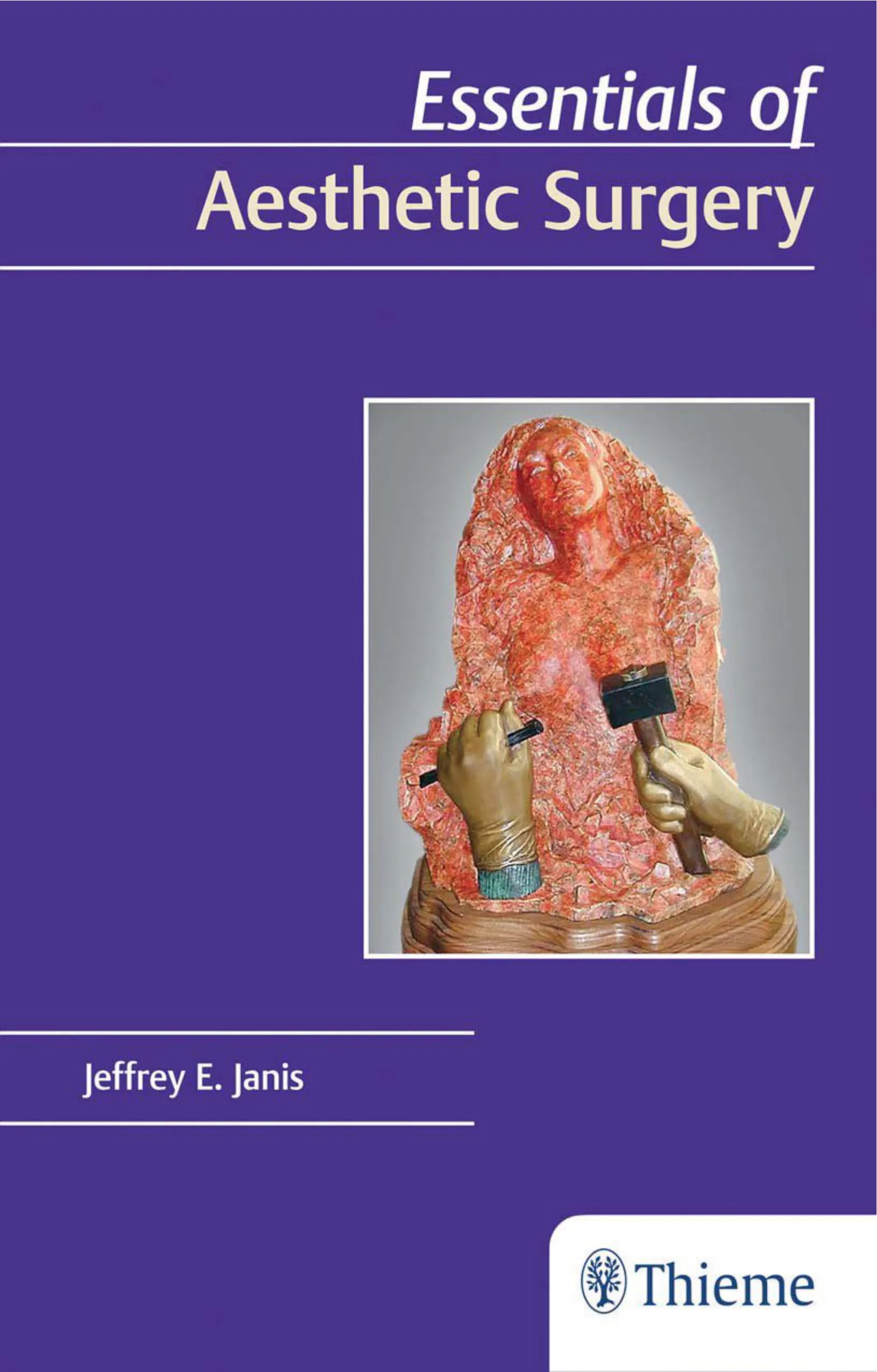


Essentials of Aesthetic Surgery Jeffrey E. Janis Thieme
(Trang không có chữ)
Essentials of
Aesthetic Surgery
(Trang không có chữ)
Edited by
Professor of Plastic Surgery, Neurosurgery,
Neurology, and Surgery;
Executive Vice Chairman, Department
of Plastic Surgery;
Chief of Plastic Surgery, University Hospitals;
President-Elect, American Society
of Plastic Surgeons;
The Ohio State University Wexner Medical Center,
Columbus, Ohio
With Illustrations by
Graeme Chambers
Amanda L. Tomasikiewicz, MA
Sarah J. Taylor, MS, BA
Jennifer N. Gentry, MA, CMI
Essentials of
Aesthetic Surgery
Managing Editor: Haley Paskalides
Director, Editorial Services: Mary Jo Casey
Production Editor: Sean Woznicki
International Production Director: Andreas Schabert
Editorial Director: Sue Hodgson
International Marketing Director: Fiona Henderson
International Sales Director: Louisa Turrell
Director of Institutional Sales: Adam Bernacki
Senior Vice President and Chief Operating Officer:
Sarah Vanderbilt
President: Brian D. Scanlan
Library of Congress Cataloging-in-Publication Data
Names: Janis, Jeffrey E., editor.
Title: Essentials of aesthetic surgery / [edited by] Jeffrey
E. Janis, MD, FACS, Professor of Plastic Surgery,
Neurosurgery, Neurology, and Surgery Executive Vice
Chairman, Departm ent of Plastic Surgery, Chief of
Plastic Surgery, University Hospitals, President-Elect,
American Society of Plastic Surgeons, Ohio State Uni-
versity Wexner Medical Center, Columbus, OH.
Description: New York : Thieme, [2018] | Includes biblio-
graphical references.
Identifiers: LCCN 2017054012 | ISBN 9781626236547
(paperback) | ISBN 9781626238671 (ebook)
Subjects: LCSH: Surgery, Plastic. | BISAC: MEDICAL /
Surgery / Plastic & Cosmetic. | MEDICAL / Surgery /
General.
Classification: LCC RD118 .E87 2018 | DDC 617.9/52—dc23
LC record available at
© 2018 Thieme Medical Publishers, Inc.
Thieme Publishers New York
333 Seventh Avenue, New York, NY 10001 USA
+1 800 782 3488, customerservice@thieme.com
Thieme Publishers Stuttgart
Rüdigerstrasse 14, 70469 Stuttgart, Germany
+49 [0]711 8931 421, customerservice@thieme.de
Thieme Publishers Delhi
A-12, Second Floor, Sector-2, Noida-201301
Uttar Pradesh, India
+91 120 45 566 00, custom erservice@thiem e.in
Thieme Publishers Rio, Thieme Publicações Ltda.
Edifício Rodolpho de Paoli, 25º andar
Av. Nilo Peçanha, 50 – Sala 2508
Rio de Janeiro 20020-906, Brasil
+55 21 3172 2297 / +55 21 3172-1896
Cover design: Thiem e Publishing Group
Typesetting by Debra Clark
Printed in India by Replika Press, Pvt Ltd.
5 4 3 2 1
ISBN 978-1-62623-654-7
Also available as an e-book:
eISBN 978-1-62623-867-1
This book, including all parts thereof, is legally protected
by copyright. Any use, exploitation, or commercialization
outside the narrow limits set by copyright legislation with-
out the publisher’s consent is illegal and liable to prosecu-
tion. This applies in particular to photostat reproduction,
copying, mimeographing or duplication of any kind, trans-
-
cessing and storage.
Im portant note: Medicine is an ever-changing science
undergoing continual development. Research and clinical
experience are continually expanding our knowledge, in
particular our knowledge of proper treatment and drug
therapy. Insofar as this book mentions any dosage or appli-
cation, readers may rest assured that the authors, editors,
and publishers have made every effort to ensure that such
references are in accordance with the state of knowledge
at the tim e of production of the book.
Nevertheless, this does not involve, imply, or express
any guarantee or responsibility on the part of the publish-
ers in respect to any dosage instructions and form s of ap-
plications stated in the book. Every user is requested to
exam ine carefully -
nying each drug and to check, if necessary in consultation
with a physician or specialist, whether the dosage sched-
ules mentioned therein or the contraindications stated by
the manufacturers differ from the statem ents made in the
present book. Such exam ination is particularly important
with drugs that are either rarely used or have been newly
released on the market. Every dosage schedule or every
form of application used is entirely at the user’s own risk
and responsibility. The authors and publishers request
every user to report to the publishers any discrepancies or
inaccuracies noticed. If errors in this work are found after
publication, errata will be posted at e.com on
the product description page.
Some of the product names, patents, and registered
designs referred to in this book are in fact registered trade-
ence to this fact is not always made in the text. Therefore,
the appearance of a name without designation as proprie-
tary is not to be construed as a representation by the pub-
lisher that it is in the public domain.
Cover photograph of the sculpture
”Surgical Aesthetic Art”
provided by the Ronadró Collection.
Additional sculptures by the artist can be found at
(Trang không có chữ)
To my wife, Emily, and my three children, Jackson, Brinkley, and Holden,
who are the center of my life and universe, and who give me the love, support,
understanding, and inspiration to do better, and be better, every day
(Trang không có chữ)
Contributors
ix
Paul N. Afrooz, MD
Aesthetic Surgery Fellow, Dallas Plastic
Surgery Institute, Dallas, Texas
Patricia Aitson
Medical Photography Supervisor,
Department of Plastic Surgery, University
of Texas Southwestern Medical Center,
Dallas, Texas
Amy Kathleen Alderman, MD, MPH
Private Practice, Alpharetta, Georgia
Tyler M. Angelos, MD, FACS
Columbus Aesthetic and Plastic Surgery,
Columbus, Ohio
Molly Burns Austin, MD
Dermatologist, Dermatology Consultants
of North Dallas, Dallas, Texas
James L. Baker, Jr., MD, FACS
Clinical Professor of Plastic Surgery,
University of South Florida, Tampa;
Professor of Surgery, College of Medicine,
University of Central Florida, Orlando,
Florida
Alfonso Barrera, MD, FACS
Clinical Assistant Professor of Plastic
Surgery, Baylor College of Medicine,
Houston, Texas
Daniel O. Beck, MD
Private Practice, Dallas Plastic Surgery
Institute, Dallas, Texas
Amanda Behr, MA, CMI, CCA, FAMI
Interim Chair and Program Director, Clinic
Director and Anaplastologist, Department
of Medical Illustration, Augusta University;
Augusta University Clinic for Prosthetic
Restoration, Augusta, Georgia
J. Byers Bowen, MD, MS
Independent Resident, Department of
Plastic and Reconstructive Surgery, The
Ohio State University Wexner Medical
Center, Columbus, Ohio
George Broughton II, MD, PhD, FACS
Regional Health Command Europe,
Faculty, Plastic and Reconstructive
Surgery, Landstuhl Regional Medical
Center, Landstuhl, Germany
Joseph M. Brown, MD
Plastic Surgeon and Medical Director,
Tampa Aesthetic and Plastic Surgery, Lutz,
Florida
Alton Jay Burns, MD
Dallas Plastic Surgery, Dallas, Texas
Michael R. Bykowski, MD
Resident, Department of Plastic Surgery,
University of Pittsburgh Medical Center,
Pittsburgh, Pennsylvania
Resident, Division of Plastic and
Reconstructive Surgery, Stanford
University Medical Center, Palo Alto,
California
Wendy Chen, MD, MS
Resident Physician, Department of Plastic
Surgery, University of Pittsburgh Medical
Center, Pittsburgh, Pennsylvania
William Pai-Dei Chen, MD
Clinical Professor of Ophthalmology, UCLA
School of Medicine, Los Angeles; Harbor
UCLA Medical Center, Irvine, California
x
Contributors
Christopher T. Chia, MD
Surgical Director, bodySCULPT; Clinical
Attending, Manhattan Eye, Ear, and Throat
Hospital, New York, New York
Plastic Surgeon, Private Practice,
Sieveking and Claiborne Plastic Surgery,
Nashville, Tennessee
Sydney R. Coleman, MD
Clinical Assistant Professor of Plastic
Surgery, Hansjörg Wyss Department
of Plastic Surgery, New York University
School of Medicine, New York University
Langone Medical Center, New York,
New York
Mark B. Constantian, MD, FACS
Adjunct Clinical Professor, Department
of Surgery, Division of Plastic and
Reconstructive Surgery, University of
Wisconsin School of Medicine, Madison,
Wisconsin; Visiting Professor, Department
of Plastic Surgery, University of Virginia
School of Medicine, Charlottesville,
Virginia
Michelle Coriddi, MD
Plastic Surgeon, Memorial Sloan Kettering
Cancer Center, Plastic and Reconstructive
Surgery Service, New York, New York
Plastic Surgeon, Private Practice,
Sugar Land, Texas
Lily Daniali, MD
Burn and Reconstructive Centers of
Colorado, Englewood, Colorado
Assistant Professor, Division of Plastic
Einstein, College of Medicine; The Atrium,
New York
Zoe Diana Draelos, MD
Consulting Professor, Department of
Dermatology, Duke University School of
Medicine, Durham, North Carolina
Dino R. Elyassnia, MD, FACS
Marten Clinic of Plastic Surgery, San
Francisco, California
Maristella S. Evangelista, MD, MBA
Assistant Professor, The Ohio State
University, Columbus, Ohio
Steve Fagien, MD, PA
Physician, Private Practice, Boca Raton,
Florida
Jordan P. Farkas, MD
Plastic Surgeon, Private Practice, Paramus,
New Jersey
Darrell Wayne Freeman, MD
Department of Plastic Surgery, The Ohio
State University, Columbus, Ohio
Brian H. Gander, MD
Assistant Professor, Division of Plastic
Surgery, University of Wisconsin, Madison,
Wisconsin
Ashkan Ghavami, MD
UCLA School of Medicine, Los Angeles;
Private Practice, Ghavami Plastic Surgery,
Beverly Hills, California
Grant Gilliland, MD
Physician, Baylor University Medical
Center, Waco; Texas A&M College of
Medicine, Dallas, Texas
†Mark Gorney, MD
Plastic Surgeon, Napa, California
†Deceased.
xi
Contributors
Miles Graivier, MD
Plastic Surgeon, The Graivier Center for
Plastic Surgery, Roswell, Georgia
James Christian Grotting, MD, FACS
Clinical Adjunct Professor, The University
of Alabama at Birmingham; Private
Practice, Grotting Plastic Surgery
Birmingham, Alabama; The University of
Wisconsin, Madison, Wisconsin
Associate Professor of Plastic Surgery, Co-
Director, Life After Weight Loss Program,
Department of Plastic Surgery, University
of Pittsburgh School of Medicine,
Pittsburgh, Pennsylvania
Bahman Guyuron, MD, FACS
Emeritus Professor, School of Medicine,
Case Western Reserve University,
Lyndhurst, Ohio
Richard Y. Ha, MD
Dallas Plastic Surgery Institute, Dallas,
Texas
Adam H. Hamawy, MD, FACS
Plastic Surgeon, Princeton Plastic
Surgeons, Princeton, New Jersey
Dennis C. Hammond, MD
Partners in Plastic Surgery, Grand Rapids,
Michigan
Christine Hamori, MD
Cosmetic Surgery and Skin Spa, Duxbury,
Massachusetts
Bridget Harrison, MD
Hand Surgery Fellow, UCLA School of
Medicine, Los Angeles, California
Ahmed M. Hashem, MD
Professor of Plastic Surgery, Cairo
University, Kasr Al-Ainy, Faculty of
Medicine, Cairo University, El Manial,
Cairo, Egypt
Professor and Chief, Division of Plastic and
Reconstructive Surgery, Stephen J. Mathes
Endowed Chair in Plastic Surgery, Division
of Plastic Surgery, University of California,
San Francisco, San Francisco, California
Ronald E. Hoxworth, MD, MBA, FACS
Chief of Plastic Surgery, University
Hospitals, University of Texas
Southwestern Medical Center, Dallas,
Texas
John H. Hulsen, MD
Plastic Surgeon, Associated Plastic
Surgeons, Leawood, Kansas
Joseph Hunstad, MD, FACS
President, The Hunstad Kortesis Center
for Cosmetic Plastic Sugergy; President,
The Internatonal Consortium of Aesthetic
Plastic Surgeons; Member, Board of
Directors, The American Society for
Aesthetic Plastic Surgery; Associate
Consulting Proessor, Division of Plastic
Surgery, The University of North Carolina,
Chapel Hill; Section Head of Plastic
Surgery, Department of Surgery, Carolinas
Medical Center, University Hospital,
Charlotte, North Carolina
Cedric L. Hunter, MD
Stanford University Medical Center, Palo
Alto, California
xii
Contributors
Professor of Plastic Surgery, Neurosurgery,
Neurology, and Surgery; Executive Vice
Chairman, Department of Plastic Surgery;
Chief of Plastic Surgery, University
Hospitals; President-Elect, American
Society of Plastic Surgeons; The Ohio
State University Wexner Medical Center,
Columbus, Ohio
Rishi Jindal, MD
Fellow, University of Pittsburgh Medical
Center, Pittsburgh, Pennsylvania
Visiting Professor of Surgery, Plastic and
Reconstruction, Illinois Cosmetic and
Plastic Surgery, Peoria, Illinois
Girish P. Joshi, MBBS, MD, FFARCSI
Professor of Anesthesiology and Pain
Management, University of Texas
Southwestern Medical Center, Dallas,
Texas
Evan B. Katzel, MD
University of Pittsburgh Medical Center,
Pittsburgh, Pennsylvania
Phillip D. Khan, MD
Plastic Surgeon, Lead Clinician, Coastal
Plastic Surgery, Supply, North Carolina
Sami U. Khan, MD, FACS
Associate Professor of Plastic Surgery,
Stony Brook Medicine, Stony Brook, New
York
Resident, Department of Plastic Surgery,
The Ohio State University Wexner Medical
Center, Columbus, Ohio
Rohit K. Khosla, MD
Division of Plastic and Reconstructive
Surgery, Stanford University, Palo Alto,
California
Kuylhee Kim, MD
Aesthetic and Reconstructive Breast
Surgery Fellow, Partners in Plastic Surgery
in West Michigan, Grand Rapids, Michigan
Janae L. Kittinger, MD
One Health Plastic and Reconstructive
Surgery, Owensboro, Kentucky
David M. Knize, MD
Associate Clinical Professor of Surgery,
Department of Plastic Surgery, University
of Colorado Health Sciences Center,
Colorado Springs, Colorado
Michael Larsen, MD
Department of Plastic Surgery, The
Ohio State University Medical Center,
Columbus, Ohio
Michael R. Lee, MD
Assistant Professor, Department of Plastic
Surgery, University of Texas Southwestern
Medical Center, Dallas, Texas
Jason E. Leedy, MD
Cleveland Plastic Surgery Institute,
Joshua Lemmon, MD
Private Practice, DFW Metroplex,
Richardson, Texas
Jerome H. Liu, MD, MSHS
Liu Plastic Surgery, Los Gatos, California
Assistant Professor, Anesthesiology, The
Ohio State University Wexner Medical
Center; Ear and Eye Institute Outpatient
Surgery Center, Columbus, Ohio
Chair, Division of Plastic, Reconstructive,
and Cosmetic Surgery, Mayo Clinic
Arizona, Phoenix, Arizona
xiii
Contributors
Alexey M. Markelov MD
Private Practice, Coos Bay, Oregon;
Clinical Assistant Professor, The Ohio State
University, Columbus, Ohio
Constantino G. Mendieta, MD
Surgeon, Private Practice, Miami, Florida
Joseph Meyerson, MD
Resident, The Ohio State University
Wexner Medical Center, Columbus, Ohio
Cecilia Alejandra Garcia de Mitchell, MD
Division Chief, Plastic Surgeon, The
Faculty Department of Surgery, Baylor
College of Medicine; Adjunct Assistant
Professor, Department of Surgery, Division
of Plastic Surgery, University of Texas
Health Science Center, San Antonio, Texas
Girish S. Munavalli, MD, MHS
Medical Director, Dermatology, Laser, and
Vein Specialists of the Carolinas, Charlotte;
Assistant Professor, Department of
Dermatology, Wake Forest University
School of Medicine, Winston Salem, North
Carolina
Purushottam A. Nagarkar, MD
Assistant Professor, Department of Plastic
Surgery, University of Texas Southwestern
Medical Center, Dallas, Texas
Foad Nahai, MD, FACS
Maurice Jurkiewicz Chair in Plastic Surgery
and Professor of Surgery, Division of
Plastic and Reconstructive Surgery,
Department of Surgery, Emory University
School of Medicine, Atlanta, Georgia
Christopher J. Pannucci, MD, MS
Assistant Professor, Division of Plastic
Surgery, University of Utah, Salt Lake City,
Utah
Thornwell H. Parker III, MD
Volunteer Faculty, Department of Plastic
Surgery, University of Texas Southwestern
Plastic Surgery, Texas Health Presbyterian
Hospital of Dallas, Dallas, Texas
Harlan Pollock, MD, FACS
Instructor, Retired, University of Texas
Southwestern, Dallas, Texas
Todd A. Pollock, MD, FACS
Surgeon, University of Texas Southwestern
Medical Center, Dallas, Texas
Jason K. Potter, MD, DDS
Dallas Plastic Surgery Institute, Dallas,
Texas
Smita R. Ramanadham, MD
Attending Surgeon, Division of Plastic
Surgery, Boston Medical Center;
Assistant Professor of Surgery, Boston
University School of Medicine, Boston,
Massachusetts
Neal R. Reisman, MD, JD, FACS
Clinical Professor, Plastic Surgery, Baylor
College of Medicine, Houston, Texas
Juan L. Rendon, MD, PhD
State University Wexner Medical Center,
Columbus, Ohio
Luis M. Rios, Jr.
Adjunct Clinical Professor, Department of
Surgery, University of Texas Health Science
Center, Edinburg, Texas
Edward J. Ruane, Jr., MD
Resident, Department of Plastic Surgery,
University of Pittsburgh, Pittsburgh,
Pennsylvania
xiv
Contributors
Christopher J. Salgado, MD
Professor of Surgery and Interim Chief,
Division of Plastic Surgery, Section Chief,
University of Miami Hospital; Medical
Director, LGBTQ Center for Wellness,
Gender and Sexual Health, University of
Florida
Renato Saltz, MD
Saltz Plastic Surgery, Salt Lake City, Utah
President, Austin-Weston, The Center for
Cosmetic Surgery, Inova Fairfax Hospital,
Reston, Virgnia
Sammy Sinno, MD
TLKM Plastic Surgery, Chicago, Illinois
Wesley N. Sivak, MD, PhD
Resident, Department of Plastic Surgery,
University of Pittsburgh, Pittsburgh,
Pennsylvania
Christopher Chase Surek, MD
Aesthetic Surgery Fellow, Department
of Plastic Surgery, Cleveland Clinic,
Cleveland, Ohio
Sumeet Sorel Teotia, MD
Associate Professor, Plastic Surgery,
University of Texas Southwestern Medical
Center, Dallas, Texas
Edward O. Terino, MD
CEO and President, Plastic Surgery
Institute, Agoura Hills, California
Spero J. Theodorou, MD
Instructor, Aesthetic Plastic Surgery
Fellowship, Manhattan Eye, Ear, and Throat
Hospital, New York, New York
Charles H. Thorne, MD
Chairman, Department of Plastic Surgery,
Lenox Hill Hospital; Manhattan Eye, Ear,
and Throat Hospital, New York, New York
Dean M. Toriumi, MD
Professor, Department of Otolaryngology,
University of Illinois at Chicago, Chicago,
Illinois
Derek Ulvila, MD
Aesthetic Plastic Surgery Fellow,
Manhattan Eye, Ear, and Throat Hospital,
New York, New York
Simeon H. Wall, Jr., MD, FACS
Private Practice, The Wall Center for Plastic
Surgery; Assistant Clinical Professor,
Department of Plastic Surgery, University
of Texas Southwestern Medical Center,
Dallas, Texas; Assistant Clinical Professor,
Division of Plastic Surgery, Louisiana State
University Health Sciences Center at
Shreveport, Shreveport, Louisiana
Ted H. Wojno, MD
Director, Oculoplastic and Orbital Surgery,
Department of Ophthalmology, The
Emory Clinic; Professor of Ophthalmology,
Emory University School of Medicine, The
Emory Clinic, Atlanta, Georgia
Vernon Leroy Young, MD
Private Practice, Washington, Missouri
James E. Zins, MD
Chairman, Department of Plastic Surgery,
Cleveland Clinic, Cleveland, Ohio
Terri A. Zomerlei, MD
Resident, Department of Plastic Surgery,
The Ohio State University, Columbus, Ohio
xv
Foreword
his career with interest and admiration ever since. It was clear to me immediately that
he had leadership qualities, a commitment to teaching, and academics and most of all
excellence as a clinician. He very quickly became a contributor, educator and innovator.
His published works, his many international and national presentations attest to his
commitment to teaching and his leadership qualities were recently recognized as he
assumed the presidency of the American Society of Plastic Surgeons.
The idea behind Essentials of Aesthetic Surgery has been in gestation for many years and it
is exciting to see the concept come to fruition. The intent is to provide a detailed guide to
Essentials of
Plastic Surgery, now in its second edition. Although there are some chapters in the Essentials
of Plastic Surgery that cover aesthetic surgery, this new book has vastly deeper and wider,
Essentials and covering the full spectrum of procedures in the face and body. The book has
been thoughtfully structured to maximize learning with signature bulleted text and clear,
memorable line drawings. It is published with an e-book version ideal for use by readers
on-the-go and who may not wish to carry the print version with them.
A new concept, and unique to this text, is that most chapters are authored by a younger
plastic surgeon working with one who has been in practice far longer. The younger author
would be more aware of the needs of those in the early years in practice as well as those in
training. The senior author with more years of experience has the long-term perspective of
surgeon brings valuable perspective to each chapter in the book and sets this book apart
from the others in its class.
xvi
Foreword
ASAPS statistics indicate the undiminished growth of aesthetic surgery, with patient
More and more trainees aspiring to a career in
aesthetic surgery, as evidenced by diplomates of the American Board of Plastic Surgery,
provides an invaluable educational resource, guide, and companion to those seeking
the core facts—a treasure trove of knowledge distilled by Dr. Janis and his team of highly
regarded contributors. It is my distinct pleasure to recommend this volume as the perfect
dedication and skill in putting the volume together.
Foad Nahai, MD, FACS
Maurice Jurkiewicz Chair in Plastic Surgery
and Professor of Surgery, Division of Plastic
and Reconstructive Surgery, Department
of Surgery, Emory University School of Medicine,
Atlanta, Georgia
xvii
Preface
Essentials of Plastic
Surgery
one step further by focusing on aesthetic surgery, dedicating a book to it in the same
stylistic vein as the parent title—with high-point and high-impact information that was
current and relevant, presented in bullet-point format with references to classic articles
to contribute. The concept was to present the information comprehensively but concisely
and to supplement it with “color commentary” from experienced surgeons who can add
a three-dimensionality to the work by adding decades of experience—things known, but
not necessarily written down all the time. Ultimately, despite a decade in the making, the
book is now in your hands as the culmination of so many hands and minds, hopefully as a
valuable and practical guide to the world of cosmetic surgery.
into nine parts—from Skin Care to Noninvasive Modalities to Surgical Approaches and
everything in between. Each chapter follows the same basic format for ease of familiarity
and readability. The common topics are covered, of course, such as facelift, necklift,
blepharoplasty, rhinoplasty, breast augmentation, liposuction, abdominoplasty, thigh
lift, and beyond. However, deep dive chapters are provided to get into the detail required
to truly master the content—such as correction of the tear trough deformity, lateral
canthopexy, Asian blepharoplasty, secondary and ethnic rhinoplasty, the nasolabial
fold, lip augmentation, nonsurgical rejuvenation, augmentation-mastopexy, gluteal
augmentation, genital surgery, and transgender surgery. Furthermore, there are topics
covered to round out the utility and comprehensive approach to cosmetic surgery, such as
proper patient selection, safety considerations, the artistry of aesthetic surgery, anesthesia
considerations, multimodal analgesia, and photography.
information to the reader. An online version was developed to make it more universal,
accessible, and current. Top Takeaways were added to the end of each chapter to
summarize the content for the quick hit review.
The true test of its utility, however, will be whether it sits on your shelf or in your pocket.
rounds, in the clinic, in the operating room, in the conference room, or in the emergency
you’ve come to expect from an Essentials book.
(Trang không có chữ)
xix
Acknowledgments
Without question, this book could not have been possible without a tremendous number
Thieme Publishers, so clearly there are many to acknowledge.
Without question, I owe a tremendous debt of gratitude to the authors across the country
who have taken an incredible amount of time out of their busy practices and lives to
carefully comb and review the literature in order to create and construct these high quality
chapters. Their careful attention to detail was matched by their patience as they endured
a lengthy and rigorous editing process where every word and illustration was carefully
scrutinized. As they will clearly attest, meticulous attention to detail and emphasis on
quality and accuracy demanded much energy, persistence and determination. To them, I
Sincere appreciation also is owed to Karen Berger, Michelle Berger, Andrew Berger, and
Sue Hodgson, without whom this book would never be possible, and Judith Tomat who
who deserve an amazing amount of credit for all of the graphics that were drawn from
Most importantly, and with the deepest and most sincere appreciation, I would like to
thank my wife, Emily, and our three children Jackson, Brinkley, and Holden, all of whom
were born during the creation of this book, for their understanding and patience during
the years, allowing the time and travel to complete this book, and above all else, for their
unconditional love and support. Without them, this book would not be possible, and my
life would be empty.
(Trang không có chữ)
Contents
FOREWORD
XV
Foad Nahai
PART I BASIC CONSIDERATIONS
1 THE AESTHETIC SURGERY PATIENT 3
Adam H. Hamawy, Foad Nahai
2 THE ARTISTRY OF PLASTIC SURGERY 13
Sumeet Sorel Teotia, Mark B. Constantian
3 PHOTOGRAPHY FOR THE AESTHETIC SURGEON 21
4 MEDICOLEGAL CONSIDERATIONS IN AESTHETIC SURGERY 43
Mark Gorney, Neal R. Reisman
PART II ANESTHESIA
5 BASICS OF ANESTHESIA FOR THE AESTHETIC SURGERY PATIENT 59
6 PERIOPERATIVE ANESTHESIA CONSIDERATIONS FOR THE AESTHETIC SURGERY
PATIENT 85
Deborah Stahl Lowery
7 PROCEDURE-SPECIFIC ANESTHESIA GUIDELINES FOR THE AESTHETIC SURGERY
PATIENT 95
Deborah Stahl Lowery
8 MULTIMODAL ANALGESIA FOR THE AESTHETIC SURGERY PATIENT 107
xxi
xxii
Contents
PART III SAFETY
9 SAFETY CONSIDERATIONS IN AESTHETIC SURGERY 119
10 DECREASING COMPLICATIONS IN AESTHETIC SURGERY 143
11 VENOUS THROMBOEMBOLISM AND THE AESTHETIC SURGERY PATIENT 160
Christopher J. Pannucci, Amy Kathleen Alderman
PART IV SKIN CARE
12 THE MEDI SPA AND OTHER PRACTICE CONSIDERATIONS 171
Rishi Jindal, Renato Saltz
13 ANATOMY, PHYSIOLOGY, AND DISORDERS OF THE SKIN 181
Thornwell H. Parker III, Molly Burns Austin, Alton Jay Burns
14 COSMECEUTICALS AND OTHER OFFICE PRODUCTS 191
Sammy Sinno, Zoe Diana Draelos
15 ETHNIC SKIN CARE 197
Sammy Sinno, Zoe Diana Draelos
PART V NONINVASIVE AND MINIMALLY INVASIVE THERAPY
16 BASICS OF LASER THERAPY 205
Darrell Wayne Freeman, Ibrahim Khansa, Molly Burns Austin, Alton Jay Burns
17 ABLATIVE LASER RESURFACING 212
Darrell Wayne Freeman, Molly Burns Austin, Alton Jay Burns
18 NONABLATIVE LASER RESURFACING 223
Ibrahim Khansa, Molly Burns Austin, Alton Jay Burns
19 CHEMICAL PEELS 231
George Broughton II, Ahmed M. Hashem, Christopher Chase Surek, James E. Zins
20 DERMABRASION 259
George Broughton II, James L. Baker, Jr.
21 BOTULINUM TOXIN 269
Joshua Lemmon, Smita R. Ramanadham, Miles Graivier
22 SOFT TISSUE FILLERS 280
Ashkan Ghavami, Miles Graivier
xxiii
Contents
23 FAT GRAFTING 297
George Broughton II, Sydney R. Coleman
24 TREATMENT OF PROMINENT VEINS 313
Edward J. Ruane, Girish S. Munavalli
PART VI ADJUNCTS TO AESTHETIC SURGERY
25 TISSUE GLUES 323
Joseph Meyerson, Renato Saltz
26 FIXATION DEVICES 329
Brian H. Gander, Renato Saltz
27 IMPLANTS AND ALLOPLASTS (NONBREAST) 335
Jason K. Potter, Edward O. Terino
28 PROGRESSIVE TENSION SUTURES 344
Terri A. Zomerlei, Todd A. Pollock, Harlan Pollock
PART VII FACIAL SURGERY
29 PERIORBITAL ANATOMY 355
Jason K. Potter, Grant Gilliland
30 FACE AND NECK ANATOMY 372
31 FACIAL ANALYSIS 390
Janae L. Kittinger, Raman C. Mahabir
32 HAIR TRANSPLANTATION 402
33 BROWLIFT 411
Joshua Lemmon, Michael R. Lee, David M. Knize
34 UPPER BLEPHAROPLASTY 429
Ashkan Ghavami, Foad Nahai
35 LOWER BLEPHAROPLASTY 451
Jason K. Potter, Ted H. Wojno
36 ASIAN BLEPHAROPLASTY 462
Jerome H. Liu, Richard Y. Ha, Lily Daniali, William Pai-Dei Chen
37 CORRECTION OF THE TEAR TROUGH DEFORMITY 482
Jason K. Potter, Grant Gilliland
xxiv
Contents
38 LATERAL CANTHOPEXY 490
Jason K. Potter, Steve Fagien
39 BLEPHAROPTOSIS 498
Jason E. Leedy, Jordan P. Farkas
40 MIDFACE REJUVENATION 509
Sumeet Sorel Teotia, Sami U. Khan, Foad Nahai
41 PERIORAL REJUVENATION 528
Alexey M. Markelov, Molly Burns Austin, Alton Jay Burns
42 FACELIFT 540
Adam H. Hamawy, Dino R. Elyassnia
43 NASOLABIAL FOLD 551
Sumeet Sorel Teotia, Maristella S. Evangelista
44 NECKLIFT 565
Sumeet Sorel Teotia, Foad Nahai
45 RHINOPLASTY 581
46 SECONDARY RHINOPLASTY 620
Richard Y. Ha, Lily Daniali, Cecilia Alejandra Garcia de Mitchell, Bahman Guyuron
47 ETHNIC RHINOPLASTY 634
Paul N. Afrooz, Dean M. Toriumi
48 LIP AUGMENTATION 645
Michael Larsen, Robert K. Sigal
49 GENIOPLASTY 676
Ashkan Ghavami, Bahman Guyuron
50 OTOPLASTY 691
PART VIII BREAST SURGERY
51 BREAST ANATOMY 711
Melissa A. Crosby, Glyn Jones
52 BREAST AUGMENTATION 723
xxv
Contents
53 MASTOPEXY 751
Joshua Lemmon, Smita R. Ramanadham, James Christian Grotting
54 AUGMENTATION-MASTOPEXY 763
Purushottam A. Nagarkar
55 BREAST REDUCTION 769
Joshua Lemmon, Michael R. Lee, Daniel O. Beck, Elizabeth Hall-Findlay
56 GYNECOMASTIA 789
Ronald E. Hoxworth, Kuylhee Kim, Dennis C. Hammond
PART IX BODY CONTOURING
57 LIPOSUCTION 799
58 BRACHIOPLASTY 818
59 BUTTOCK AUGMENTATION 828
Sammy Sinno, Constantino G. Mendieta
60 ABDOMINOPLASTY 837
Wesley N. Sivak, Luis M. Rios, Jr., James Christian Grotting
61 MEDIAL THIGH LIFT 856
62 BODY CONTOURING IN MASSIVE-WEIGHT-LOSS PATIENTS 869
63 FEMALE GENITAL AESTHETIC SURGERY 887
Phillip D. Khan, Christine Hamori
64 NONINVASIVE BODY CONTOURING 927
Michael Bykowski, Derek Ulvila, Spero J. Theodorou, Christopher T. Chia
65 AESTHETICS OF GENDER AFFIRMATION SURGERY 934
Juan L. Rendon, Christopher J. Salgado
CREDITS 957
INDEX 965
(Trang không có chữ)
Essentials of
Aesthetic Surgery
(Trang không có chữ)
PART I
Basic Considerations
(Trang không có chữ)
3
SENIOR AUTHOR TIP: Cosmetic surgery is elective and rarely addresses medical
conditions, but it restores or improves physical features that are concerning to patients.
Although the request for aesthetic surgery is most commonly associated with aging, some
patients seek improvement of normal anatomic structures to enhance their appearance.
DEMOGRAPHICS AND STATISTICS1,2
Interest in cosmetic procedures continues to increase with over $15 million spent
annually in the United States for combined surgical and nonsurgical procedures.
91% are women, and 9% are men.
Approximately 25% of cosmetic patients are minorities.
Approximately 40% of cosmetic patients are 35-55 years of age.
Approximately 50% of patients have multiple procedures.
• 47% of patients have multiple procedures performed simultaneously.
ROLE OF THE AESTHETIC SURGEON
Is a and an aesthetic surgeon second
Acts as a physician, therapist, and artist:
• Physician:
•
• Considers aesthetic objectives. Will not go against aesthetic sense
Must have a clear understanding of patient’s motivation and expectations before surgery
Ultimately concerned with the patient’s welfare
An experienced aesthetic surgeon should be able to recognize
and Many patients seeking aesthetic surgery are excellent
candidates and do well postoperatively despite taking antidepressants.
3
A well-informed patient is a happy patient.
PATIENT CHARACTERISTICS
Consults several surgeons before making decision, compares factors
Takes considerable time during consultation and may have many questions
about multiple problems
Has already decided exactly what he or she wants and is looking to see if
surgeon can do it
Does not talk much and wants surgeon to explain everything and make
the decisions
Adam H. Hamawy, Foad Nahai
4
Part I Basic Considerations
PATIENT CONSULTATION
INTRODUCTION AND FIRST IMPRESSION
Patients may be nervous and insecure about their appearance.
Personal conversation at the beginning of the consultation helps to relax patients and
establish rapport.
The surgeon should begin immediately assessing the patient’s general appearance,
demeanor, and behavior during the initial interaction.
The initial introduction should also establish why the patient is there to see the surgeon
and what their aesthetic concerns are.
4
SENIOR AUTHOR TIP: Today most patients come in for a consultation having
researched on the Internet and most likely consulted with other physicians. After an
introduction and “small talk” designed to put patients at ease, I will ask how much they
know about the procedure they are interested in. After they respond, I will add that I will
provide them all the information I feel is important in making a decision.
HEALTH HISTORY
Baseline health, comorbidities, tobacco use, prior surgeries, and prior pregnancies are
determined.
Surgical risk is carefully assessed based on medical history and desired procedure.
Health criteria for aesthetic surgery should be at least as stringent as those for
reconstructive cases because of the strictly elective nature.
Surgery may be deemed inappropriate for unhealthy patients and those with a high risk
of complications.
SENIOR AUTHOR TIP: Patients often ask me if they are too old for a facelift. I tell them
there is no such thing as “too old for a procedure”; it is not age that counts but general
health. The question should be, “Am I healthy enough for a facelift?” I am also asked,
“Am I too young for a facelift.” My answer is that there is no set age. If I think the patient
will see an improvement, I will recommend a facelift regardless of age.
SENIOR AUTHOR TIP:
issues for fear of being turned down. For facial rejuvenation, I usually ask about smoking
history. If they say, “I do not smoke,” I will ask if they ever have in the past and, if so,
for how long and how heavily. I repeatedly ask about high blood pressure, because I
believe untreated and or unrecognized hypertension is the major contributing factor
to hematoma after facial rejuvenation. When patients are asked about prior surgery,
aesthetic procedures.
5
Chapter 1 The Aesthetic Surgery Patient
PSYCHOLOGICAL EVALUATION4
psychopathology.
• Cosmetic surgery may improve symptoms in some patients with psychological
conditions like depression or neurosis.
• Certain groups consistently are shown to do poorly after aesthetic procedures.
suitable recommendations.5 Psychiatric consultation should be obtained when appropriate.
Aesthetic surgeons determine how closely a patient’s self-image matches the true
image and decide if the patient’s self-image can be improved with surgery performed
on the true image.
6
SENIOR AUTHOR TIP: I like to determine the motivation behind the desire for surgery.
Is the patient doing this for himself or herself? Are there hidden agendas such as saving a
failing marriage, wishing to please a partner or parent? I advise my patients they should
do it for themselves and not for anyone else. An otherwise excellent surgical result may
lead to patient disappointment if it does not meet the hidden agenda. A more youthful
face or shapely body may not save a failing marriage or push a boyfriend or girlfriend
into a proposal. Why patients seek a procedure and who they are trying to please may
not always be readily apparent, but it is important for surgeons to know.
PSYCHOLOGICAL INDICATORS
long time.
• Patient generally feels good about himself or herself, is aging, and wants to look
younger.
• Patient impulsively decided on cosmetic surgery and has considered it for only a
brief period of time.
• Patient has excessively “shopped” for surgeons. Patients who are still uncertain after
• Patient is being treated for multiple psychiatric illnesses and/or history of numerous
psychiatric admissions.
MOTIVATION
Intensity of motivation positively correlates with satisfaction and shorter recovery and
negatively correlates with postoperative pain.
Patients seeking cosmetic surgery are motivated by or pressures.
• Patients with are generally better candidates than those with
external motives.
• Patients with internal motives desire change for themselves and usually feel
6
Part I Basic Considerations
defect alleviates the anxiety.
CAUTION:
• Patients with seek to please others who think that physical
change will result in a social change (e.g., improve a relationship, save a marriage,
advance a career).
PSYCHOLOGICAL CONDITIONS
7-9
• The encountered psychological disorder in cosmetic patients
• Can be transient as a reaction to grief or a persistent pathological process. Patients
have minimal joy and poor motivation and consistently appear tired.
• When treated and controlled, depressed patients make great surgical candidates
and may show additional improvement of symptoms with cosmetic surgery.
SENIOR AUTHOR TIP: A significant number of my patients undergoing facial
rejuvenation take antidepressants. They do well and recover as rapidly and are as
pleased as those who do not take antidepressants. Though concerns have been raised
that selective serotonin reuptake inhibitor (SSRI) antidepressants may increase the risk
of hematoma, this has not been my experience.
• Personality disorders present usually with behavioral issues. Some personality disorders
are not well suited for cosmetic surgery, and psychiatric evaluations may be
warranted before proceeding.
• take good care of their appearance and are obsessed with
subtle or unperceived imperfections. They have pompous opinions of themselves
and are often “name droppers.” They are prone to postoperative depression and
dissatisfaction.
• are emotional and have an intense need for attention. They have
volatile emotional responses and may laugh or cry easily. They use their emotional
displays to control others. They are usually noncompliant with instructions and late
histrionic patient will seek praise, approval, and reassurance.
• are socially withdrawn and eccentric. They are unable to
evaluation. They make few comments and do not elaborate on their responses.
example, a patient might explain the reason for desiring surgery as, “I just want to
look that way.”
7
Chapter 1 The Aesthetic Surgery Patient
• Patients with a are preoccupied with suspicion and have
others for any misfortune. They usually are secretive and can be argumentative
and moralistic. During evaluation they may be very guarded and businesslike with
• are characterized by being exceptionally concerned or anxious,
having somatic complaints. They usually ask multiple, repetitive questions and
expect detailed, technical responses. They are often obsessed and well read about
all possible complications. A neurotic patient will get very defensive if not addressed
seriously. But, with reassurance and proper preoperative counseling, they are usually
good surgical candidates and are happy with the results.
• Characterized by:
• Estimated incidence is 0.2% of the general population but
• Take constant precautions to hide their focus of concern with clothing, makeup, and
body position
• May accompany other disorders, including major depression, obsessive-compulsive
disorder, and eating disorders
CAUTION:
SENIOR AUTHOR TIP: A thorough evaluation of a patient’s motivation and
mental state, as described above, is essential and a predictor of patient behavior
postoperatively. Turning down or referring patients for psychological evaluation is rare
in my practice. Referral for evaluation has to be handled delicately so a patient does not
have the impression that I think he or she is unstable. Turning down a patient also has
to be handled with sensitivity. I tell the few patients I turn down that I am aware of their
concerns but do not think I am able to address them to their satisfaction.
PHYSICAL EVALUATION
A patient’s physical appearance must correlate with the health history.
A focused physical examination of the area of concern, with objective documentation
of any deviation from the aesthetic norm, is performed and appropriate measurements
are obtained when possible.
Adjacent anatomic areas are examined to determine whether they contribute to the
Patients seeking cosmetic surgery of the breasts or body should disrobe appropriately
to allow a complete examination. Surgeons should be cautious with patients who will
not disrobe to allow proper examination.
8
Part I Basic Considerations
TIP: A chaperone should always be in the room during the physical examination of
sensitive body areas.
patient and documented.
REJECTION
After psychological and physical evaluation, surgical eligibility can be decided (Fig. 1-1).
••••••••••••••••••••••••••••••••••••
••••••••••••••••••••••••••••••••••••
C
o
n
c
e
r
n
5
4
3
2
1
Deformity
1
2
3
4
5
PATIENT SELECTION GUIDE
Surgical eligibility guide. The vertical axis represents the degree of the patient’s concern
regarding the problem, from 1 (minimal) to 5 (maximal). The horizontal axis represents the
surgeon’s objective evaluation of the nature of the complaint, from 1 (minimal) to 5 (maximal).
Most applicants are categorized within the area between the diagonal dotted lines. The closer to
the upper left corner, the more likely the possibility of patient dissatisfaction regardless of quality
of result. The converse is true of patients categorized in the lower right corner. From experience,
we suggest keeping this scheme on the back page of each patient’s record in simple diagrammatic
surgeons and websites, this record will help a surgeon or an associate remember original
impressions. Experience shows that this helps to keep us out of trouble.
to the surgeon.
by surgery.
• The
• The
• The patient has
• The patient’s comorbidities deem them to be for elective surgery.
Aesthetic surgeons should listen to their instincts and not proceed if they are uneasy
about the patient or the surgery.
For patients with unrealistic goals, surgeons should attempt to clarify that these results
are not achievable.
TIP: To prevent confrontation, if a persistent patient insists on proceeding with
surgery, the surgeon can claim that he or she is not able to achieve the desired results.
9
Chapter 1 The Aesthetic Surgery Patient
PREPARING FOR SURGERY
is critical in preventing disappointment postoperatively.
language that patients can easily understand.
Patients are informed about what to expect after surgery.
• Thorough counseling on all risks of the procedure
• Clear description of the location and length of expected scars
• Realistic timeline for recovery and downtime
• Express guarantees should not be made.
• All discussions documented, with detailed informed consent forms
for preoperative planning and documentation of
surgical alteration.
• It is the only postoperative record of a patient’s preoperative appearance for
comparison.
• Photographs can be used to demonstrate the aesthetic deformity to the patient
from multiple views that are not possible to observe in a mirror.
CAUTION:
Preoperative imaging, testing, and/or medical clearance are arranged, as indicated.
If appropriate, it may be necessary to see the patient again before operating to ensure
understanding, review preoperative testing and consultation results, and answer
additional concerns or questions.
SENIOR AUTHOR TIP: Patients like to have lists of dos and don’ts before surgery.
Video imaging has proved a useful tool in my practice, not only to show patients what
the anticipated result might be, but also to indicate to me the patient’s expectations.
Most patients think that plastic surgery and cosmetic surgery in particular leave no
scars! I emphasize the length and location of the scars while explaining that our goal is
to place the scars to be least noticed.
THE DAY OF SURGERY
• The patient is examined and marked preoperatively.
markings is helpful.
• Final questions about the procedure and recovery are answered.
• The patient and accompanying family are reassured. It is normal for them to be
nervous and have last-minute reservations.
• All operative goals are restated.
10
Part I Basic Considerations
SENIOR AUTHOR TIP: After explaining the procedure again, describing the scars,
and marking the patient, I always ask if we left anything out. Are we adding anything?
Too many patients wake up thinking they had less performed than they had requested,
and some ask, while being prepped preoperatively, that we remove moles or undertake
separate aesthetic procedures.
I always tell the family that I will personally come out and talk with or call them after
rushed through the procedure, and if it takes longer, it does not mean that the patient
or I had a problem. For long procedures or and those that take longer than scheduled,
I ask the circulating nurse to call and update the family.
• The patient is covered to maintain modesty and provide warmth.
induction.
• The waiting family is frequently given progress reports.
• A clean and neat dressing is carefully applied to cover the surgical site.
SENIOR AUTHOR TIP: I always like to be in the operating room and if appropriate
hold the patient’s hand as anesthesia is being induced. A time-out is mandatory for all
surgeries, even cosmetic ones.
• Reassuring and talking with the patient in the recovery room is important.
• The surgeon should visit the waiting spouse or family or call them if they are not
readily available.
• The patient is seen again before discharge or that evening in the room if he or she is
staying overnight.
• Being repetitive with the patient
and family is essential.
• The patient is called that evening at home or in the hospital room.
POSTOPERATIVE CARE
Patients are seen within 1 or 2 days or called at home postoperatively for a progress report.
Patients are reassured that wounds are healing normally.
Patients are typically seen at 1, 3, 6, and 12 months, then annually, assuming no
complications.
Photos are obtained at 6-12 months postoperatively.
Progress of long-term results is explained.
RECOVERY AFTER COSMETIC SURGERY
up to 1 year (rhinoplasty).
• Patients are informed of the expected time course for resolution before surgery and
at each follow-up visit (Figs. 1-2 and 1-3).
11
Chapter 1 The Aesthetic Surgery Patient
• Edema and ecchymosis are to be
expected after any procedure.
• Surgeons should give reassurance that
results will continue to improve over
time, as appropriate.
from cosmetic surgery.
and maintaining a calm demeanor
to reassure them what is normal are
essential.
wide range of emotions in the
postoperative period, characterized
by the following commonly heard
comments:
“I wish it was a month
from now.”
– Days 1-3: “I’m beat.” Patient
is exhausted, sleepy.
– Days 4-7: “What did I do?”
Patient is sad, irritated, angry.
“You should have told me about. . .” Patient is critical, nitpicky,
scared, impatient, complaining.
“Not too bad. . .” Patient begins to normalize and see results.
“You look great.” Patient notices others’ reactions and
compliments and begins to feel good about surgery.
“But what about. . .” As most of the swelling and bruising resolve,
some focal areas may lag in recovery or may not appear as expected.
“Wow, I love it.”
“What’s next?”
SENIOR AUTHOR TIP: Surgeons should be supportive with patients who have a
complication or delayed recovery, seeing and calling them often, and explaining the
course of their care as the problem resolves. I reassure patients with complications
result.
MAINTENANCE COUNSELING
will improve patient satisfaction in the long term and allow
patients to be a partner in the aesthetic improvement process.
Keeping a healthy lifestyle and sustaining good habits will augment the results of
cosmetic procedures beyond what can be achieved surgically.
Information for physical training and nutritional counseling is provided, if needed.
in enhancing the results and
preserving longevity.
3 days
1 week
3 weeks
6 weeks
3 months
Physical recovery. Times may vary
depending on the procedure.
Surgery
1 wk
Day 1
Day 2
Day 3
“Better”
“Really swollen”
“Resolving”
“Almost Gone”
“Gone”
3 wks
6 wks
3 months
Edema curve. The time range
may vary depending on the procedure.
12
Part I Basic Considerations
REVISIONS
A clear, documented revision policy should be agreed on
Adequate time for healing and resolution of edema is allowed before considering
revision. The following timeframes are useful guidelines:
• Wait at least 6 months
• Wait at least 12 months
• Wait 3-6 months
• Wait 6-12 months
• Wait at least 3 months
Surgeons should “see” and clearly understand what needs to be revised and the
expected goals of revision.
Patients should have of what can be achieved with a revision.
TOP TAKEAWAYS
Contrary to the perception of most patients, aesthetic surgery and cosmetic
medicine is not a commodity. It is a very personal service based on a
professional relationship between the patient and surgeon—a partnership based
on mutual trust, mutual respect, and a common goal.
surgical skills, and aesthetic sense.
Most patients shop around and pick a surgeon based on price, reputation,
a surgeon they are “comfortable” with. Similarly, operating on patients with
whom we are not comfortable or have not established rapport preoperatively
REFERENCES
1. 2016 Cosmetic Surgery National Databank Statistics. American Society for Aesthetic Plastic
Surgery. Available at
2. 2015 Plastic Surgery Statistics Report. American Society of Plastic Surgeons. Available at https://
3. Rohrich RJ. Streamlining cosmetic surgery patient selection—just say no! Plast Reconstr Surg
104:220, 1999.
4. Rohrich RJ. The who, what, when, and why of cosmetic surgery: do our patients need a
preoperative psychiatric evaluation? Plast Reconstr Surg 106:1605, 2000.
5. Gorney M. Recognition and management of the patient unsuitable for aesthetic surgery. Plast
Reconstr Surg 126:2268, 2010.
6. Ferraro GA, Rossano F, D’Andrea F. Self-perception and self-esteem of patients seeking cosmetic
surgery. Aesthetic Plast Surg 29:184, 2005.
7. Nahai F. Evaluating the cosmetic patient on antidepressants. Aesthet Surg J 34:326, 2014.
8. Nahai F. What is aesthetic surgery, anyway? Aesthet Surg J 30:874, 2010.
9. Nahai F, ed. The Art of Aesthetic Surgery: Principles and Techniques, ed 2. New York: Thieme
Publishers, 2010.
13
Nature’s paradigm for survival relies to a great extent on the concept of beauty. Ultimately,
evolution requires successful survival of a species, animal or plant, through nature’s own
rules of beauty: harmony, balance, and symmetry. An overarching study of beauty lends
itself to the philosophical comprehension of aesthetics
AESTHETICS AND ITS ASSOCIATION
Often refers to the study and philosophy of and
Origin from Greek word, aisthetikos, implying “sensitive, relating to perception of the
sense,” which in turn derives from implying “I sense and feel.”
human civilization and evolution.
• What is acceptable as the “ideal” beauty has evolved.
comprises several disciplines whose goal is
• The rise of aesthetic medicine and surgery in modern times has an increasing
relationship to the science of aesthetic medicine and the safety of invasive and
noninvasive procedures.
• Social acceptance of aesthetic procedures continues to evolve among the sexes and
various cultures.
• Clinical and psychological studies have shown an of
patients who seek aesthetic procedures.
1-3
BEAUTY AND ITS CONCEPTS
ANCIENT CONCEPTS IN BEAUTY
Symbols of ancient beauty can be found in early civilizations such as Egypt and Troy and
are unavoidable when we study Western beauty.
considered beautiful in ancient Egypt.
• Two most powerful and ubiquitous symbols of Western beauty originate from two
queens of antiquity: Cleopatra and Nefertiti.
has been known as the paragon of beauty, ever since Roman conquest
of Egypt.
Sumeet Sorel Teotia, Mark B. Constantian
14
Part I Basic Considerations
emergence came after her painted
bust was discovered in 1912.
Akhenaten.
Plastic Surgery (ASAPS) is Nefertiti (Fig. 2-1).
• Ancient Egyptians provided vast information indicating
that both sexes went to great lengths to improve their
appearance.
Egyptians in burial and around mummies
as eye makeup in ancient Egypt
perhaps gave rise to the smoky eye makeup worn
today.
antibacterial properties.
reduce glare from the sun, thus providing not only a function, but also
beauty.
• The of beauty perhaps is even more powerful than the subject itself,
even when we consider “beauty” in ancient terms.
voice and vivacity, and not necessarily beauty.
and wrinkled face—hardly what one would call beautiful in any era.
Ancient Greeks described what we know as earliest Western theories of beauty:
• Pre-Socratic philosophers such as
mathematical terms.
• Pythagoreans saw an innate connection between beauty and mathematics.
embodied proportions considered to be
beautiful.
• Early Greek architecture relied on establishing and thereby
evoking harmony and beauty, and Aristotle saw that the goal of virtue was to obtain
beauty.
• a Greek mathematician, recorded in his treatise,
golden ratio:
golden ratio.
GOLDEN RATIO
Also known as the or golden proportion
Mathematically, two quantities are in the if their is the same as the
ratio of their to the larger of the two quantities.
• In algebra, for any numbers a and b with a>b>0, the golden ratio is:
• The golden ratio can be geometrically described using the golden rectangle, and
thus is easier to understand (Fig. 2-2).
Bust of Nefertiti.
15
Chapter 2 The Artistry of Plastic Surgery
a+b
a
a
b
A golden rectangle consists of a square and a rectangle. The square
(white) has four sides with a length of 'a.' The rectangle (red) has
two sides with lengths of 'a' and two sides with lengths of 'b.' When
the rectangle is placed next to the square with both 'a' lengths
adjacent, the two shapes together generate a golden rectangle. In
• In decimal system, the golden ratio is represented by 1.6180339887498948482 . . .
golden mean, based on Greek sculptor Phidias, who is credited as having built the
Parthenon.
• The (cube, tetrahedron, octahedron, dodecahedron, and
icosahedron) have some correlation to the golden ratio.
•
Leonardo of Pisa, was an Italian mathematician, who in
1202 in his book introduced the number sequence named after him.
the
Fibonacci sequence:
Fn = Fn-1 + Fn-2
including art, music, sculpture, and architecture.
Fibonacci sequences in nature. A, Fibonacci leaf pattern in nature. B, Cross section of
nautilus depicting Fibonacci spiral.
A
B
De Divina Proportione golden
ratio as the “divine proportion”
4
16
Part I Basic Considerations
Fig. 2-4).
THE VITRUVIAN MAN
The Vitruvian Man,
, an ancient Roman architect and engineer.
• Pen and ink drawing interpreting Vitruvius’ work on proportions of human body,
created circa 1490 (Fig. 2-4)
• da Vinci drew various drawings for Pacioli’s book, and they often collaborated.
Vitruvian Man.
A
B
Many refer to this drawing as “the proportion of man.”
Even though the drawing has been connected with the golden ratio, the proportions
number ratios.
The drawing is based on ideal geometric human proportions as related to geometric
principles outlined by Vitruvius in his extensive treatise, 5
He determined that the is the principle source of proportion among the
classical order of architecture.
• Vitruvius asserted that a structure must have qualities of and
venustas—solidness, usefulness, and beauty, known as
Greeks thought the human form was the greatest work of art.
• Vitruvius wrote about the proportion of man:
17
Chapter 2 The Artistry of Plastic Surgery
The following text is stated above and below da Vinci’s drawing:
• Above:
• Below:
equal to the ears and to a third of the face.
tone for future classical painters who were inspired by
representing nature’s perfection in proportion. The often-
ideals of symmetry, harmony, and form as they related to the
CLASSICAL CONCEPTS IN BEAUTY
The ideals of human beauty described by ancient Greek
philosophers were rediscovered during the Renaissance.
classical beauty arose from this reemergence.
The “classical ideal” refers to readoption of ancient Greek
idealism and the study of nature.
sculptures of men and women
“Classical beauty” is a woman who conforms to the standard
Greek classical ideal, with proportion and symmetry as it relates
to nature’s ideal, and not necessarily “mankind’s ideal.”
One such female classical ideal was the famous statue,
(Fig. 2-5).
• The statue of Venus de Milo is marble and exhibited in Paris,
Venus de
Milo.
18
Part I Basic Considerations
• Also known as in Greek; thought to be sculpted around 100 BC by
Alexandros of Antioch
Greek goddess of love and beauty
• Discovered by a peasant in the island of Milos in 1820
• Formerly, logo of the journal and the seal of
6:
(1944-1946).
SENIOR AUTHOR COMMENTARY:
This principle articulated by Vitruvius and quoted above is key because it relies on
internal aesthetics (i.e., the relationship of one part to another) rather than external
ones (i.e., the relationship of one part to an external absolute). In practice, the
surgeon may be guided by each of the principles described above, but at some point
a compromise has to be made between what is desired and what is achievable. We
never work with the anatomy that we would like, but rather the anatomy that we have
been given. Rarely do neoclassical canons follow the surgeon into the operating room.
Actually, most evidence indicates that these canons do not even apply very often
outside the arts. Farkas and his co-authors7-10 assessed these ideals in white, black,
and Chinese populations, and found that they rarely existed.11 When Farkas tested
“attractive” and “average” faces in North American populations against the canons,
none conformed to them.
It actually appears that three components of facial attractiveness are critical:
and neoteny (juvenile features in an adult).
indicates similarity to a typical phenotype for a group and therefore signals
genetic diversity (and presumably greater health and disease resistance).
seems obvious as a characteristic of attractiveness; in fact, studies across
Interestingly, it is not simple youthfulness but neoteny that is particularly associated with
facial attractiveness. A baby’s features (large eyes, small nose, round cheeks, smooth
skin, glossy hair, and lighter skin tones) correlate with greater perceived attractiveness,
more paternal attention, and even a lower incidence of childhood abuse. The preference
for childlike facial features appears consistently across ethnic populations, regardless
of sexual orientation.9,10
Attractiveness is also related to sexual dimorphism—that is, the degree to which a
particular face resembles the prototype of his or her sex. In men, this means larger jaws
and supraorbital ridges; more prominent cheekbones; smaller eyes; thinner lips; and
wider, larger noses. In women, dimorphism implies prominent cheekbones; smooth,
hairless skin; wider eyes; higher, thinner eyebrows; smaller jaws; fuller lips; and shorter,
smaller noses. Therefore, although facial attractiveness may not always conform to phi
adaptations.11
19
Chapter 2 The Artistry of Plastic Surgery
One of my favorite neoclassical canons not mentioned above dictates that, “the distance
between the eyes equals the width of the nose.” Farkas and co-authors7,8 determined
that this ideal actually occurs in only 41% of whites, 35% of Han Chinese, and only 3%
of blacks. I have treated many patients in whom well-meaning surgeons tried to follow
this rule and instead produced lower noses that were now disproportionately narrow
for the widths of the patients’ tips or bony vaults.
Therefore, when confronted with a patient whose interalar width exceeds his or her
intercanthal distance and in whom narrowing would produce an unaesthetic result,
these are the surgeon’s practical choices:
Reduce the alar base anyway and accept a distorted result;
Move the orbits laterally; or
Ignore the rule.
I always choose the last one.
Ideal proportions and indices are harmonious and lovely—for painters and sculptors.
Individual human anatomy gives much less room for surgeons to follow—and it should
be our patients themselves who dictate what is normal and what they wish to change,
not us. Surgeons’ right brains can still guide them to optimal proportions and shapes
TOP TAKEAWAYS
Concept of beauty exists within nature’s paradigm for survival
Historical scholars have given us the golden ratio as a means to study patterns in
nature, art, mathematics and beauty.
Plastic surgeons adapt themselves to study form and function of the human
reconstructive surgery.
Artistry in plastic surgery comes from a lifetime of dedication, education, and
immersion in improving results that produce harmony.
REFERENCES
quality of life, psychological distress, and eating disorder symptoms: a prospective study.
Aesthetic Plast Surg 36:1090, 2012.
2. Saariniemi KM, Salmi AM, Peltoniemi HH, et al. Does liposuction improve body image and
symptoms of eating disorders? Plast Reconstr Surg Glob Open 3:e461, 2015.
3. Saariniemi KM, Salmi AM, Peltoniemi HH, et al. Abdominoplasty improves quality of life,
psychological distress, and eating disorder symptoms: a prospective study. Plast Surg Int
2014:197232, 2014.
St Andrews, 1999.
5. Rowland I, Howe TN, eds. Vitruvius. Ten Books on Architecture. Cambridge, UK: Cambridge
University Press, 1999.
20
Part I Basic Considerations
6. Brent B. The reconstruction of Venus: following our legacy. Plast Reconstr Surg 121:2170,
2008.
-
icans. Aesthetic Plast Surg 24:179, 2000.
adult North American Caucasians: revision of neoclassical canons. Plast Reconstr Surg 75:328,
1985.
9. Bashour M. History and current concepts in the analysis of facial attractiveness. Plast Reconstr
Surg 118:741, 2006.
10. Bashour M. An objective system for measuring facial attractiveness. Plast Reconstr Surg
118:757, 2006.
11. Constantian MB. Rhinoplasty: Craft and Magic. New York: Thieme Publishers, 2009.